

In 2007, I was working in publishing, at Simon & Schuster, and a friend of mine there was working on the publicity for A.J. Jacobs’s book, The Year of Living Biblically; to write the book, A.J. spent one year in literal compliance with biblical rules: he was fruitful and multiplied, he grew a beard, he didn’t partake in mixed-fiber clothing.
A.J.’s new book is The Year of Living Constitutionally: One Man’s Humble Quest to Follow the Constitution’s Original Meaning. He put his family through a lot with this one, and it’s pretty damn funny – and also poignant, as you might imagine, given what we’re currently going through. (Let’s not get into that…this is actually a fun conversation!) A.J. marched around Manhattan with a tricorne hat and a 1700s musket, and probably scared the crap out of a bunch of people – and, as they say, he learned a lot along the way. The book is a breath of fresh air, and I’d like to think that my and Mark’s conversation with A.J. is, too. –kb

Follow Food with Mark Bittman on: Apple Podcasts | Spotify | Overcast | Pocket Casts | Amazon Music
Meanwhile, in Morocco …
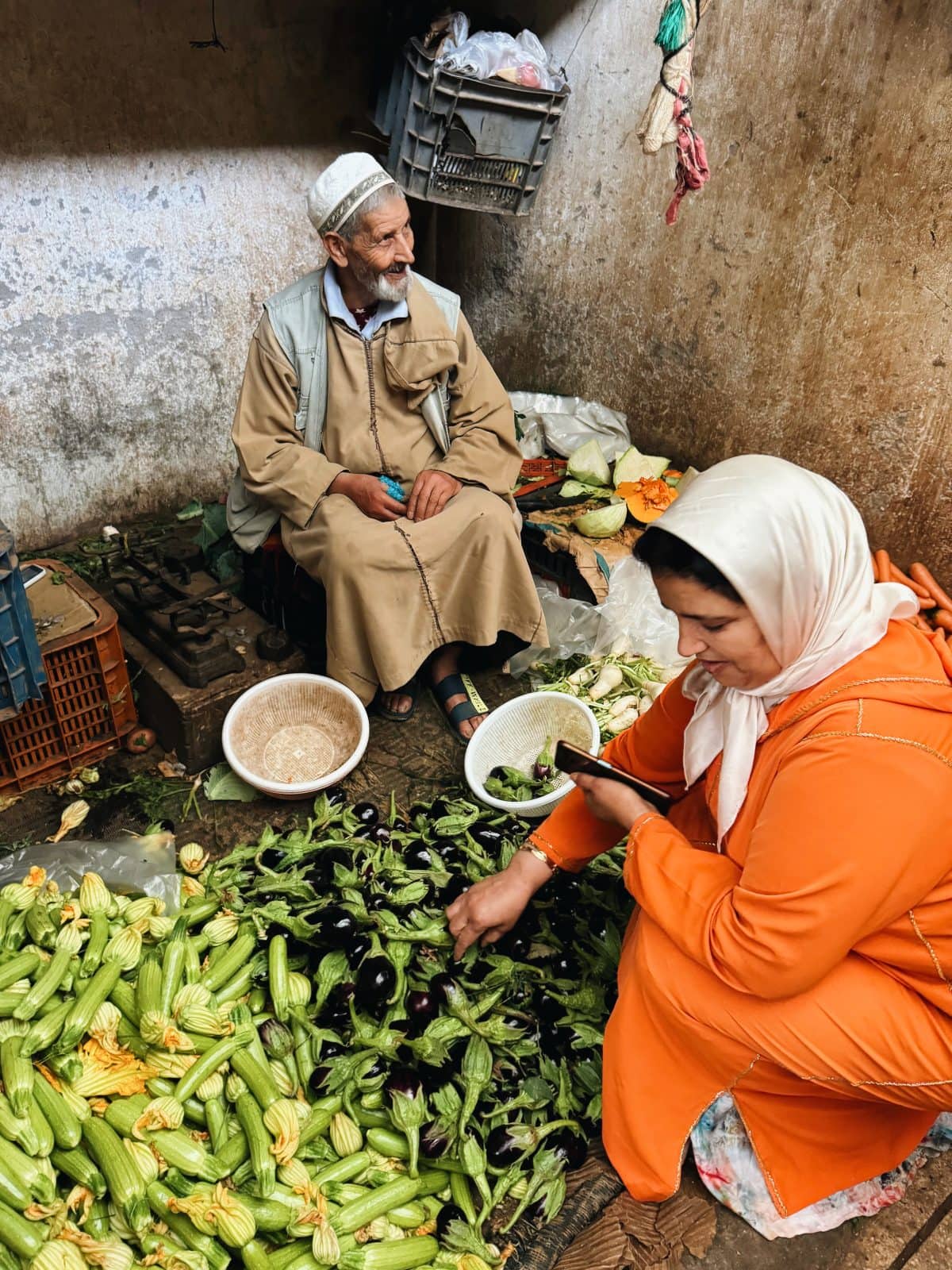
We arrived in Marrakech at 2 a.m., having left Mani (southern Greece, in case you’re not up to the minute with our voyage) at something like 6 a.m. the previous day. That was our third tough trip in our three-month voyage, and the last. Needless to say, we were a bit wiped out the next day but, eager to get a taste of the city, we visited an early morning food souk (where I saw some of the most beautiful eggplants ever) to buy provisions for dinner; we were staying in an apartment.
Then we tackled the medina. It was tough: packed with tourists, the narrow streets continually invaded by scooters despite the crowds – dangerous as well as constantly annoying – the shops selling a variety of legitimate crafts and total junk, between which we were too befuddled to discern. We decided we would have better medinas in our future, ate an unmemorable lunch at a rooftop café overlooking Jamaa El Fna, the main square, and then headed to the lovely, cool Bahia Palace.
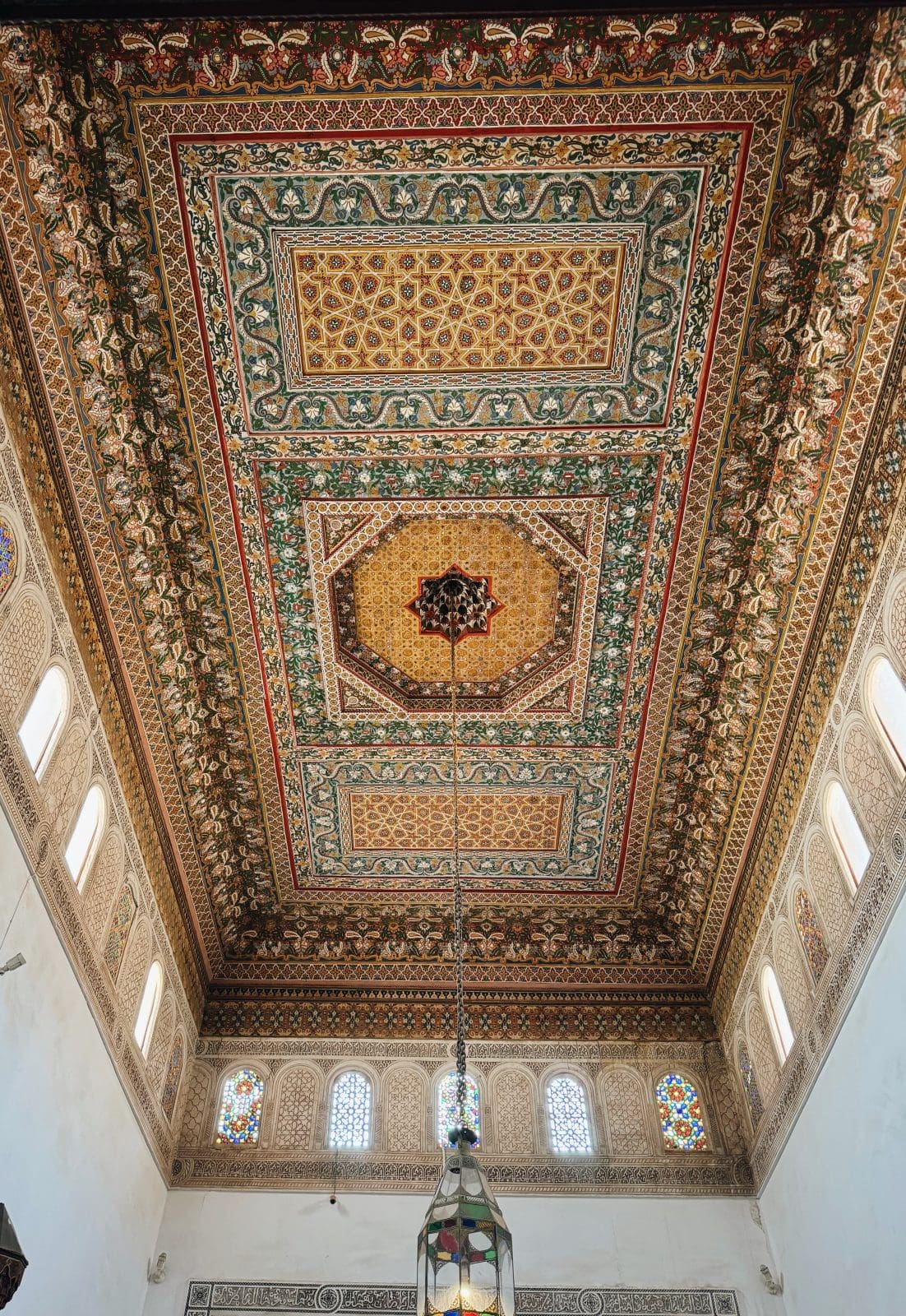
I won’t spend much time on our Marrakech visit, because the city is big and difficult to parse, the place we stayed was too far from the center, and if it is fabulous, we were too tired to appreciate it. If our visit is a good indication, the Bahia Palace is a can’t miss, and the rest of the monuments and main tourist attractions are not compelling. We took a dawn balloon ride, which was thrilling, beautiful, and sublime; but of course you don’t have to go to Morocco for that.
Less than sixty hours or so after arriving, we left, by car: At everyone’s recommendation, we hired a driver for the following two weeks, and that was the right decision. Our destination was the town of Demnat.
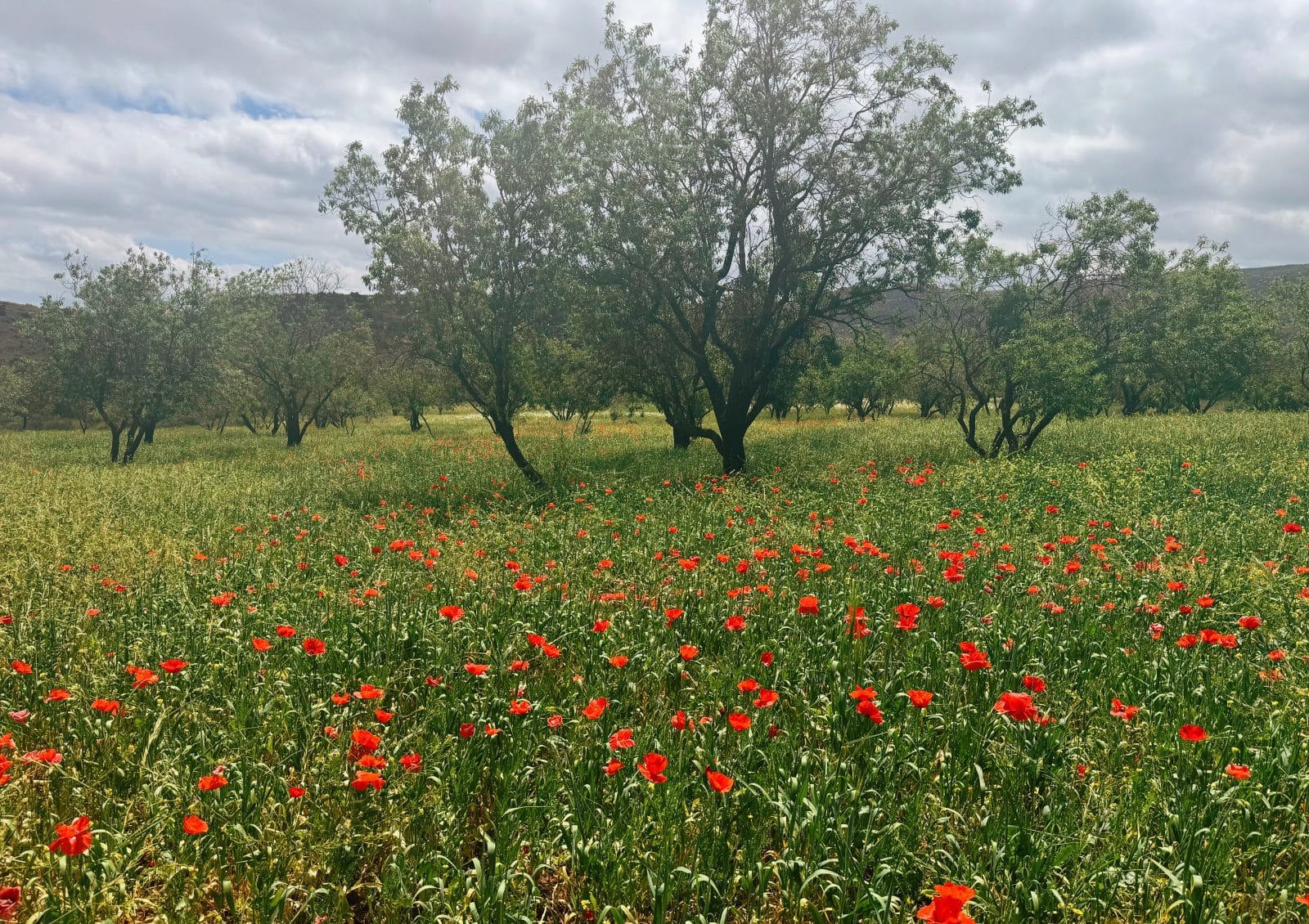
Morocco is about the same size as California and, as we were about to discover, at least as varied in its geography: In many places, terrain and vegetation change quickly and dramatically, and driving, although generally slow, gave us a lot to look at. East of Marrakech the land is desolate and uninteresting, but there are some farms, olive groves – everywhere – small towns with animals hanging in open shops and tagines lined up on burners, mountains in the distance. The temperature dropped, fields of poppies began to appear, it became lusher in general; the trees grew more varied, older and more beautiful.
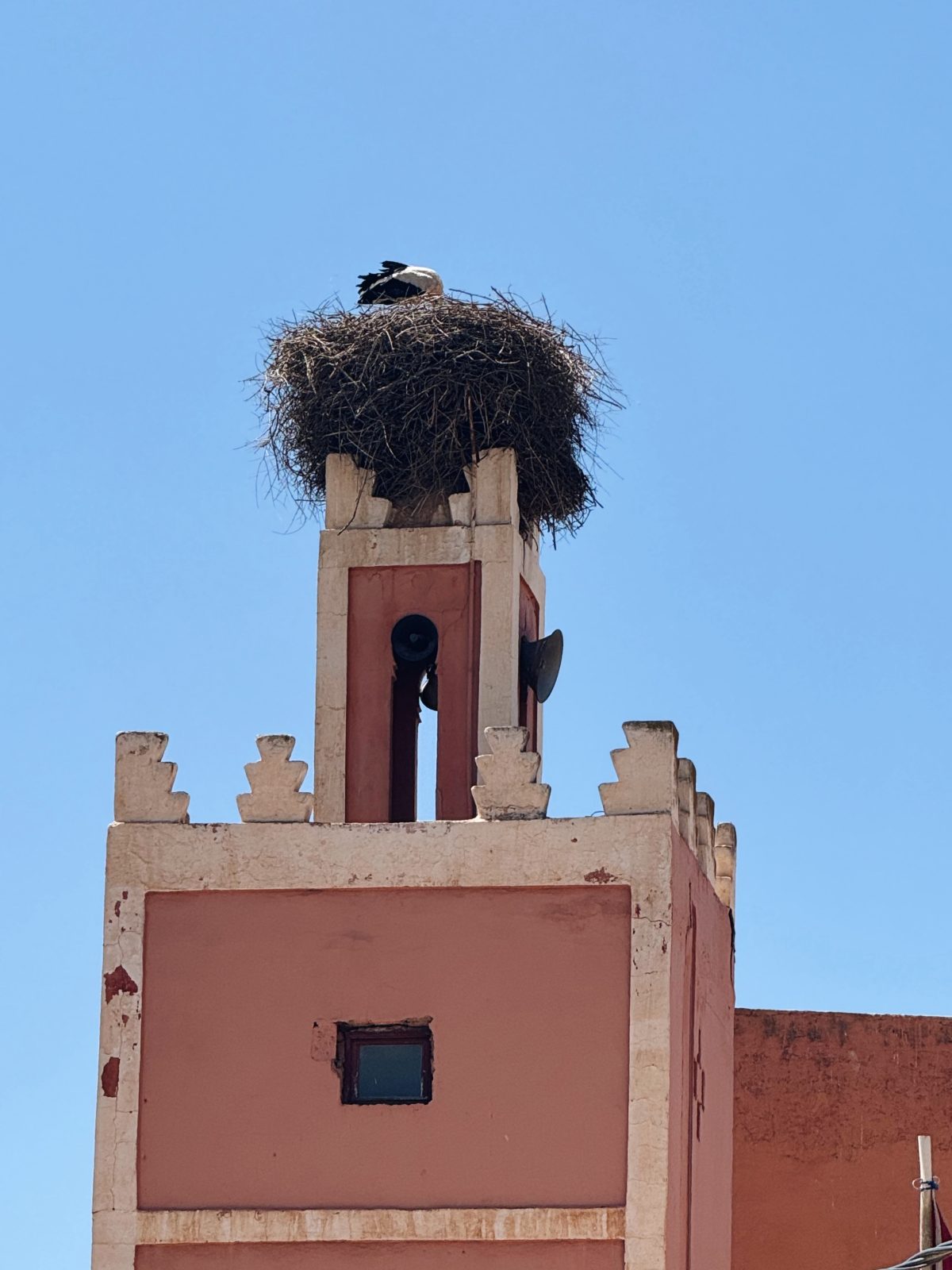
Demnat itself is a busy little city whose main interests to us were its normal services (there was an excellent ATM, which I’ve come to appreciate), the storks nesting on the top of mosques (turns out this is common), and one restaurant in particular. By day five or so of Morocco, we’d already had our share of tagines – which all too often amount to bland stews, usually with meat (or over couscous, in which case they’re called couscous, but not radically different). But our day-guide insisted we try a literal no-name tagine restaurant down an alley: “It’s the best-kept secret in Morocco,” he said.
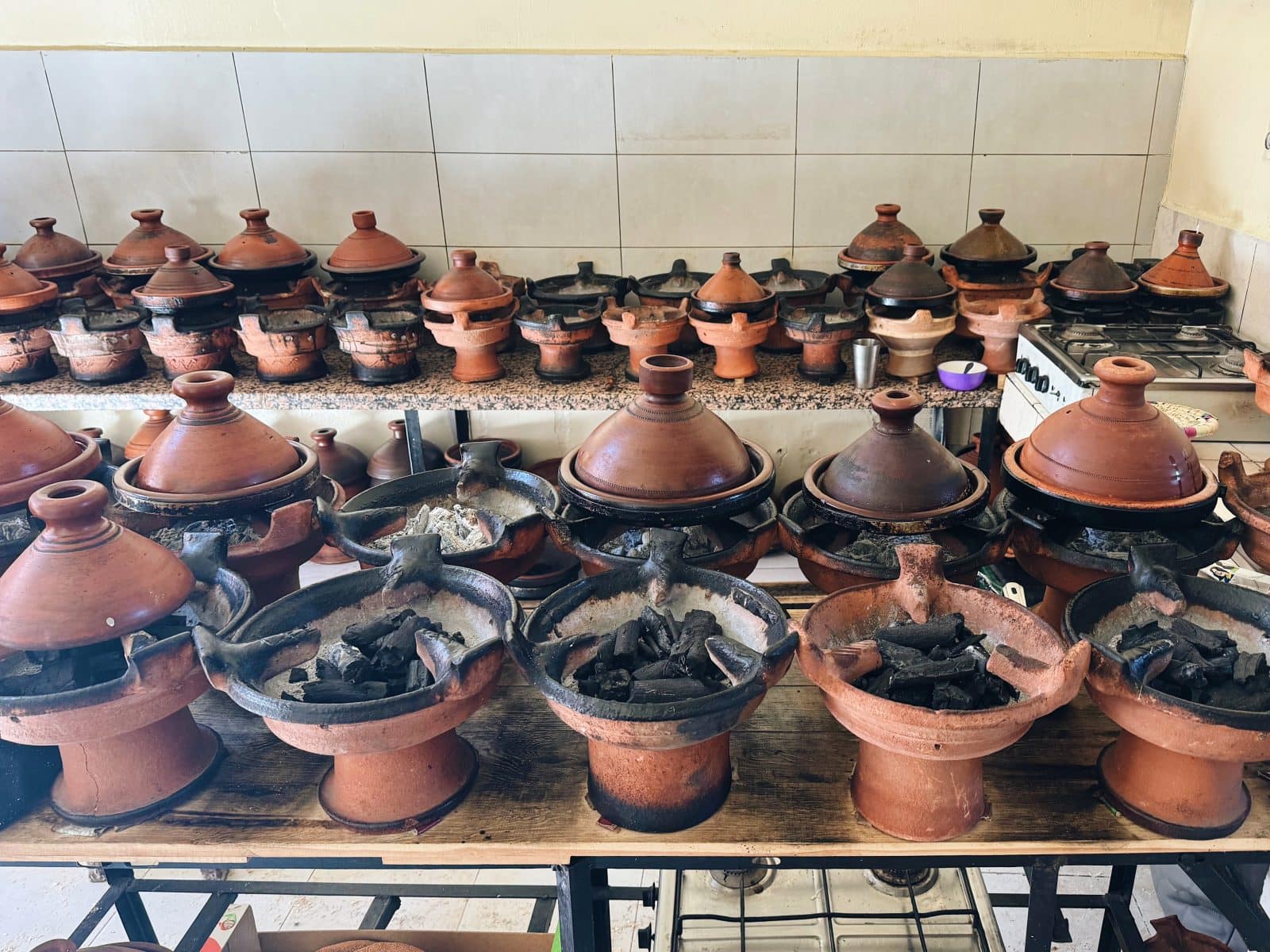
It turned out to be a 20-by-30-foot room, open to the street, with the typical lineup of tagines on small charcoal fires. But for whatever reason – a third generation restaurant? Better meat and veg? Real charcoal? Superior technique? – these tagines were craveable. There’s only one choice: beef-and-root vegetable. But the beef was beautifully browned and tender, glazed and sticking to the bottom, and the vegetables – potato, a kind of yam, carrot, turnip – had absorbed its flavor. Spectacular.
I may as well take this opportunity to make a couple of generalizations about Moroccan food.
- Olive oil: The good stuff is as good as you get anywhere, which makes perfect sense; there’s no reason Italy should have a monopoly on “the best” olive oil, and it doesn’t. Furthermore, the common olive oil here, the stuff used for cooking or plopped on the table, is often local and far superior to the daily oil most of us have access to.
- Almonds: They taste like they’ve been sprayed with almond extract. Unless that is actually the case (I’m kidding, aren’t I?), they’re the best I’ve ever tasted.
- Walnuts: Straight from the tree. This is true of many nuts and citrus. Lemons and oranges are essentially free. This is a joy.
- Sitting on the table are not salt and pepper but salt and cumin. (I remembered a conversation with Dave Chang, probably twenty years ago, in which he was saying “Why pepper? What’s so special about pepper?” Which is a good question.) Not as versatile as pepper – although I could be saying that thanks to a lifetime of using pepper – but a pleasing local quirk. (Sometimes ras el hanout, a cumin-based spice mix that varies from one cook to another, is brought as well, but not in a shaker.)
Okay, there will be more about food to come, though very little in this entry, because the real enjoyment of our three days in the greater Demnat area were: a) our wacky riad (originally a term used for a Moroccan house with a courtyard, now usually used to mean “auberge,” or small hotel, usually with a courtyard), and b) two wonderful hikes.
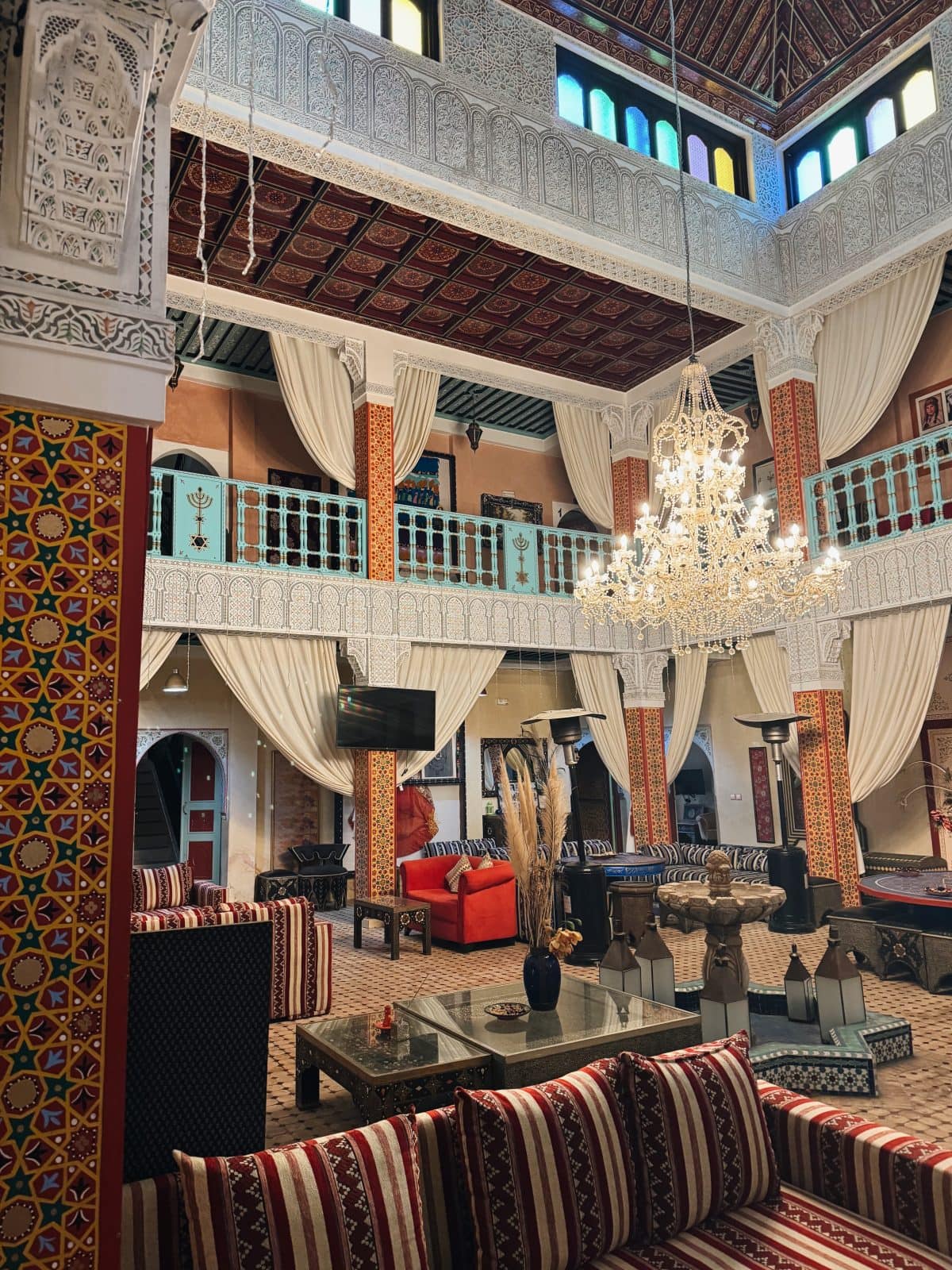
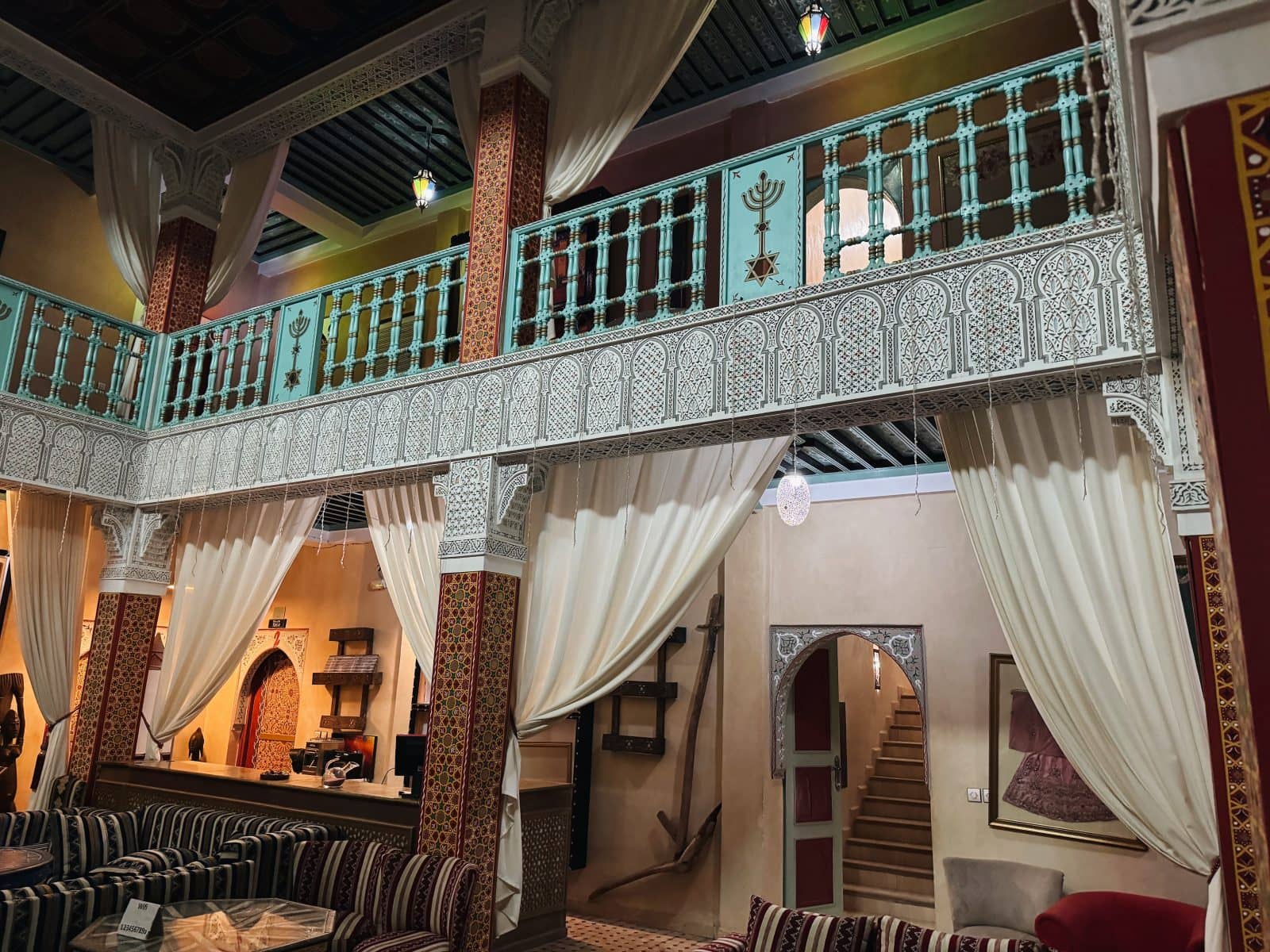
The riad – Kasbah Ait Oumghar (that’s a Facebook link, which has a photo gallery; there is, of course, a booking.com page as well) – came as a bit of a shock. It’s a sprawling house, featuring hundreds of objets, some of art and some ordinary, with barely a square foot of floor or wall left unadorned, painted in old Moroccan style, with carved and wildly painted wood and cut and painted metal everywhere; there is nowhere for the eye to rest. The place looks like it’s 400 years old, but it was actually built around 2005; they certainly fooled me.
Outside is a grand view of the local gorge (more on that in a second) and the hills beyond, behind which the sun set. A kind of nutty, wonderful place in which I could easily spend a couple of weeks (as long as I made myself content with a never-ending string of tagines).
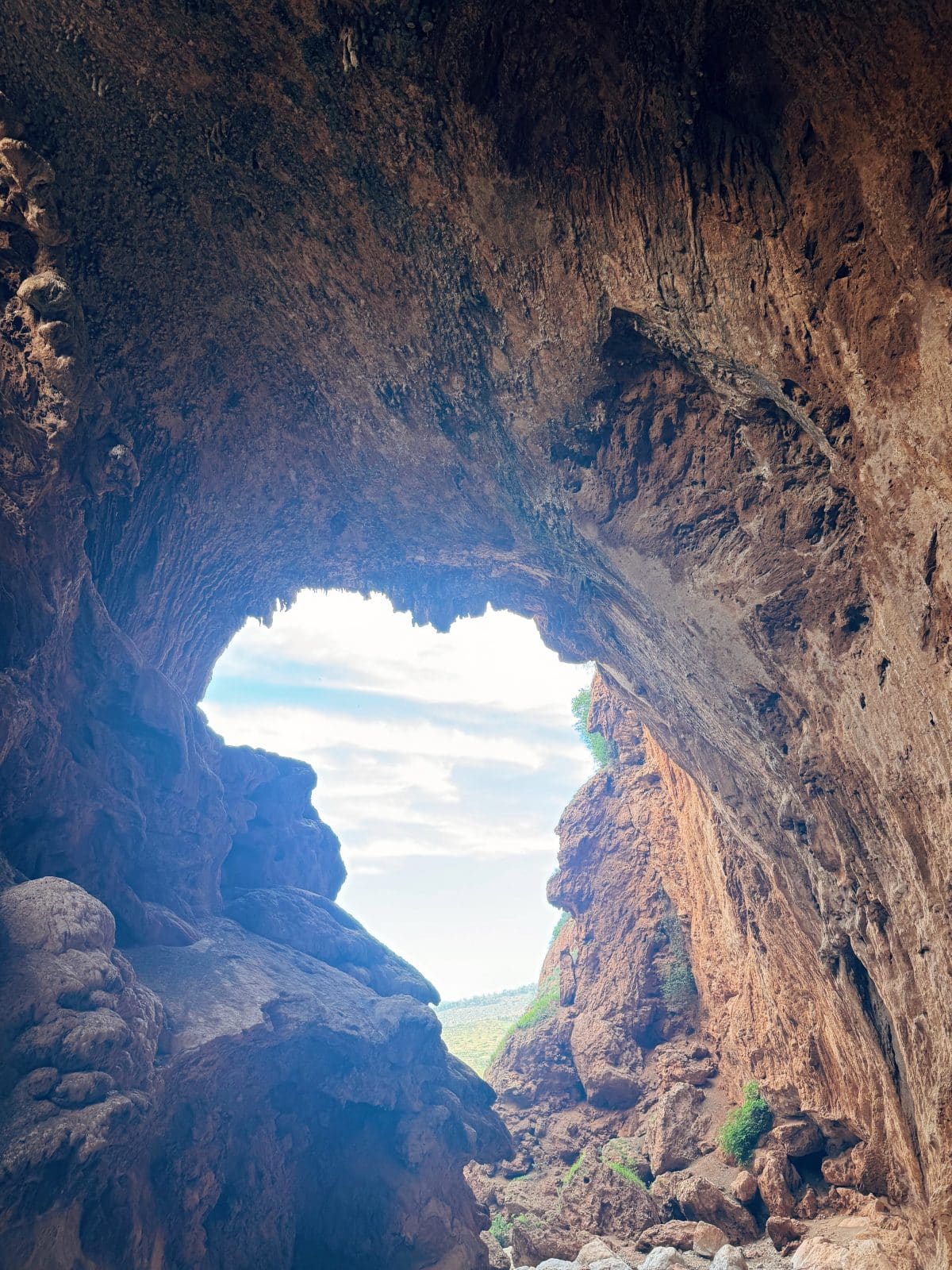
We inquired after a local guide, and found one – M’hamed – who knew his way around. The next morning he led us on the short walk up the road to the village of Iminfri, known for its natural bridge, a span of rock over a canyon. There are easy steps down, and easy steps up; getting from one set of stairs to the other is the hard part (also climbing back up is a bit of an effort), and in my newfound role as an old man, I relied heavily on M’hamed’s help in getting from rock to rock. (Kathleen did fine independently; both M’hamed and Youseff, our driver, impressively scrambled into the caves above, which were once inhabited by – according to M’hamed – “pigmies.”) Distance-wise, it was a short hike, and only took an hour, or a little more. Thrill and sight-wise, it was nothing short of a highlight of the trip.
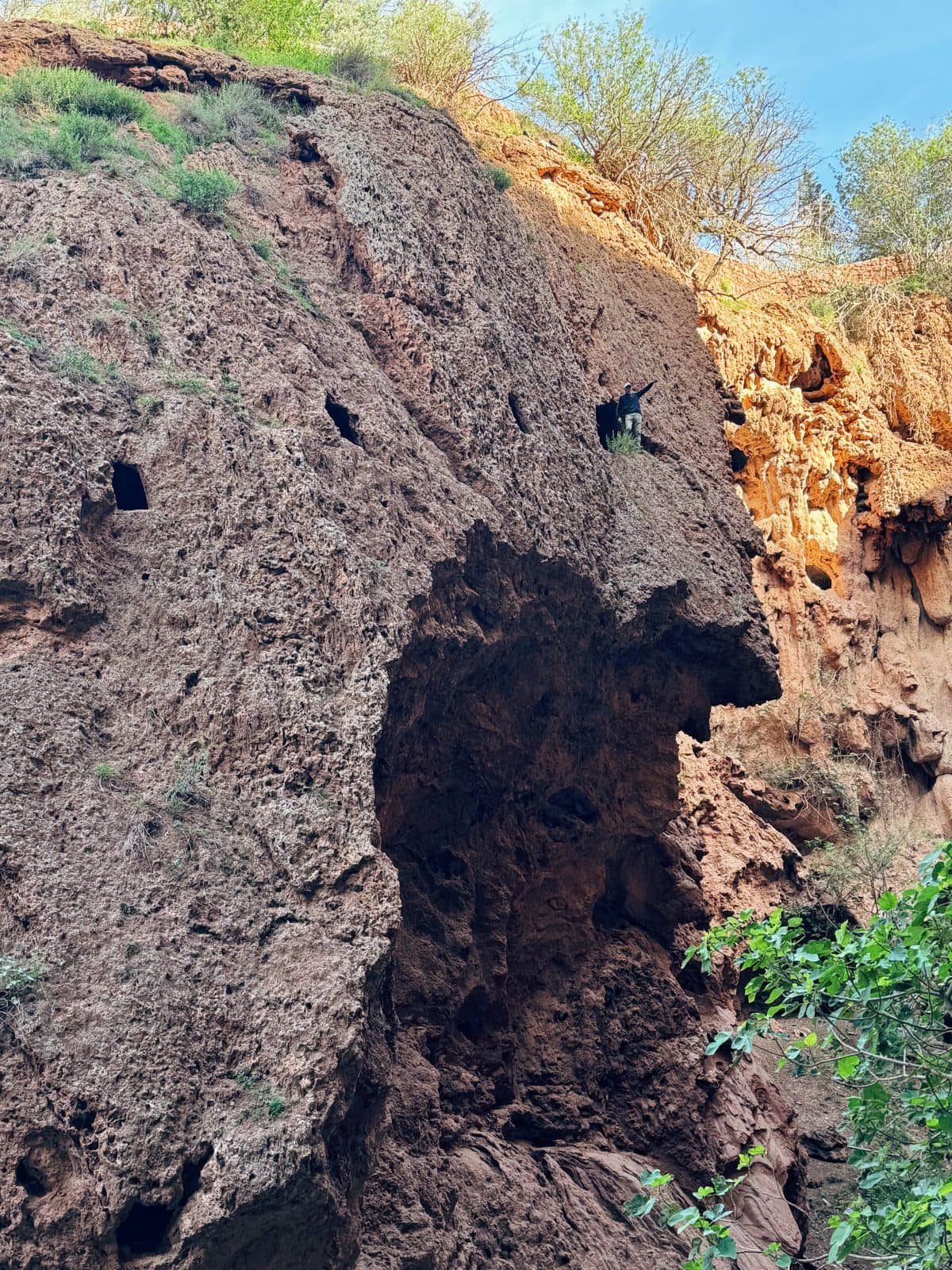
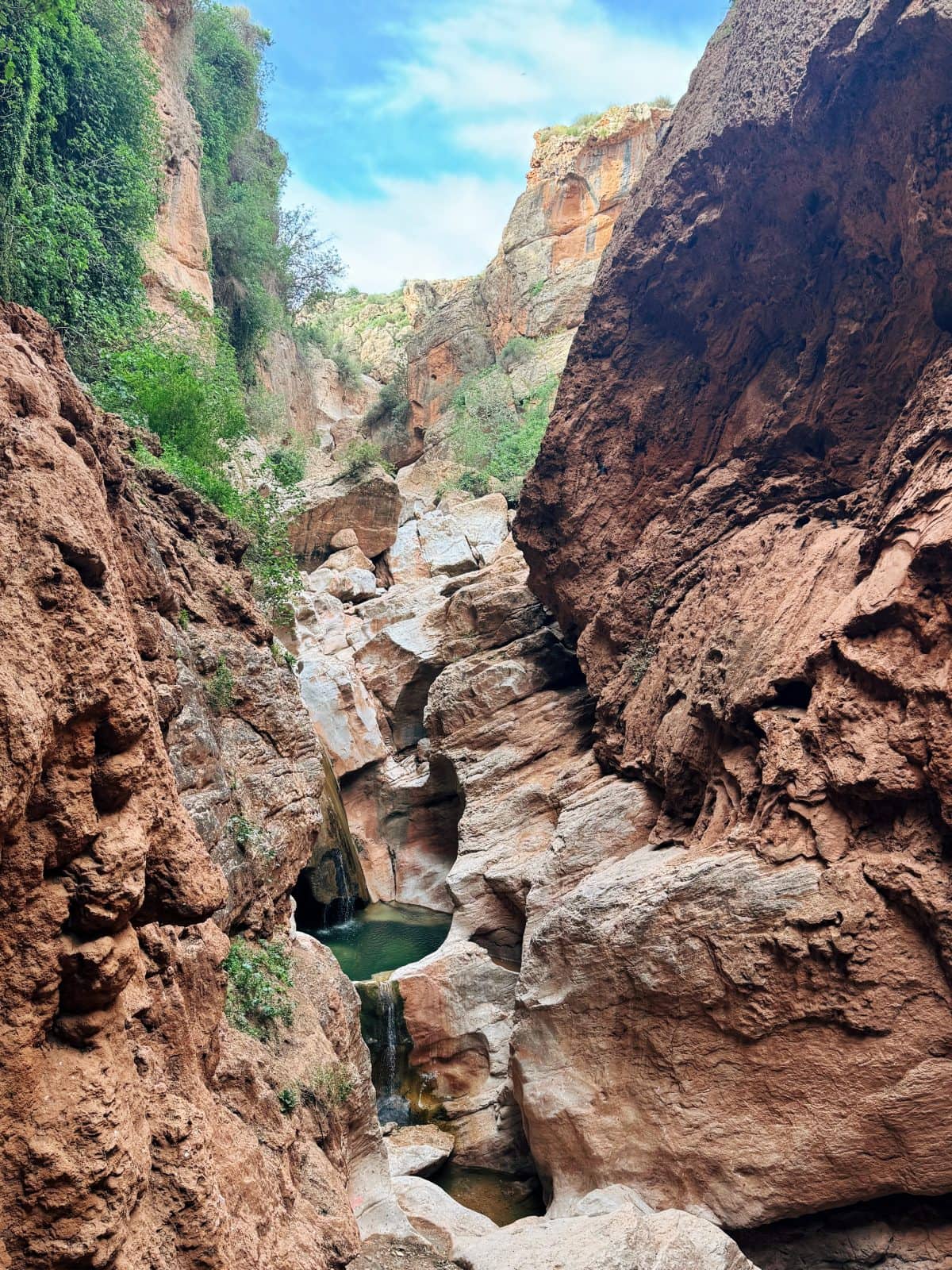
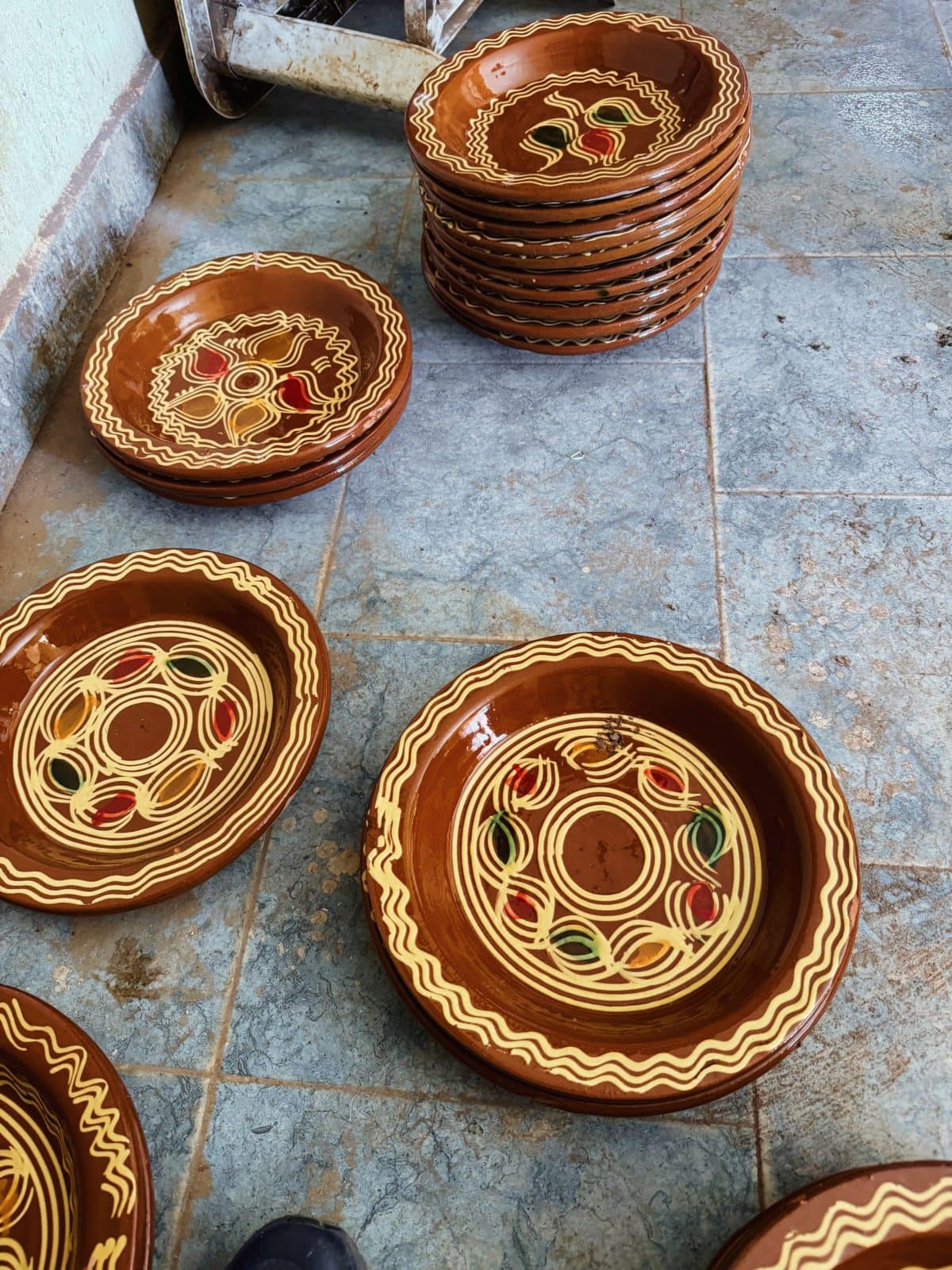
At this point we would have followed M’hamed anywhere. He took us on a long drive “behind the mountain,” promising a village with traditional ceramics near the end. The drive featured long views of gorges and mountains, and, in the village, we saw all the stages of creating the local hand-made clay pottery, from digging to throwing, glazing, and baking. An ancient craft, done more-or-less traditionally, with the addition of gas-fired kilns, electricity-driven wheels (for people who’ve thrown pottery, this video is old hat; but I was transfixed), and decorative paint from Italy. From there we went to eat the good tagines.
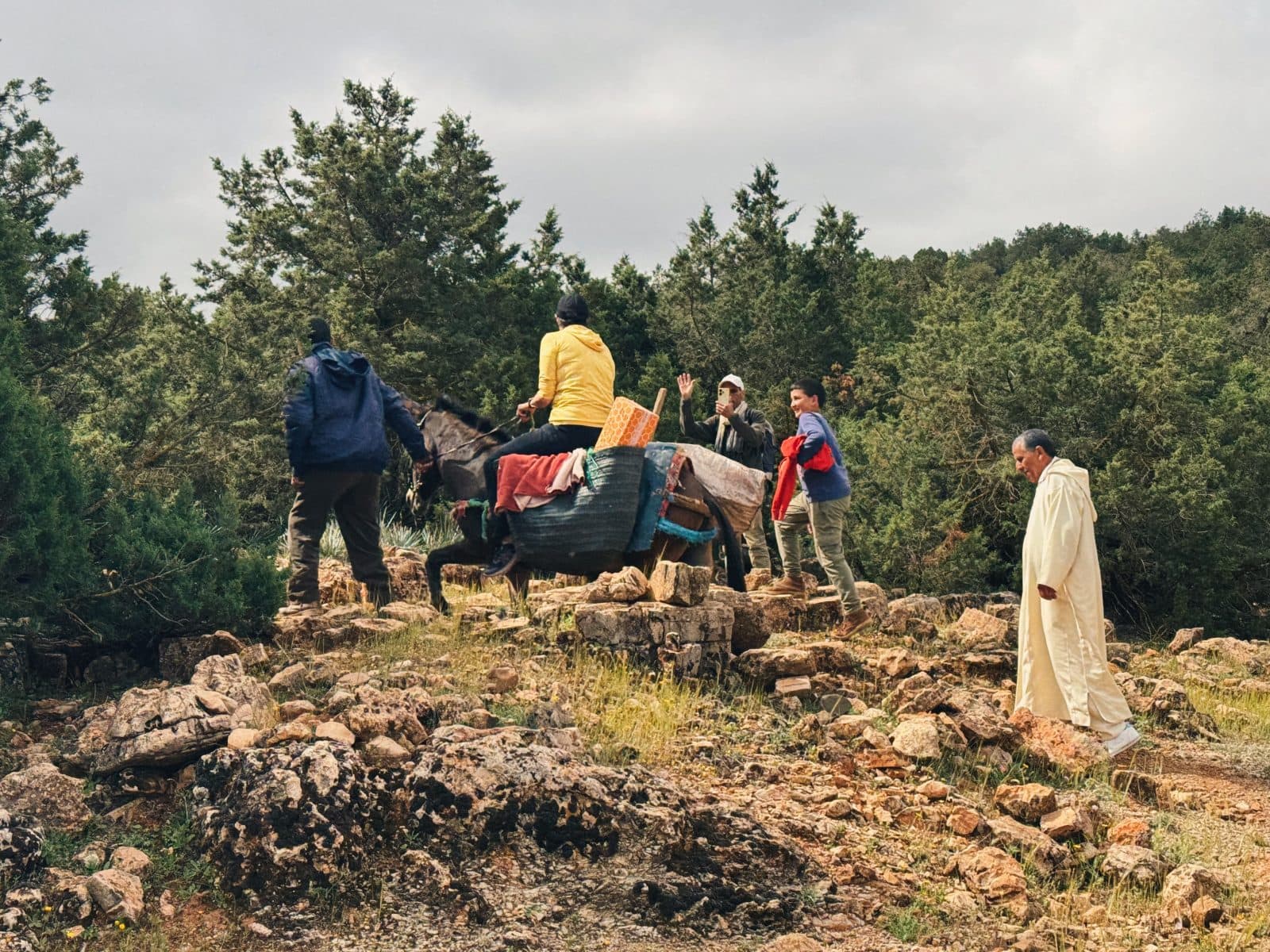
The next day M’hamed asked us if we were up for a longer hike, this one over the mountain across from the riad: steep, over rocks, on the way up, he said, but gentle, through meadows, on the way down. And it was just as promised: A bit of a challenge, a lovely, meadow-y summit, where we met some villagers on a donkey (who immediately offered to give Kathleen a ride), and then a long, slow decline through poppy- and buttercup- and olive-filled fields to get back down.
For lunch we ate rotisserie chicken, fries, lentils, salad, and beans. Not life-changing, but not tagine, either. For dinner … tagine. And then, off to the mountains.
Comment