


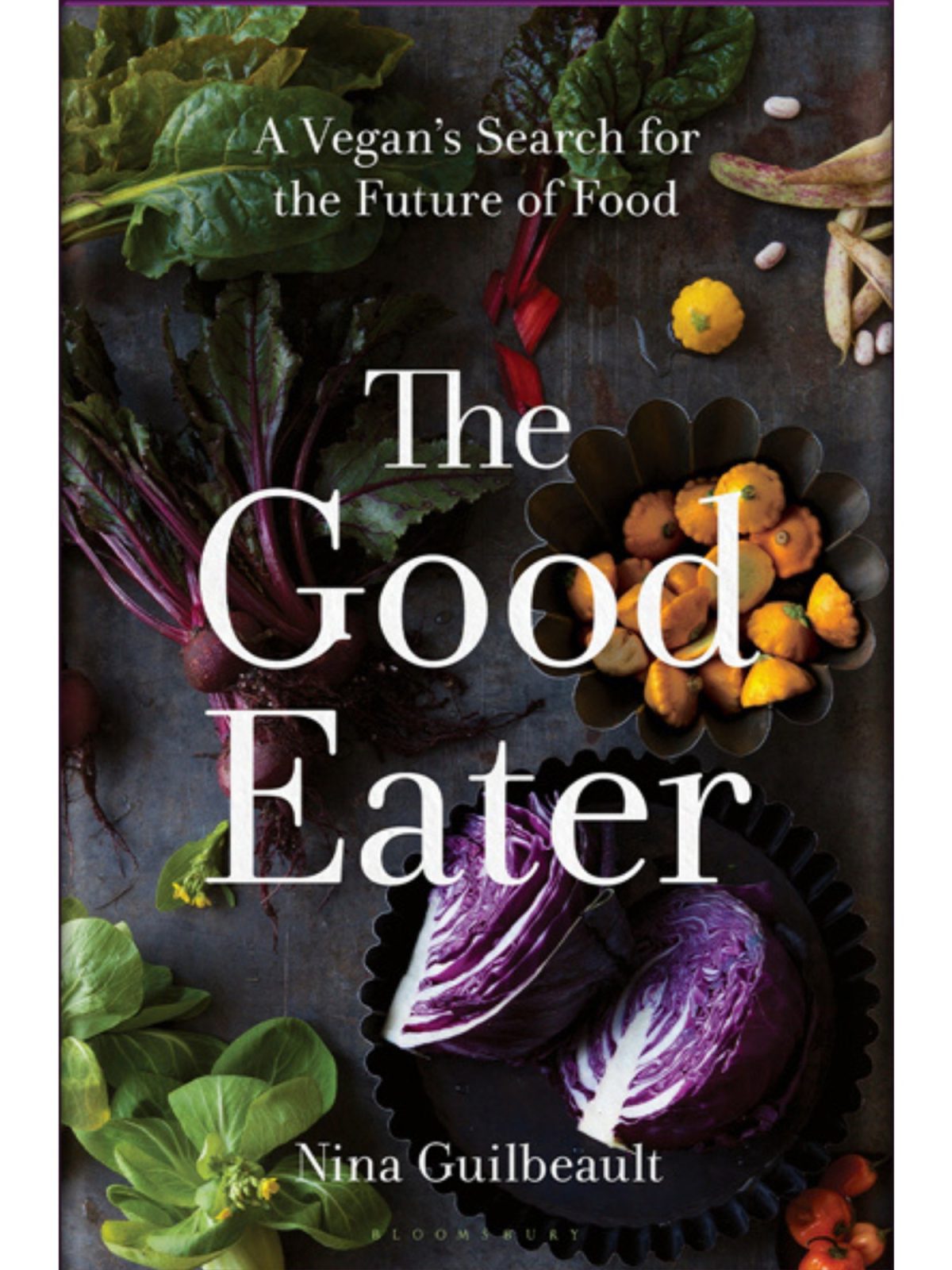
Nina Guilbeault is by trade a sociologist, but she writes as well. We were interested in her just-published new book, The Good Eater: A Vegan’s Search for the Future of Food, because her goal was clearly to determine whether there is a truly ethical (and practical) way for people to eat, a common goal among those of us who have the time and resources to eat pretty much any way we choose. Nina is a vegan, but not a militant one; she understands that the food system – and individuals’ eating – is a complicated thing, and looks at the “How should we eat?” question from a number of different angles: She looks at the history of veganism and animal rights, regenerative agriculture (much of which is livestock-dependent), fake meat, and more.
The following is an adapted excerpt from the introduction to The Good Eater. – mb
I’m not the person you might expect to tell the story of how veganism entered the mainstream. My parents weren’t hippies, and I ate plenty of meat and dairy earlier in my life. I was born in the Soviet Union in a tiny country called Moldova, landlocked between Romania and Ukraine, to a modest family of Russian, Ukrainian, and Jewish origins. Growing up in the rubble of the collapse, we didn’t have much choice about what to eat.
When I was seven years old, we won the golden ticket, a chance to try our luck at the (North) American Dream in Toronto, Canada, where a whole new world of delicacies opened up to our inexperienced palates. At the grocery store, I marveled at the seemingly endless array of fruit yogurts, whole aisles of potato chip bags, gigantic racks of barbecued ribs, sugary cereals, tubs of ice cream in every flavor, and muffins, pies and cakes made ready-to-eat. We quickly adopted the Standard American Diet without a second thought.
When I was a teenager, we were shocked when my father suddenly announced that he wanted to become a vegetarian.
Yet like many immigrant families, we continued to eat the familiar foods of our homeland, and Russians don’t shy away from meat and dairy. My taste buds still awaken to memories of borscht (beet soup) with smetana (sour cream), blini (crêpes), tvorog (cottage cheese), sirniki (cottage cheese pancakes), pelmeni (meat dumplings), plof (a meaty rice dish), kalbasa (sausage), and salati (“salads” made of potatoes, peas, pickles, eggs, ham, and mayonnaise).
That’s why, when I was a teenager, we were shocked when my father suddenly announced that he wanted to become a vegetarian. My dad grew up in an obscure village in a country nobody had heard of, and yet for years, he had apparently harbored a desire to give up meat. When he took up yoga and meditation to deal with the intense pressures of immigrant life, he felt a kinship with the Indian philosophical principle of ahimsa, “nonviolence,” which preaches vegetarianism. Odd pucks of faux meat appeared in our freezer, large tubs of mixed nuts filled the cupboards, and soon my dad was putting a weird green paste on his toast, which I found totally off-putting. (This was way before avocado toast became a trendy thing.)
For many years, my vegetarianism wasn’t a big part of my identity.
Our Russian friends, of course, made fun of him, teasing him with remarks about loss of manliness and warning that he would never feel satiated again. My dad wasn’t sure he’d manage the transition, but he decided to give it a try out of moral principle. My sister and I got on the bandwagon, mostly because we admired his convictions. Yet for many years, my vegetarianism wasn’t a big part of my identity. If anything, I gladly compensated for the lack of meat in my diet with a hearty serving of dairy—yogurt, ice cream, and especially cheese. Who would deny themselves such pleasures?

But as is often the case with big life changes, a personal tragedy unexpectedly shifted my attitude. While abroad, my father called me to let me know that my grandfather’s cancer had taken a turn for the worse. My beloved Dedushka was the wise old grandfather of storybooks. I had last seen him over winter break after he’d had a medical emergency over Novi God (the Russian New Year). Rather than celebrating, I spent the holiday cooking meals, shuttling between hospitals, and translating doctors’ orders. We thought he’d turned a corner, but now, my father said over the phone, he was gone.
The loss of our Dedushka was devastating and yet, as those who have experienced grief know, sometimes a glimmer of hope emerges out of the darkness. My grandfather’s passing was the catalyst that inspired me to research the link between diet and disease, something I had never bothered to do before. What I found rocked me to my core, offering a glimpse of another reality where my whole family might have made different food choices, and where my Dedushka might have enjoyed more years of good health.
Unlike many of the most zealous converts, I didn’t embrace the vegan lifestyle overnight.
That summer, I went down a rabbit hole. Slowly, I learned many disturbing truths about our food system, including the outsize impact of the animal agriculture industry on climate change and chronic disease. I educated myself about the overuse of antibiotics on factory farms, a potentially cataclysmic problem that creates treatment-resistant bacterial strains that could be a catastrophic blow to modern medicine. Unlike many of the most zealous converts, I didn’t embrace the vegan lifestyle overnight. For me, it was a gradual process, two steps forward, one step back, until one day I found myself on the other side of an impossible divide and could no longer ignore the consequences of what I put on my plate. Although my new knowledge couldn’t save my grandfather, it forever changed my life.
When I came back to my graduate program that autumn, I declared to my professors that I wanted to understand how veganism, long a niche subculture, was turning into a mainstream movement. I could sense the vegan wave cresting, and I wanted to be there when it hit shore. Eventually, my committee gave in, and I was lucky enough to secure funding to research this growing movement around the world. On my travels, I met every kind of vegan there is. Righteous activists defending the lives of innocent animals. Iconic influencers embodying the aspirational, health-conscious vegan lifestyle on social media. Fitness gurus proving that plants can power ambitious athletic performance. Documentary filmmakers, authors, and podcasters spreading the word. Visionary founders revolutionizing food technology in Silicon Valley, and deep-pocketed investors supporting their mission to end animal agriculture.
Yet as I broadened my network and dived deeper into the vegan community from all its angles, I began to sense some of its internal frictions surfacing, especially at the boundaries of my various vegan friend groups. There were the animal rights activists I met in Boston, Paris, and Tel Aviv, who toiled in underpaid jobs at charities to save as many animal lives as they could, committed to raising consciousness and expanding the moral circle. There were my social media influencer friends in Los Angeles, who followed strict health-conscious diets and eschewed any processed foods. Perhaps most charismatic were my biotech enthusiast friends in the Bay Area, who started “alternative protein” companies they hoped could change meat itself. All these groups were under the umbrella of a movement to change the future of food, and yet many had different—and often opposing—ideas about how to get there.
For me, these tensions came to a head when, at last, I defended my dissertation and moved to the Bay Area to begin a postdoctoral fellowship at UC Berkeley’s Sustainable Food Initiative, where I planned to turn my research into a book. There, I was surprised to meet many food movement advocates who were, to say the least, skeptical of the new vegan products on offer, if not downright derisive. To them, the Impossible Burger did not herald some Silicon Valley techno-utopia where we can have our meat and eat it too. In their view, these new products, made of genetically modified soy sprayed with herbicides, reinforced the very same values— efficiency, uniformity, and cheapness—that uphold our industrialized fast food system.
[Food movement advocates] expressed skepticism of a movement that was turning a philosophy with ancient (and often radical) origins into a glamorized lifestyle.
Others expressed skepticism of a movement that was turning a philosophy with ancient (and often radical) origins into a glamorized lifestyle. They argued that such a shift represents a tone-deaf ignorance of deep cultural traditions tied to humble beginnings all around the world and excludes those who have been eating plant staples for generations. They wanted a future in which we returned to our roots, and even right back to the land, where we grew our own food, ate seasonally and locally, and cooked our own meals rather than expecting corporations to feed us.
Can veganism be reconciled with the realities of feeding a growing world population? Can veganism scale without sacrificing its values?
There were undeniable truths in all these points of view, and I found myself trying to reconcile them, which turned out to be far more challenging than I ever expected. Many questions surfaced: Can our concerns for the fates of animals be addressed through behavioral change alone? Can we shift the food system without sacrificing convenience, affordability, and taste? Is capitalism the only route to systemic transformation? Can veganism be reconciled with the realities of feeding a growing world population? Can veganism scale without sacrificing its values? Is there truly an ethical way to eat?
My own journey to answer these questions led me to an entirely different place than I initially expected. At the outset of the book, I had been a die-hard vegan on a mission to convince others of the value of my perspective, yet one who came to it from the perch of a rigorous academic. At the end, my position is far more nuanced and complex than I ever expected. I am still a committed vegan, but for me, the term no longer fully captures everything I care about with regard to food.
I am … a vegan who wishes that vegans and others in the food movement would stay focused on the problems of factory farming, rather than turn against each other.
I am a vegan who now better understands the realities of farming and what it takes to bring wholesome food to the table. I am a vegan who cares deeply about food being nourishing and healthful, not just tasty or convenient. I am also a vegan who wishes that vegans and others in the food movement would stay focused on the problems of factory farming, rather than turn against each other. I am a vegan who appreciates the complexities of the food system, and thinks that there is no simple “silver bullet” technological solution that can solve the deeply entrenched issues we face.
Most of all, I am a vegan who believes that if we have a choice about what to eat, we also have a duty to play our part in cultivating a just, nourishing, and equitable food system for all.
Comment