

Accepting a simple, honest definition could lead to an overhaul of our food system
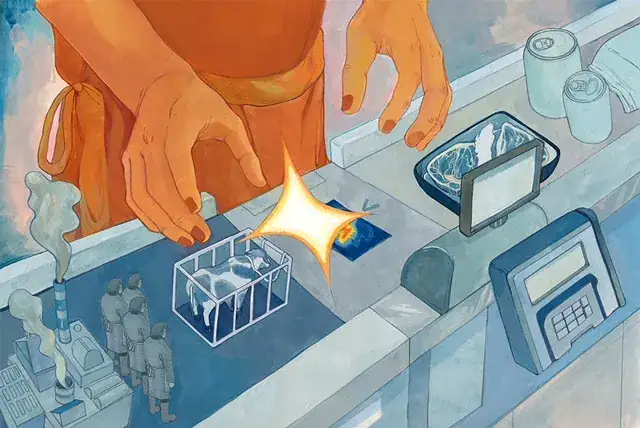
When I became a columnist on the New York Times opinion page, with the charge of writing weekly about food, some things seemed pretty simple: I’d say what good food was, I’d say what we needed to do to produce it, and, surely, within a few years, the low-hanging fruit – egregious use of pesticides, mistreatment of farmworkers and other laborers in the food world, routine use of antibiotics in raising animals, constant violation of environmental laws by industrial agriculture – would at least begin to be addressed.
I wasn’t young then, but I was naïve: Other than a little action at the margins, we still have a status quo in which it is accepted that – as of now – something like seventy percent of the food in supermarkets qualifies as ultraprocessed, which means that, in addition to contributing to all of the problems mentioned above (and that’s just a small part of the list, the part I thought most easily addressed), most of our food causes diet-related disease. And so, every couple of years I feel compelled to update and rewrite a story I’ve now written probably five times (and reiterated in talks and interviews dozens of times), just to remind myself and anyone else who cares to be reminded that this huge problem exists, among all of our other huge problems. (If you want the details of what’s outlined here, I suggest you read Animal, Vegetable, Junk, my book on the subject.)
An objective newcomer could conclude that we’ve decided that agriculture, food processing, and marketing are best run almost entirely to reach the goal of maximizing profits.
An objective newcomer could conclude that we’ve decided that agriculture, food processing, and marketing are best run almost entirely to reach the goal of maximizing profits, with inadequate (and often-ignored) regulation, and almost no guiding principles around their impact on humans, other species, or the earth.
After all we, as a nation, could be saying – as other nations do, including our neighbor Mexico (though not our neighbor Canada) – that good food is a constitutional guarantee. That (this is my wording) “nutritious, affordable, and green food is the right of all.” We do not, and by failing to do so, we fail to nourish ourselves well. But not only do we not guarantee a right to food, we fail to identify what food is and what it’s for, and surely a beginning to fixing “our food problem” starts with doing that and acting accordingly.
Corporate producers have no interest in “fixing” our “broken” food system, because for them it isn’t broken.
Why quotes around “our food problem”? Because eaters have a food problem, the problem of equal or universal access to good food, the problem of growing food with poisoning the air and land and water, and so on; but corporate producers have a different food problem, and that is making money off of food, and they’re succeeding at that, perhaps more now than ever. They have no interest in “fixing” our “broken” food system, because for them it isn’t broken. Somehow we must force them to, or take control of it away from them, or – most likely – a combination of both.
The first step is to accept this definition: Food is to nourish people. We could elaborate on that, but that’s the fundamental principle. Unfortunately, we don’t act as if we believe that.
Of course, acting on that fundamental principle is not easy. It is, however, possible, in ways that it hadn’t been until now. Until recently, hunger, malnutrition, and famine were inevitable; now they are not. Until recently, the true costs of increasing yield at the expense of resource use and health were hidden or undiscovered; now they are obvious. Until recently, we did not accurately know which aspects of food promoted health and which promoted disease; now, we actually do. Until recently, many people believed (and still do) that industrial agriculture would “feed the world”; now we know it won’t, and that instead it’s playing a role in destroying it.
Until now, in other words, many of our food-related problems could be chalked up to ignorance; that’s no longer an excuse. The only excuse is that the reigning version of our political economy allows, even encourages, some portion of humanity to thrive at the expense of others. Quote all the Churchill (“Capitalism is the unequal sharing of blessings…Socialism is the equal sharing of miseries.”) and Thatcher (“There is no alternative.”) you want: Encouraging inequity is a deplorable notion. Encouraging it in food is starving people, injuring them, killing them before their time.
And food, like climate, like income, like the environment, like housing, and more, raises all the important issues; it’s as good a tool as anything else for grappling with all the big issues that face us. If we can’t sustainably and reliably provide ourselves with good food, we’re looking at a future of increasing illness and planetary degradation. The challenges are great, but the costs of not meeting them are inconceivable. Step by step, we must upgrade the food system; in doing so, we upgrade society.
This might begin in any number of ways. Since ideas are cheap, it’s best to first consider those that combine meaningful impact with their likelihood of actually happening. I could say “Free, high-quality food for all,” and get laughed off this page. I could scale back: “Let’s end monoculture,” but we’re not in any position to do that or even have that conversation. Even, “Mandate that 20 percent of food be organic,” in an era of Michelob Organic Hard Seltzer and other abominations, is not likely to be super meaningful.
Let me, then, put forward several achievable ideas — all justifiable, and achievable in the very near future (I mean, assuming a reasonable government, not a safe assumption, but one that we need to make in order to have any hope of progress) — that will at least allow us to see and to start down the road to building a food system that is green and just, and all that those two words imply. Even these first steps are not minor, but they represent the beginning steps on an alternative path.
- Restrict the sale of junk food to children, an idea that was humming along until Ronald Reagan was inaugurated. We could also tax junk food (beginning with soda) and use the income to subsidize fruits and vegetables. Okay, that’s three ideas right there, but they’re related, and they’re all happening in countries both richer and poorer than ours. There are, for example, around thirty countries with some form of soda tax; in the US there are a few cities.
- Institute real and enforceable regulations governing the raising of animals for food, and enhance transparency on “farms” (they’re really factories) doing so. (Enforcing existing environmental laws would help here as well, since these factories are egregious polluters.) The extent to which animals’ lives are discounted is hidden from most Americans, who would be horrified and ashamed if they saw what happens in large-scale “barns.” Favoring decent treatment for animals is hardly the same as “being vegan.”
- Fix tipped wage and other racist and sexist wage laws. Five or more of the worst-paying jobs in the United States are in the food system. Much of this problem is due to New Deal-era laws that were designed to keep women, immigrants, Blacks, and people of color in general in their places. The Federal tipped wage law, for example, still allows for a minimum wage of $2.13 per hour for employees who earn more than $30 per month in tips. (Employers are supposed to make up the difference between actual earnings and the “real” minimum wage, but that practice is routinely ignored.) A $20 minimum wage for all would go a long way here, though of course not far enough.
- Clean up agriculture’s impact on the environment. As long as the biggest farmers take billions of dollars in aid from the government each year, we—the taxpaying public—can justifiably expect them to farm in ways that build soil, protect water and air, and mitigate climate change.
Farming to maximize healthy food for humans was never a goal, any more than minimizing damage to the land and other creatures.
For more than 150 years, the Department of Agriculture — founded to harness the political and economic power that comes with being an agricultural behemoth — has determined that industrialization and commodification, the business of food, would come first. The actual well-being of farmers was a distant and incidental second, and eaters — well, we take what the market gives us. Farming to maximize healthy food for humans was never a goal, any more than minimizing damage to the land and other creatures.
Yet it isn’t at all ridiculous for the USDA to use the answer to the question, “What is food for?” as a guiding principle. And that answer is simple: Food is to nourish people, fairly and equitably, while respecting the people who provide it and the land and other resources from which it comes.
Comment