
Print
Everyday Sandwich Bread
Prevent your screen from going dark
Makes 1 large loaf 1x
Time at least 3 hours, largely unattended
Units
Scale
Ingredients
- 1 1/4 cups whole or 2% milk, plus more as needed
- 3 1/2 cups all-purpose flour or bread flour, plus more for kneading and shaping
- 1 teaspoon salt
- 2 1/4 teaspoons (1 package) instant yeast
- 1 tablespoon sugar
- 2 tablespoons good-quality vegetable oil, plus more for greasing
Instructions
- Heat the milk in the microwave or in a pot on the stove until it reaches about 100°F, a little hotter than lukewarm.
- To mix the dough in a standing mixer (helpful here because it’s less likely than a food processor to overwork the wet dough), combine the flour, salt, yeast, sugar, oil, and milk in the mixer bowl. With a dough hook, mix on medium-low speed until the ingredients are combined, then on medium speed until the dough is tacky and smooth, 8 to 10 minutes. (Or mix and knead by hand as described below; the dough will take about twice as long to get to this stage.) To mix the dough in a food processor, pulse the dry ingredients together a few times to combine, then with the machine running add the oil and milk through the feed tube and process until the dough is a well-defined, barely sticky, easy-to-handle ball, about 30 seconds. Turn it out onto a lightly floured work surface and knead (you shouldn’t need much flour) until smooth, 4 or 5 minutes.
- Grease a large bowl with oil. Shape the dough into a rough ball, put it in the bowl, turn it to coat all over with oil, and cover with plastic wrap. Let rest at room temperature until the dough has doubled in size, 2 hours or more.
- Press down on the dough to deflate it. Dust the work surface with a little flour, turn the dough out onto it, cover with plastic wrap, and let rest for 15 minutes.
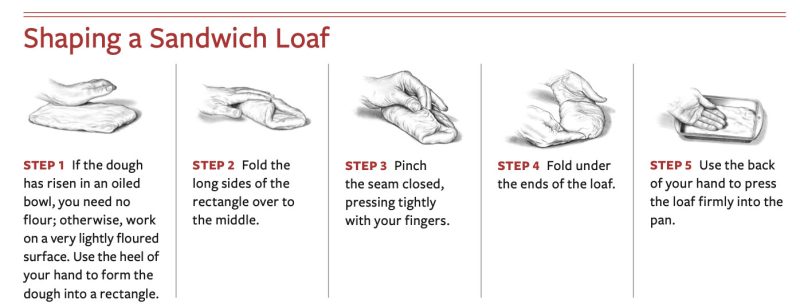
- Grease a 9 × 5-inch loaf pan with oil. Shape the dough into a sandwich loaf (see below) and transfer it to the pan. Loosely cover with a clean kitchen towel or plastic wrap and let rise in a warm place (see the headnote) until the top of the dough expands to about an inch above the pan, about 1 1/2 hours.
- Heat the oven to 350°F. Brush or spray the top of the loaf lightly with water. Bake for 45 to 50 minutes, rotating the pan once, until the loaf falls easily from the pan and the bottom of the loaf sounds hollow when you tap it. (The internal temperature will be about 200°F.) Remove the loaf from the pan and cool completely on a wire rack before slicing.
Recipe variations
Making Yeast Bread Dough by Hand or with a Standing Mixer
By hand
Combine half the flour with the salt and yeast in a large bowl and stir to blend. Add all of the water and any butter, oil, eggs, or other liquids, and stir with a wooden spoon until smooth. Add the remaining flour a bit at a time; when the mixture becomes too stiff to stir with a spoon, begin kneading, adding as little flour as possible—just enough to keep the dough from being a sticky mess. Knead until smooth but still tacky; the time will vary depending on the recipe.