


Despite the significant toll that feeding the world already takes on the planet (see “Where’s the Money?”, August 1), approximately 800 million people worldwide still suffer from hunger. As farmers deplete the nutrients in the soil on their own farms, developing untouched forests becomes an attractive way to increase yields without taking on the difficult task of improving the soil quality on existing fields. This destruction of natural habitats not only causes the significant release of greenhouse gases when biomass is converted to CO2, it also poses such a significant threat to biodiversity that it makes the food system the leading cause of biodiversity loss worldwide.
[The practice of developing untouched forests] makes the food system the leading cause of biodiversity loss worldwide.
Organizations such as the REDD+ initiative (Reducing emissions from deforestation and forest degradation in developing countries) work to prevent deforestation by incentivizing farmers to keep nearby forests intact, providing them with funds to increase yields on their existing farmland. However, this approach does not incentivize farmers to convert their present farmland back to natural ecosystems. Preventative actions like REDD+ are necessary, but further action is required to repair existing environmental damage. We need solutions which actively restore ecosystem and climate health, because the global food system is not sustainable if kept at the status quo.
We need solutions which actively restore ecosystem and climate health, because the global food system is not sustainable if kept at the status quo.
Land-Neutral Ecological Restoration
One solution to the food system’s large carbon footprint and impact on biodiversity is known as “rewilding.” This is the process of converting farmland back into the natural ecosystem. According to Bernardo Strassburg, the founder and president of the International Institute for Sustainability, if done on a select 15 percent of agricultural land, rewilding has the potential to prevent 60 percent of likely extinctions and sequester 30 percent of all CO2 that has ever been emitted into the atmosphere by human activities. Unfortunately, this process is time consuming, complex, and can be harmful if done without proper considerations.
Actions that reduce the world’s greenhouse gas emissions and protect biodiversity must simultaneously improve farmer livelihoods without sacrificing food production if they are to be considered successful.
While rewilding is often seen as a win due to its positive impact on the climate and the natural world, the results are much more nuanced when looking at how farmer livelihoods—especially in low-income regions and communities—are affected by this practice. Many farmers already struggle economically, and asking them to set aside their land for the sake of biodiversity and greenhouse gas emissions can be burdensome. Actions that reduce the world’s greenhouse gas emissions and protect biodiversity must simultaneously improve farmer livelihoods without sacrificing food production if they are to be considered successful. Failing to achieve all of these issues merely shifts the burden from one problem to another.
Land-neutral ecological restoration is one subset of rewilding that takes farmer livelihoods into account, by ensuring that any conversion of productive farmland back into natural habitat is offset by an increase in productivity in the remaining farmland. For example, restoring one half of a parcel of farmland to its pre-converted state while doubling the yield of the remaining half of the farmland is “land neutral” because total agricultural production is unchanged. This helps avoid tricky issues that would arise from trying to optimize for ecosystem benefits without taking farmer and consumer livelihoods into account. However, focusing only on outcome metrics without considering how those outcomes are achieved can create global goals that are not feasible at smaller scales.
Limiting the scope of rewilding to regions where 75 percent of the existing yield gap can feasibly be closed through additional funding and technology helps ensure that food production and farmer livelihoods don’t suffer as a result of conservation efforts. However, this approach results in a solution that costs 52 percent more to put in place, while at the same time causing a 29 percent reduction in efficacy for carbon sequestration and a 28 percent reduction in efficacy for biodiversity measures compared to a solution which doesn’t consider farmer livelihoods or total food production. The increased cost and reduced impact limits this strategy’s total potential impact but is required to maintain food production and keep this theoretical transformation ethical.
Theory of Change
Land-neutral ecosystem restoration follows four steps to achieve its goal of modifying farmland use while improving farmer livelihoods and maintaining food production.
Taking on these four steps to tackle the biodiversity and climate crisis has the power to be transformational. If applied on a global scale, the food system could be the greatest asset to solving the biodiversity and climate crises as opposed to being one of the biggest contributors to them.
The first step is to identify the locations that meet the requirements for a potential restoration project. Efforts must be taken at the local scale to assess the local context and determine what land would be appropriate for this process across all considerations, such as existing land tenure, type of ecosystem being restored and the farm’s current role in food production. Second, after determining which land can be restored, the remaining farmland’s productivity must be increased to make up for the loss of farm acreage while fairly compensating the landowner for the loss of productive land. Third, to create the greatest magnitude of impact, this technique should be expanded to rewild up to 15 percent of all current farmland, creating contiguous stretches of rewilded land in order to best promote biodiversity conservation. Finally, the restored land must be kept in its restored natural state indefinitely, as a reversal back to farmland would undo the benefits of the process.
Taking on these four steps to tackle the biodiversity and climate crisis has the power to be transformational. If applied on a global scale, the food system could be the greatest asset to solving the biodiversity and climate crises as opposed to being one of the biggest contributors to them. However, each individual step is a daunting challenge that requires significant capital and personnel investment. With a projected lifetime cost of $2,500-$6,000 USD per hectare, rewilding the 2.9 billion hectares of land identified for land neutral ecosystem restoration could cost over $10 trillion to accomplish and maintain. To put this into perspective, however, the climate crisis is expected to cost the world $1.7-$3.1 trillion every year by 2050, potentially justifying the price tag for the climate change mitigation benefits. The costs associated with accomplishing each of these four steps could be covered by governments trying to meet their emissions and biodiversity goals, NGOs and philanthropies, and even through carbon markets. Unfortunately, those funds currently aren’t sufficient and must increase if land-neutral ecological restoration is to gain significant traction.
One shortcoming of this strategy is that it does not aim to reduce food insecurity or malnutrition, but seeks only to maintain current rates while repairing the environment. While rewilding doesn’t help feed more people, it can serve as one crucial part of the puzzle of making food systems truly sustainable over the long term.
The map below (Strassburg et al 2020) shows priority areas for land-neutral ecological restoration, with regions in red being the highest priority.
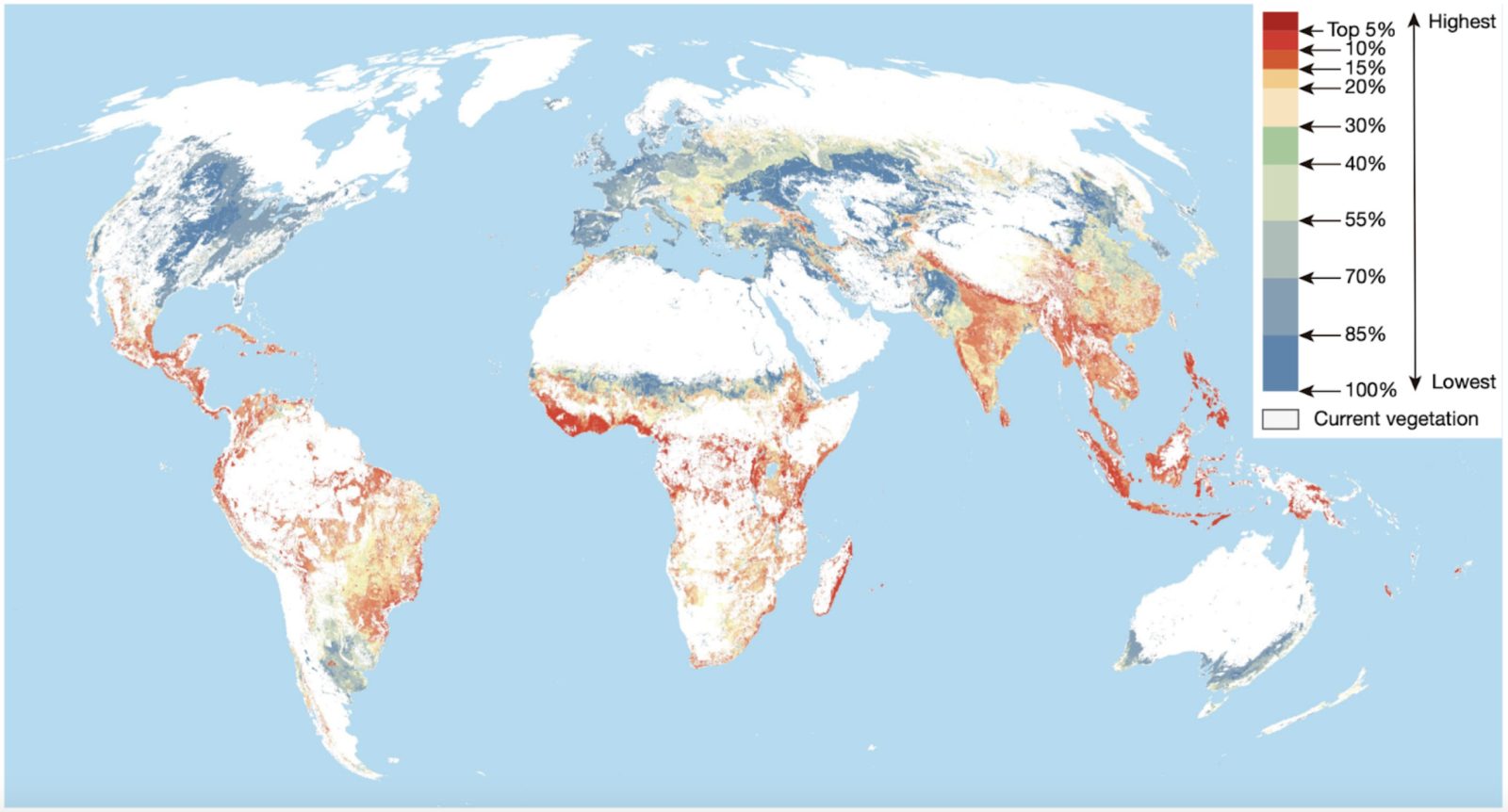
The majority of high priority areas are in the less wealthy developing countries of the global south, while the majority of low priority areas are in the global north, especially in North America and Europe. This is due to three primary factors: land is more expensive in wealthier countries; remaining biodiversity hotspots are most often in developing countries; and wealthy countries rarely have a yield gap that could be closed to facilitate true land neutrality after restoration.
If enacted poorly, rewilding projects could take advantage of poorer farmers who are coerced into selling their farmland for short term gain.
This places an additional burden on people who have historically had less access to nutritious and plentiful food and whose food choices have caused less environmental harm than people in wealthy countries. If enacted poorly, rewilding projects could take advantage of poorer farmers who are coerced into selling their farmland for short term gain, or with a potentially false promise of the yield increase that they could see in their remaining land if they are assisted in closing their yield gap. As such, initiatives like these must be done extremely carefully, with on-the-ground personnel in each case to ensure equity in the deals and to make sure that any rewilding projects don’t cause or exacerbate food insecurity.
One opportunity to achieve this is to target abandoned farmland as opposed to productive farmland. Even in wealthy parts of the world, farmland is being abandoned at a staggering rate. The European Union expects to see 11 percent of their agricultural lands—or 20 million hectares—abandoned between 2015 and 2030. The reasons for abandonment vary, but it is often due to economic shifts, demographic shifts, and soil degradation. Rewilding abandoned farmland is more limited in scope, as it is less prevalent than active farmland, but it has fewer trade-offs than converting productive agricultural land. The land is cheaper to acquire than similar non-abandoned plots, and rewilding the land doesn’t come at the expense of reducing food production. In addition, since most abandoned farmland can be found in wealthy countries, there is a lower chance of power being unfairly exerted to convert the lands against the will of the local people. Converting a plot of land with degraded soil can be a double-edged sword, however, because the state of the degradation means that the soil can hold more additional organic matter (and thus sequester more CO2), but locally relevant vegetation might have a harder time taking hold for biodiversity benefits. These abandoned lands could be a good place for rewilding initiatives to start but, due to their limited total area, cannot be where they end.
Land-neutral ecological restoration has the potential to sequester hundreds of gigatons of carbon from the atmosphere and prevent thousands of projected extinctions at the same time.
Looking Forward
Land-neutral ecological restoration has the potential to sequester hundreds of gigatons of carbon from the atmosphere and prevent thousands of projected extinctions at the same time. However, this practice faces significant challenges in terms of mobilizing funding, expanding to the maximum scope, and ensuring stakeholder equity. Food-related climate solutions that have the potential to negatively impact food security and take agency away from farmers have high consequences for going wrong, and all possible effects must be well understood before they begin. Further research should be conducted in small scale tests around the world before rolling out the land-neutral ecological restoration on a global scale, but due to the magnitude of the potential positive impact, it should certainly be pursued.
The current food system provides us with innumerable benefits, but also poses a very real cost to the climate and to biodiversity. While land-neutral ecological restoration can’t solve all food system climate impacts, such as methane emissions from cattle, it has the potential to begin healing some of the worst climate and ecological impacts of the modern global food system.
1 Comment