

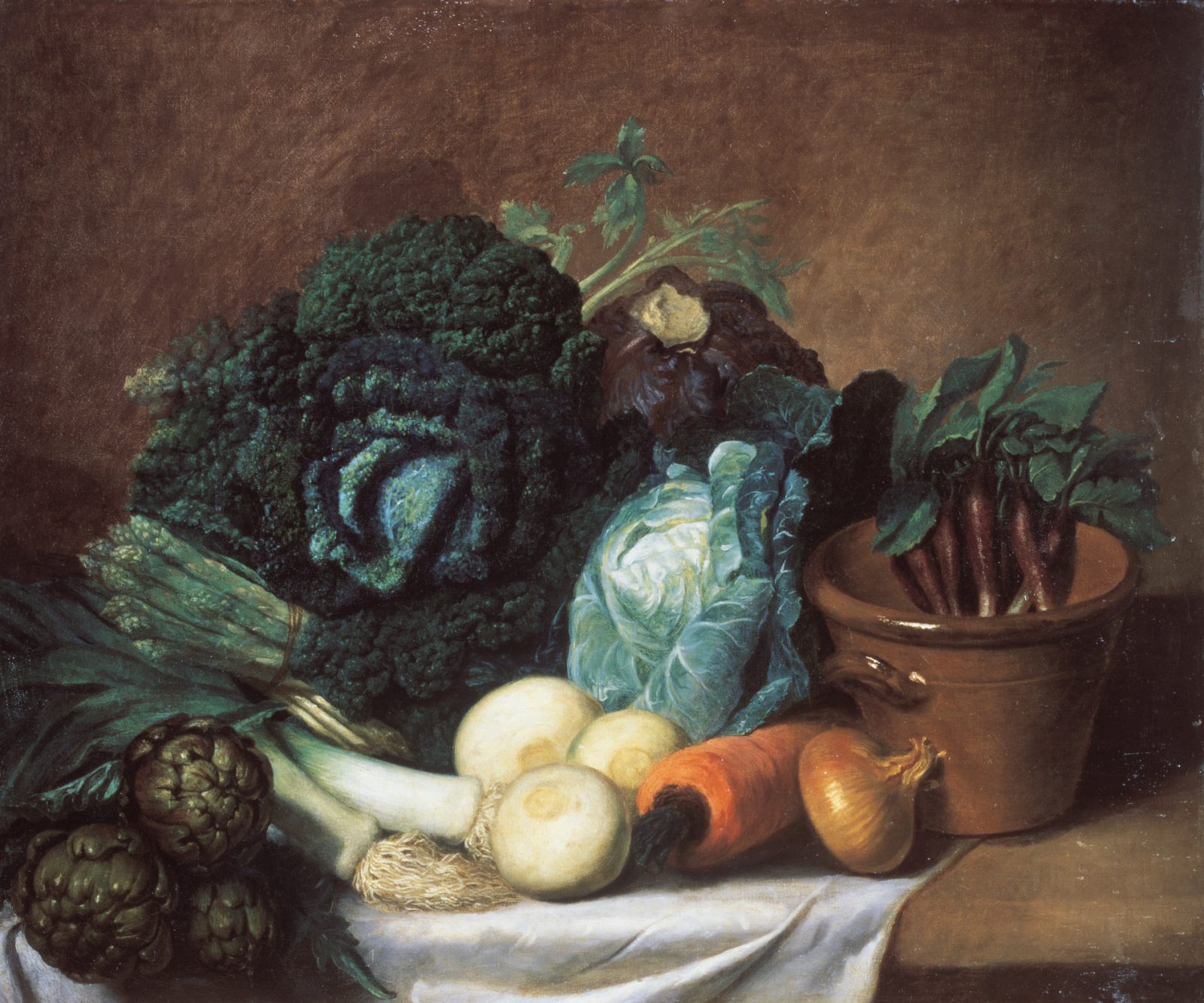
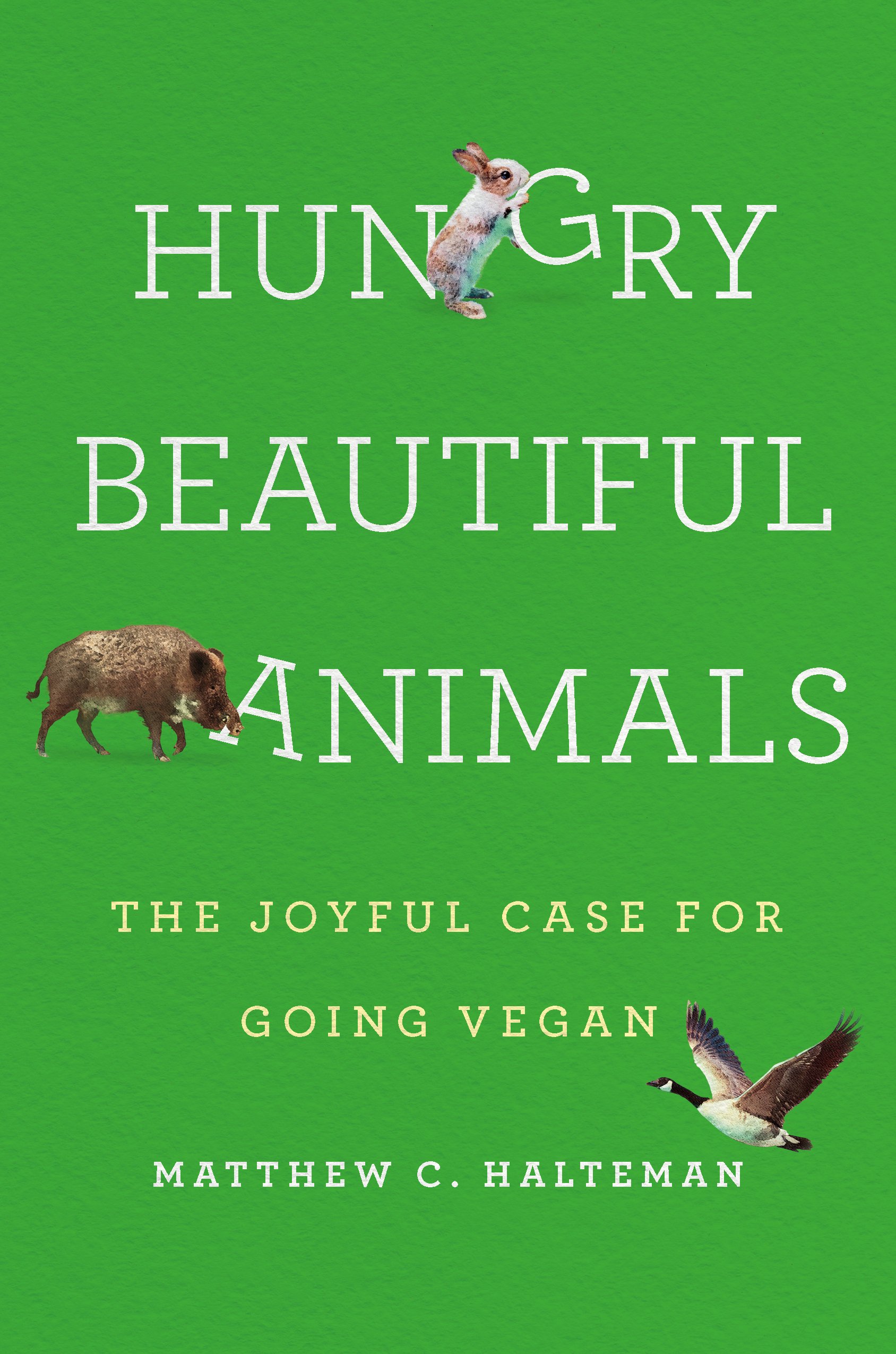
The following is an excerpt from Hungry Beautiful Animals: The Joyful Case for Going Vegan, by philosopher and animal advocate Matthew C. Halteman.
My family tree is full of good people in agriculture. So, growing up in the American Midwest, I spent the lion’s share of my life voraciously consuming animal products. Two decades ago, however, the curious convergence of my bulldog’s love, my partner’s appetite for culinary challenges, and a fellow philosopher’s constructive criticism set off a vegan experiment that’s still going strong. One of the most important lessons I’ve learned is that shame, blame, and rigid rules don’t serve a joyful vegan practice. But progress is possible if we focus on what going vegan promotes — flourishing for all life! — rather than what it restricts. I believe deeply in the urgency of going vegan and the joys that accrue to doing so. But I feel compelled to be honest about the obstacles, including social stigma. While challenging, it can be surmountable — even liberating. And (bear with me here) even during the holidays!
Consider the hidden complexities buried in the simple wish to have the closest thing possible to a stress-free Thanksgiving weekend. With an omnivorous extended family. Who loves you even more than they love to see vegans fail. If just barely. During your sixth month of going vegan.
It’s your dad’s concern that all this vegan stuff means you’ve rejected the family’s religious heritage that looms largest in the pit of your stomach.
Your mom does most of the cooking and is generally supportive of you. But she’s also conflict-averse, nervous about departing too much from the traditional menu, and terrified of setting off her brother, your Uncle Keith, who is a pugnacious lawyer, avid hunter, and python breeder. Keith’s daughter, your favorite cousin, Imani, is a graduate student in sociology with a passion for worker justice. She’s veg-curious but reserved about making her interest public. Especially since Aunt Antonia (her mom, to whom she’s very close) has become a vocal proponent of a meat-heavy training regimen to chase improved performance as a triathlete. Imani’s brother Jaylen and your sister Sammy will spend the weekend rotating among the PlayStation 5, televised football games, and theological discussions over beer and buffalo wings with you and your dad — an electrician who always thought he’d end up a pastor and still reads and thinks like one. Jaylen and Sammy will regale you with bacon jokes and tempt you with wings (which won’t be too difficult, alas). But it’s your dad’s concern that all this vegan stuff means you’ve rejected the family’s religious heritage that looms largest in the pit of your stomach.
In a worst-case scenario, an early, tear-streaked departure seems possible. Maybe even probable.
You love these people to pieces. But this event has all the makings of a shit show. Uncle Keith. Your mom’s dread over balancing interests at dinner. Your only real ally having to protect both her parents. Jaylen and Sammy’s bacon-snorting, wing-pushing antics. Your dad’s suspicions of betrayal. All that risky business plus the unstable hybrid of enthusiasm and insecurity you feel as a newly aspiring vegan equals walking on broken glass all weekend between private and public meltdowns. At least you won’t have to walk on eggshells now that you’re going vegan. But in a worst-case scenario, an early, tear-streaked departure seems possible. Maybe even probable.
Not with spiritual exercises on the job! Instead of spending the month of November in dread over your simple wish for a lovely Thanksgiving, you decide to prepare. Using the spiritual exercise of attention —the continuous vigilant observation of your inner ecology’s responses (or likely responses) to challenging circumstances outside — you take an inventory of your hopes and fears for the long holiday weekend. You immediately notice a tension between your mind and heart that could complicate both your social interactions and your physical well-being.
There’s a strong intellectual desire to share your reasons for going vegan with the people you love.
There’s a strong intellectual desire to share your reasons for going vegan with the people you love. You want your mom to see how delicious and easy to prepare vegan holiday fare can be. You want Imani to know how deeply it resonates with her advocacy for worker justice. You want Antonia to discover the health risks of meat-heavy diets and the rewards of plant-powered athletic training. Most of all, you want your dad to understand that going vegan has invigorated and expanded your commitments to unconditional love and service to others that he has modeled since your earliest memories. You’ve taken these steps in large part because he trained you to practice what you preach.
But emotionally, you’re not ready to risk making a big public show of your enthusiasm. You fear disapproval. And you have moral qualms, too, about making things hard on your mom and Imani. Even if you had the fortitude to handle Uncle Keith on blast with Jaylen and Sammy piling on, it wouldn’t be fair to force your mom to endure her worst hospitality nightmare or your cousin to choose sides in a no-win situation. And you can’t deny that parts of you are already anticipating the shame of too many beers leading to a wing binge, while other parts conspire to guzzle the very brews that will make the binge more likely. Part of you wants to just fly under the radar and pretend nothing’s different. Clam up and eat whatever. It’s just one long weekend.
Pretending you’re someone you’re not, even to save the feelings of others, is at best unbecoming of cherished relationships and at worst an act of intellectual cowardice.
As you attend to these emotional risks and note your inner dialogue, you discern that — tempting as it is— dissimulating is not intellectually, emotionally, or physically feasible. Pretending you’re someone you’re not, even to save the feelings of others, is at best unbecoming of cherished relationships and at worst an act of intellectual cowardice — dishonest both to your best self and to your loved ones. This kind of dishonesty is bound to result in unwanted emotional fallout for everyone, as your trust and intimacy with others and your own self-esteem suffer the predictable consequences of your reluctance to show them and yourself who you’re striving to become.
All high-minded and stout-hearted considerations aside, hiding the truth will physically reduce you to a trembling, headachy omnishambles. Long days of eating around the edges, stealth snacking, and consuming foods you wish you hadn’t are not going to power you through late nights of Scattergories (Cards Against Humanity?), whisky-fueled ping-pong tournaments, and the umpteenth screening of Planes, Trains and Automobiles.
You fear you’ll either come on too strong, invite disapproval, and create conflict, or remain too timid, sacrifice intimacy, and let yourself down.
Your hopes and fears are clarified. You hope to spend quality time with people you love in ways that are intellectually and emotionally true to yourself and respectful of them. You fear you’ll either come on too strong, invite disapproval, and create conflict, or remain too timid, sacrifice intimacy, and let yourself down. The practice of attention has been fruitful.
Now it’s time to take inventory of the other spiritual exercises in your arsenal and assemble a program to maximize the fulfillment of your hopes and minimize the likelihood that your fears diminish your resolve or sabotage your experience. In doing so, you’ll want to choose exercises that work collectively to empower you in three complementary ways: (1) to think and act wisely when circumstances are under your control; (2) to respond graciously when circumstances are outside your control; and (3) to act and respond in mindful accord with the best interests of your community. Let’s call these the powers of confidence, calm, and conviviality, respectively.

Nothing ratchets anxiety higher at a family gathering than the selective avoidance and abruptly halted interactions of ceding space to unnamed elephants in every room.
Your first challenge is to find a strategy for balancing your intellectual and emotional hopes authentically to share yourself with others with your social hope of doing so without causing emotional strain or even chaos for yourself and others. You discern that the safest way to strike this balance is to increase your power of confidence for the coming interactions with your mom, Imani, and your dad (which seem likely to go well if you approach them wisely); increase your power of calm for the coming interactions with Uncle Keith, Aunt Antonia, Jaylen, and Sammy (which seem unpredictable and potentially incendiary unless you’re on your guard); and increase your power of conviviality by thinking ahead about how to manage your planned interactions with Mom, Imani, and Dad so that they’re unlikely to elicit stressful or hurtful interactions with the others. Nothing ratchets anxiety higher at a family gathering than the selective avoidance and abruptly halted interactions of ceding space to unnamed elephants in every room.
“If you tell your uncle he’s eating vegan mashed potatoes and creamed limas, we’ll have words,” [your mom] laughs, equal parts reassured and apprehensive.
Using the spiritual exercise of listening — seeking to learn and empathize with the hopes, fears, and experiences of others — you call your mom three weeks ahead of the event to talk about the menu. She’s incredibly relieved and touched by your thoughtfulness. You ask her how she envisions the event going and whether there’s anything you can do to help. She replies that she wants to be as supportive as possible, but feels like it’s a step too far to take the turkey or bacon green beans almondine off the menu— “Keith will sic Chumley [prized ball python] on me!” She asks whether it would be okay if she plans to serve those items, while using plant-based butter and soy milk to veganize all the other sides. “If you tell your uncle he’s eating vegan mashed potatoes and creamed limas, we’ll have words,” she laughs, equal parts reassured and apprehensive.
Using the spiritual exercise of taking on responsibilities — making commitments that allow you to practice fulfilling your expectations of yourself — you promise your mom that you’ll send her a list next week of the best products to use for these purposes. In the meanwhile, you pledge to experiment with recipes for a delicious if unobtrusive vegan protein for yourself to add to the feast, as well as an incredible dessert that everyone will love. Here’s your chance to perfect the tiramisu you’ve been working on. And you’ll bring a variety of veg-friendly snacks, too, to take the pressure off your mom to do more than she can handle.
But if your mom loves advance planning, Imani and your dad will be stressed out by preliminary conversations featuring the v-word. Rather than giving them something to dread, you decide to discern how best to approach interactions with them catch-as-catch-can over the weekend, at least the interactions concerning your vegan journey. Using the spiritual exercise of research — investigating areas of inquiry pertinent to your own well-being and that of others with whom your flourishing is intermeshed— you begin looking into books and podcasts that might help you to frame your aspirations more confidently in terms that resonate with Imani and your dad.
You land on two simple wishes for sharing your aspirations with Imani. You’d like to be better prepared to discuss how going vegan aids the fight for worker justice. And you’d like to have a recommendation for learning more about plant-powered triathletes, given Imani’s health concerns about her mom’s meaty training regimen. This research will be a win-win-win: it will strengthen your own commitments, allow you to communicate them better to your cousin, and offer an indirect way to plant a seed of caring for your aunt without complicating the holiday.
Somehow it’s midnight and your empowering research has given way to pure, unadulterated fun, reminding you that recreation is an important spiritual exercise, too, for finding joy and maintaining flow.
For the vegan triathlete piece, you land on ultra-endurance athlete Rich Roll’s celebrated classic Finding Ultra. As a bonus, you discover Roll’s scintillating podcast series in which he hosts conversations with everyone under the vegan sun on everything from life transformation through food (chef Babette Davis), to spiritual minimalism (Light Watkins), to the “meatless meat moonshot” (Bruce Friedrich), to Arnold Schwarzenegger (Arnold Schwarzenegger). Somehow it’s midnight and your empowering research has given way to pure, unadulterated fun, reminding you that recreation is an important spiritual exercise, too, for finding joy and maintaining flow.

For the worker justice piece, you decide on the Reverend Dr. Christopher Carter’s The Spirit of Soul Food: Race, Faith & Food Justice. The second chapter, “Food Pyramid Scheme,” offers the most concise account you’ve seen of how domestic and international food politics exacerbate existing problems for agricultural workers, including poverty, environmental injustice, food apartheid, and hunger, all of which disproportionately affect communities of color. And Carter’s religious orientation makes this research a two-for-one, as the text and endnotes are full of references to work by theologians and philosophers who might be of interest to your dad (or at least helpful to you in meeting him where he is).
With the aid of the spiritual exercises of attention, listening, taking on responsibilities, research, and recreation, you feel confident in your preparedness to be yourself and enjoy your time with Mom, Imani, and Dad.
Comment