
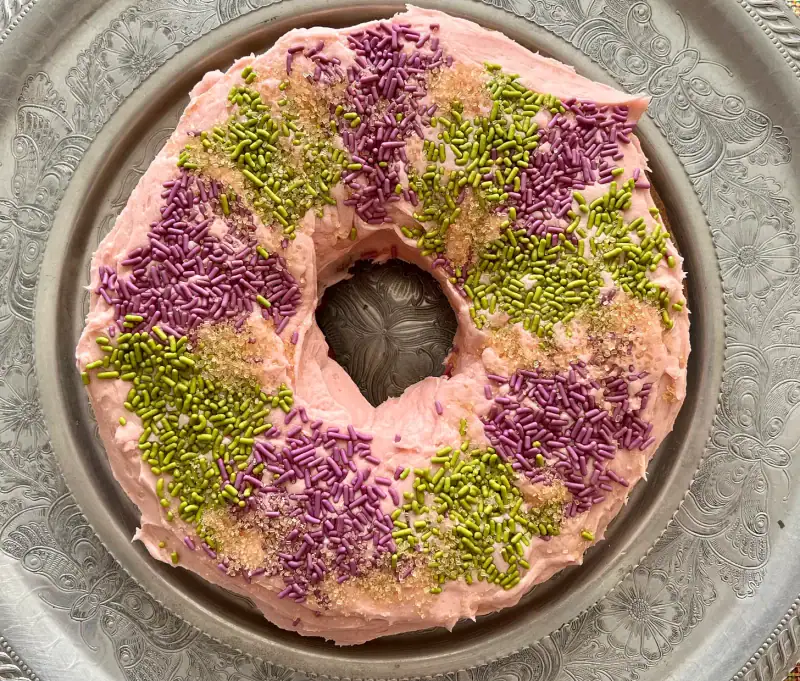
Bittman Bread King Cake
Prevent your screen from going dark
Makes 8 to 10 servings 1x
Time 8 to 12 hours for the jumpstarter; about 3 hours of intermittent work to mix and fold the dough; a couple hours to fill, bake, cook, and decorate the cake
Ingredients
- 100 grams whole wheat starter
- 300 grams whole wheat flour
- Water as needed
- 5 grams salt
- 1 stick softened butter (113 grams)
- 75 grams turbinado sugar
- 5 grams ground cardamom (about 2 teaspoons)
- 80 grams golden raisins
- Glaze or buttercream and decorations
Instructions
- Combine the starter, 100 grams whole wheat flour, and 100 grams water in a large bowl. Stir, scraping the sides and bottom as necessary until all the flour is absorbed. Cover with plastic or a damp towel and let sit at room temperature for 8 to 12 hours. The jumpstarter will bubble and become quite fragrant. (If you haven’t already, feed the starter: Add 50 grams each whole wheat flour and water and stir or shake. Make sure your container is at least double what you think you need. Cover and return to the refrigerator.)
-
When you’re ready to make the dough, add the remaining 200 grams flour and 100 grams water. Stir with a rubber spatula or wet hands until a dough forms and looks springy, 1 to 2 minutes. If there’s still flour not incorporated around the bottom or edges of the bowl, stir in more water 5 grams at a time as you work. The dough should be wet and shaggy but still form a loose ball. Cover again and let sit for about 1 hour.
-
With wet hands, fold the salt into the dough, adding enough water to create a little milkiness on the surface without losing the ability to hold a loose shape. Cover and let sit for about 30 minutes.
-
Proceed with the 4 folds about every 30 minutes. As you work, wet your hands and the dough with enough water so it becomes smooth while still holding some shape. After the 3rd fold, make the filling: Mash the butter in a small bowl with the sugar, cardamom, and raisins.
-
After the 4th fold, line a stockpot that’s at least 12-inches in diameter and has a tight-fitting ovenproof lid with two layers of overlapping parchment. Turn the dough onto a wet surface and use wet hands to press it into a rectangle about 16- by 9-inches, with the long side toward you. Dab the top evenly with bits of the sugar mixture. (Don’t try to spread it or you’ll tear the dough!)
-
Working from the long side closest to you gently stretch and roll the dough tightly to enclose the filling; set the log seam side down. Bring the ends together to form a circle, stretching and pressing as necessary to form a relatively seamless splice. Transfer the ring to the prepared pan, fitting it in the bottom so it’s almost touching the sides of the pot. Use scissors or a razor blade to cut 6 or 7 vents into the top of the dough. Let the cake rest until it puffs slightly and the indent from your finger springs back slowly, 15 to 30 minutes.
-
Cover the pot and put in a cold oven and set for 400°F. Remove the lid after 30 minutes and continue baking until the top forms a golden crust and the filling bubbles through the vents, 15 to 20 minutes more. An instant-read thermometer inserted into the thickest bready part should register 200°F. Brush the top with any pooling butter from the bottom of the pot and let the cake sit in the pot for 10 minutes before transferring to a wire rack and slipping out the paper. When cool, glaze, frost, or sprinkle as you like. Cut into wedges and serve.
— Recipe adapted from Bittman Bread