

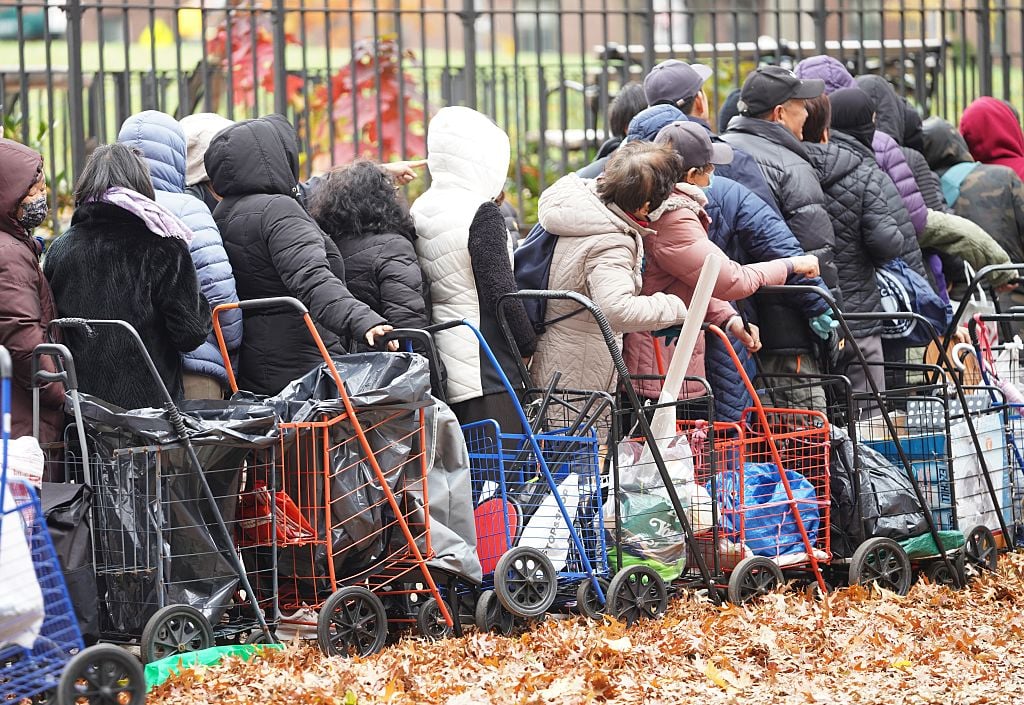
A father in Illinois had to choose between going to work or going to the food bank because he only had enough gas for one trip. A deaf person in Nebraska had to go to their doctor to get additional proof of their disability. In states like Missouri, Nebraska, Texas, and Florida, many applicants are now required to get a letter from their landlord or a neighbor verifying how many people eat in their household.
These are just a few of the experiences that food banks and anti-hunger advocates are hearing from those who are newly applying or being forced to re-apply for food stamps. Nationwide, food aid organizations are scrambling to absorb the fallout as strict Supplemental Nutrition Assistance Program (SNAP) requirements under H.R.1—dubbed the ‘One Big Beautiful Bill’ by President Trump—go into effect.
Since H.R.1 passed in July 2025, an estimated 5 million people, including 1.5 million children, have lost SNAP benefits, according to the Center on Budget and Policy Priorities, a nonpartisan research and policy institute.
These changes fly in the face of the reality that, according to the U.S.Department of Agriculture (USDA) Economic Research Service’s most recent report, 47.9 million people in our country live in food-insecure households, meaning they don’t always have the means to get the food they need.
Ironically, Brooke Rollins, who heads the USDA, credits the drop in SNAP to a “better economy.” But food insecurity researchers and public health experts say that doesn’t match with the data: in fact, unemployment rates have remained fairly stagnant while food costs have gone up.
“Inflation has persisted through 2026, driven by President Trump’s tariffs, soaring gas and energy prices (aligned with the Middle East conflict) in addition to a variety of weather and food safety shocks,” Dawn Thilmany, an agricultural economist and professor, wrote in Forbes last month…“for low-income Americans and this is especially problematic during a year when food assistance benefits have decreased for many U.S. households.”
Eric Savaiano, a program manager for food and nutrition access and economic justice at Nebraska Appleseed, agrees that the need for nutrition assistance hasn’t disappeared.
“Back in June 2025, they did not magically solve hunger. And so our economy has not gone up. Our unemployment rate has not magically been completely wiped out or anything,” says Savaino. “And so all these people are just turning to other resources, like food pantries and food banks, or are just struggling and not getting what they need, which is bad for everybody.”
Qualifying for SNAP now means more paperwork and more frequent verification—not just answering questions, but providing several documents to prove the answers: Have you worked 20 hours per week? How many people eat in your household? Do you qualify for an exception because you are 65 or older, caring for a child under 14, or unable to work because of a disability?
This creates substantial roadblocks for many applicants, says Savaiano. “We’ve heard from people who have relied on the call center to apply for SNAP because they’re 77 and blind and they can’t get that done on paper because of their disability. They’ve had to try to find other resources to do it and haven’t done it. They’re calling us to see if we can help them. It’s just insane the amount of paperwork that they’re requiring each time people reapply.”
Then there are the new time limits. Under H.R.1., those who fail to document enough work or another qualifying activity can lose SNAP after three months. Certain groups that are known to face barriers to steady employment were exempt from documenting work hours, so they didn’t have to go hungry, but that changed with H.R.1.
Veterans, people who aged out of foster care and are 24 or younger, and those experiencing homelessness are among the groups who have to document 20 hours of work per week before qualifying for nutrition assistance.
It is not only the recipients themselves who are burdened by changes under the new law. By October 1, states are expected to shoulder 75 percent of SNAP’s administrative costs, up from half, while the federal government’s share drops to 25 percent. This shift is creating more funding pressure on states that are also bracing for huge cuts in federal Medicaid funding under H.R.1. Many states are reporting that these new requirements are creating an untenable burden for caseworkers as well as those applying for SNAP. Callers can’t get connected with their state agencies, for example, or they are getting letters about an interview with a caseworker for a date that already passed.
In Massachusetts, since January, about 75 percent of calls to the Massachusetts Department of Transitional Assistance (DTA), the state agency that administers SNAP, are disconnected before callers reach someone, according to Seana Weaver, the CEO at Worcester County Food Bank. She’s heard from multiple people who scheduled auto callbacks, only to be ghosted, after clearing their schedule to be available.
“We are the wealthiest country on Earth and we’re having a man-made hunger crisis that could easily be fixed by a policy choice and having the political will to do so.”
“We are the wealthiest country on Earth and we’re having a man-made hunger crisis that could easily be fixed by a policy choice and having the political will to do so,” says Gina Plata-Nino, the director for SNAP at the Food Research & Action Center, a nonprofit that tackles the root causes of hunger and food insecurity.
“You have people working two to three jobs, making very little money, and they don’t have enough to pay for their basic needs. And [SNAP] really is the difference between folks being able to pay for a shelter, childcare, medicine, in order to just live day to day,” she said, emphasizing the debilitating effects that hunger has on people during all stages of life.
She’s also hearing reports from those who work in food emergency services that they are “seeing bigger lines than they did during the pandemic.”
Health care providers are sounding the alarm in their communities about these dangerous implications. About 350 providers across Massachusetts signed a September letter to Governor Maura Healey urging the state to invest more funding in the agency that administers SNAP and eliminate excessive verification requirements that aren’t mandated.
In the letter, they outline the grave risks of going hungry: “Research shows that children living in food insecure households are more likely to be hospitalized, to have low birthweight, to develop asthma and anemia, to experience developmental delays, and to fall behind in school. With 80% of brain development occurring within the first three years of life, infants and toddlers are particularly sensitive to the effects of food insecurity–which do not present months or years later, but just after a few days and weeks. Household food insecurity is also linked with parental depression, anxiety, and increased stress, which in turn impacts child health and development.”
The letter also cites research suggesting that food insecurity in the United States generates up to $237 billion in avoidable health care costs each year.
Steep declines in SNAP participation are also impacting local economies, especially in rural communities where margins can be razor-thin for small businesses. Every dollar spent through SNAP multiplies throughout the larger food system, generating local revenue for small family farms, ranchers, grocers, bodegas, and truckers.
“Everybody’s feeling these cuts because SNAP goes into these communities and then is an economic boon to those communities,” said Nebraska Appleseeds’ Savaiano. “A grocer that we talked to has lost about 40% of their SNAP income, which amounts to about $60,000 in a six month period.”
Seven grocery stores in Illinois shuttered this year, stating that cuts to SNAP benefits and financial obstacles led to the closures.
Declining sales at local grocers can also mean that they either have to cut back or stop donating food to pantries and community organizations altogether.
Community members and organizations are shoring up aid where they can. During the growing season, Osamequin Farm in Seekonk, Massachusetts has a “Harvest Garden” inviting people to pick what they need. Free and fresh produce is available at weekly farm stands thanks to Harlem Grown, a youth-focused organization in New York City that provides mentorship and hands-on education in urban farming, sustainability, and nutrition.
Food banks are heartened by people who are volunteering and donating, but everyone I spoke to for this piece is worried that pantries, schools, hospitals, places of worship, and mutual aid groups are struggling to keep pace.
“It’s not sustainable,” Weaver, of Worcester County Food Bank, said. “As the strain moves to different income levels, that means that people are going to make choices around what they’re donating, how much they’re donating, what they can do around charity.”
In Illinois, Save Our SNAP, a growing coalition of more than 100 Illinois organizations working to protect SNAP, lobbied for the state to create a $70 million program called Families Receiving Emergency Support for Hunger. About 175,000 people—who lost all or part of their SNAP benefits due to H.R.1–will receive a one-time $400 emergency cash payment to what will hopefully be “a bridge as they figure out how they’re going to meet the work requirements,” said Robert Desio, the senior manager of public policy and benefits at the Northern Illinois Food Bank.
Save Our SNAP brings together groups across sectors, including housing justice advocates, legal aid providers, and those supporting survivors of domestic violence to work at the local, state, and federal level. Desio says the coalition is encouraging other states to build the same collective action in their own communities.
The Food Research Action Center (FRAC) invites everyone to act now for their communities by emailing your Senator to support a “Farm Bill or farm relief legislation that provides significant investments and reverses the crushing impacts of the Supplemental Nutrition Assistance Program.”
Comment