I was on Cape Cod a couple of weeks ago, where one of the highlights, especially in “off”-season, is eating seafood. My three-night span represented a kind of typical progression. Not easily duplicated, as you’ll note, but there are aspects of it that might help seafood lovers see things differently.
Night one: We opened oysters. (Ironically, a couple of days earlier, I was offered Cape Cod’s famous Wellfleet oysters at a restaurant in Dallas; I declined, but mostly because I knew I was shortly going to be eating them locally. Otherwise…oysters travel famously well; they were shipped from the east coast nationwide and even internationally throughout the nineteenth century. This is a pretty good history.)
Anyway. Oysters. Like all of this shellfish, these came from my friend Alex at Wellfleet Shellfish Company. But they’re a bit different from the usual “Wellfleets,” almost all of which are farmed. These were wild, gathered by a local who roams the tidal flats pretty much daily. (With a license, this is legal.) They’re amazing, much different from the near-uniform farmed version: varied in age, of course, and therefore size, shape, and flavor, with some intensely full and briny, others milder, smaller, sometimes drier. They’re not all winners, but the best are among the best eastern oysters ever.
And for some reason they’re easy to open. Or maybe it’s the confidence I’ve gained with these nearly stab-proof gloves (for ultimate protection, you want chain mail, something like this). I also really love this Opinel knife, which is sturdy and effective and, unlike most oyster knives, has a fairly sharp blade so detaching meat from shell can happen pretty much at the same time as opening.
Alright. Cooking-wise, there’s nothing to say about oysters, really. At least if you’re me: My favorite way to eat them is raw, maybe with a little lemon, so that’s not a recipe. Nor is there any revelatory recipe for the lobsters that followed (but I’ve included my basic steaming method below). The things I might do differently from many people is a) to steam not boil, and b) to save every last bit of shell and uneaten portions and then reuse the lobster cooking liquid to simmer that stuff for a few minutes, until I have a strong stock; usually I wind up with three or four cups, which is ideal.
I guess I’ll note that I don’t do melted butter anymore. Not that melted butter doesn’t make the meat taste “better”—it makes most everything taste “better”—but that I’ve become more of a purist; I want to taste lobster, not butter. Again, maybe a little lemon. But not much.
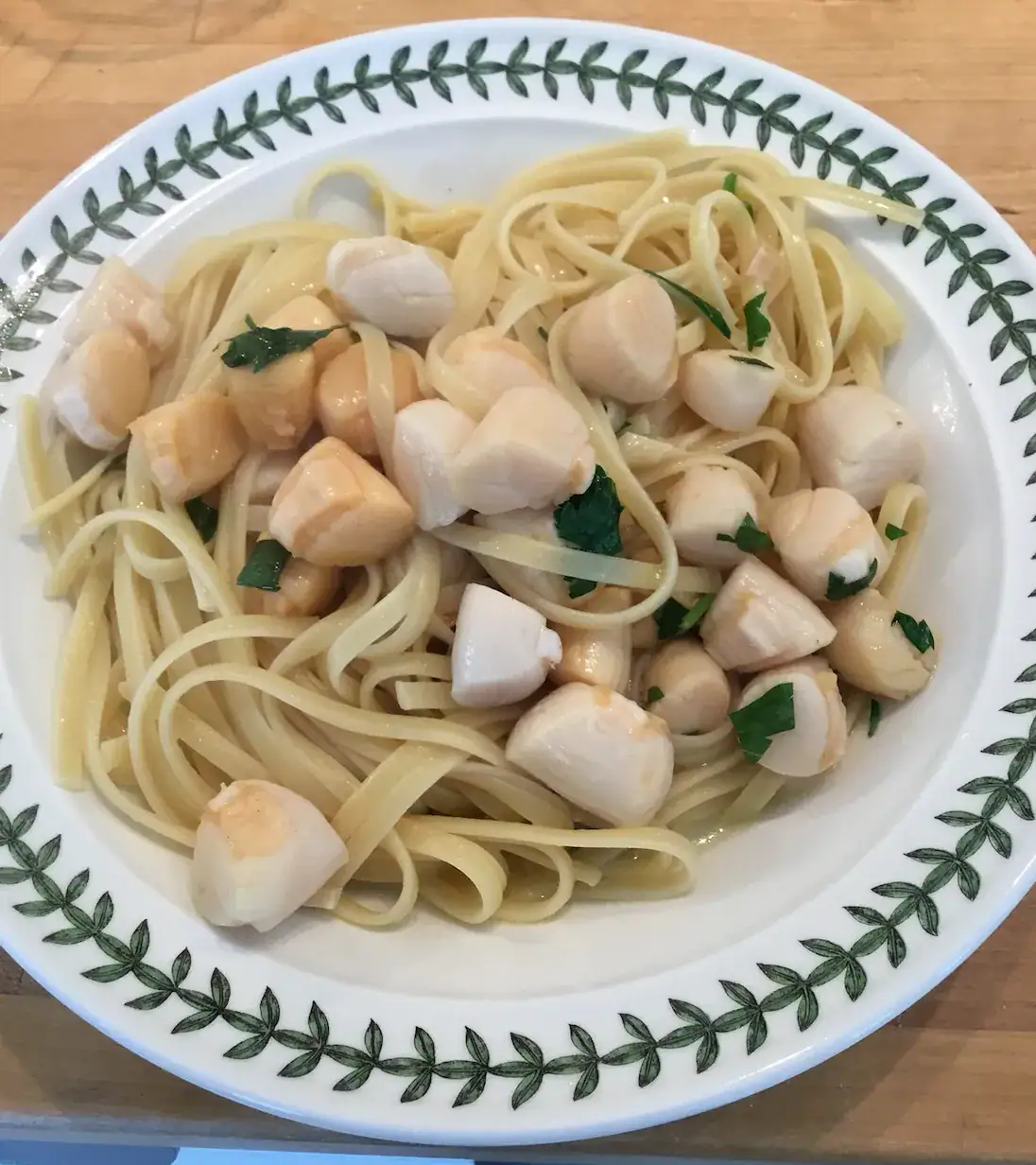
Night two was scallop night: I steamed four huge, in-shell sea scallops, and we ate two of those (sadly, no pix, sorry). Important here was to steam the scallops in the lobster broth, and then save that again. Then I made pasta with scallops, garlic, and bread crumbs, using near-end-of-season local bay scallops. (That’s one of the many “thank-you-Marcella-Hazan” recipes in my repertoire; I started making it in the eighties, from The Classic Italian Cookbook. I’m not even sure whether my version is identical to hers or widely variant at this point, since I haven’t looked in years.) The bays barely need cooking: While the pasta water is coming to a boil, you combine olive oil and garlic (and maybe a chile), and cook that until the garlic is barely colored, then add some fresh bread crumbs and toast them. You cook the pasta; you toss the whole thing with the scallops over low heat, for just a minute or two, maybe with a little of the pasta cooking water if it seems dry. Period. Well, parsley if you have it.
Pasta with bay scallops
Log in, or become a member today.
Join in: enjoy 7 days free, plus 40% off your first year with access to 1,000+ highly vetted recipes from the How To Cook Everything series and beyond, essays from Mark, and original pieces from our contributors.
Through our (more than a thousand, and growing) highly vetted recipes from the How to Cook Everything series, original food essays and reporting, thoughtful podcast conversations and introductions to new and responsible food products, we aim to showcase what’s possible, from farm to fork, and power a growing movement that encourages people to think about food not as a commodity, but as central to our health and happiness.
We hope you join us on this journey. We’d love to have you as a part of the Bittman community. As a member, you'll have access to:
New recipes every week
1000s of recipes from How to Cook Everything and beyond
First access to in-person events with Mark and Kate
Exclusive discounts from our favorite brands
Q&As with Mark and the team
Subscribe to our free newsletter
Join over 105,000 passionate individuals who receive our weekly emails. It’s 100% free and you can unsubscribe anytime. Plus, we’ll email you a sampling of what premium members receive on a weekly basis.



Comment