
Print
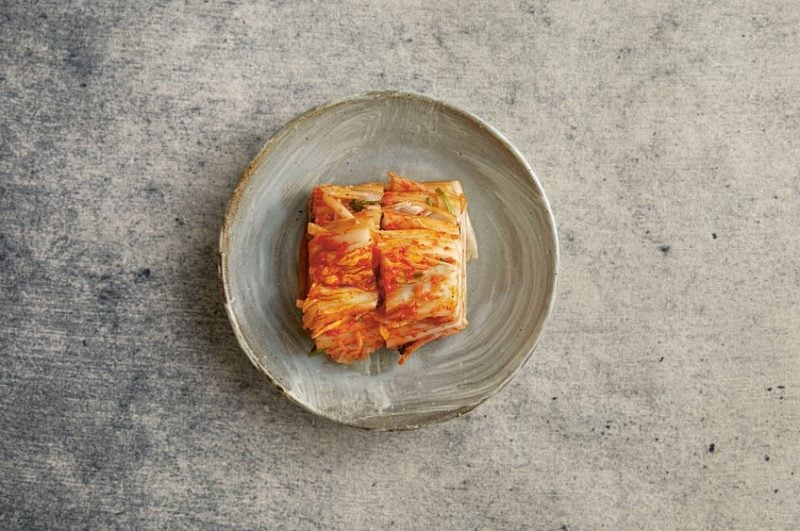
JP Park’s Napa Cabbage Kimchi (Baechu Kimchi)
Prevent your screen from going dark
Makes 4 1/2–5 1/2 lb (2–2.5 kg) 1x
Time 1 hour, plus 7 hours brining time, 11-12 days fermentation + 10 Minutes cooking time
Units
Scale
Ingredients
Ingredients for the brined cabbage:
- 1 large head napa cabbage/Chinese leaf (4 1/2–5 1/2 lb/2–2.5 kg)
- 1 cup (120 g) coarse sea salt
Ingredients for the rice slurry:
- 1 tablespoon glutinous rice flour
Ingredients for the kimchi seasoning:
- 1/2 cup (65 g) gochugaru (red chili flakes)
- 6 tablespoons minced garlic
- 1 tablespoon chopped fresh ginger
- 2 cups (16 fl oz/480 ml) Korean pear juice
- 1 tablespoon salted shrimp
- 3 tablespoons anchovy fish sauce
- 12 oz (350 g) mu (Korean radish), cut into 11/2-inch (4 cm) matchsticks
- 3 1/2 oz (100 g) onion, halved and thinly sliced
- 1 3/4 oz (50 g) scallions (spring onions), cut into 11/2-inch (4 cm) lengths
- 1 oz (30 g) minari, cut into 11/2-inch (4 cm) lengths
Instructions
Brine the cabbage
- Remove any damaged leaves from the cabbage. Make an incision 2 inches (5 cm) long at the base of the cabbage and pull the cabbage in half by tearing with your hands. With extra-large napa cabbage, cut into quarters.
- In a bowl, stir to combine 1/2 cup (60 g) of the coarse salt with 4 cups (32 fl oz/950 ml) of water. Taking the halved cabbage, dip it into the salt water four times, making sure each leaf is evenly coated. Repeat for all. Sprinkle the remaining 1/2 cup (60 g) salt evenly over the cabbage, focusing on the thicker parts of the leaves and including the outer layers and the base.
- Choose an airtight glass or ceramic container large enough to fit the kimchi with a small amount of breathing room at the top (to prevent overflow while fermentation occurs). Place the salted cabbage into the container cut-side up. Pour in the brine remaining in the bowl to cover. To prevent the cabbages from floating, set a heavier object, such as a water bottle, on the cabbage to keep it submerged.
- Let the cabbage brine at room temperature for 6–7 hours. Check that the cabbage is sufficiently brined by gently bending the thickest part of the leaf; it should gently bend to the touch. Rinse the cabbage three times under cold running water, squeeze out excess water, and place the cabbage face down in a sieve to drain excess moisture. Discard the brine from the container.
Make the rice slurry
- In a small saucepan, combine the glutinous rice flour and 1 cup (8 fl oz/240 ml) water and cook over medium heat, whisking constantly so that the flour does not clump. When bubbles begin to form, cook, while stirring, for another 3 minutes to form a slurry. Remove from the heat and let cool completely.
Make the kimchi seasoning
- In a large bowl, combine the gochugaru, garlic, ginger, pear juice, salted shrimp, fish sauce, and cooled rice slurry and mix until evenly combined. Add the radish, onion, scallions, and minari and toss.
- To assemble the kimchi, stuff each layer of the prepared cabbage with the kimchi seasoning mixture. After finishing each wedge, use the outermost leaf to enclose the cabbage and prevent the kimchi seasonings from escaping. Place the finished kimchi into the container with the cut-side facing up, pressing the cabbages down firmly so that there is no space left in the container. Pour any remaining kimchi seasoning over the pressed cabbages. Cover the surface of the kimchi with plastic wrap (cling film) to avoid contact with oxygen as much as possible and close the container. Let ferment at room temperature for 1–2 days and then move into the refrigerator for an additional 10 days.
- The kimchi can be stored for more than 1 year if stored well in the refrigerator, as long as it’s prevented from coming into contact with oxygen as much as possible.
— Excerpted from The Korean Cookbook © 2023 by Junghyun Park and Jungyoon Choi. Photography © 2023 by Jinju Kang. Reproduced by permission of Phaidon. All rights reserved.