

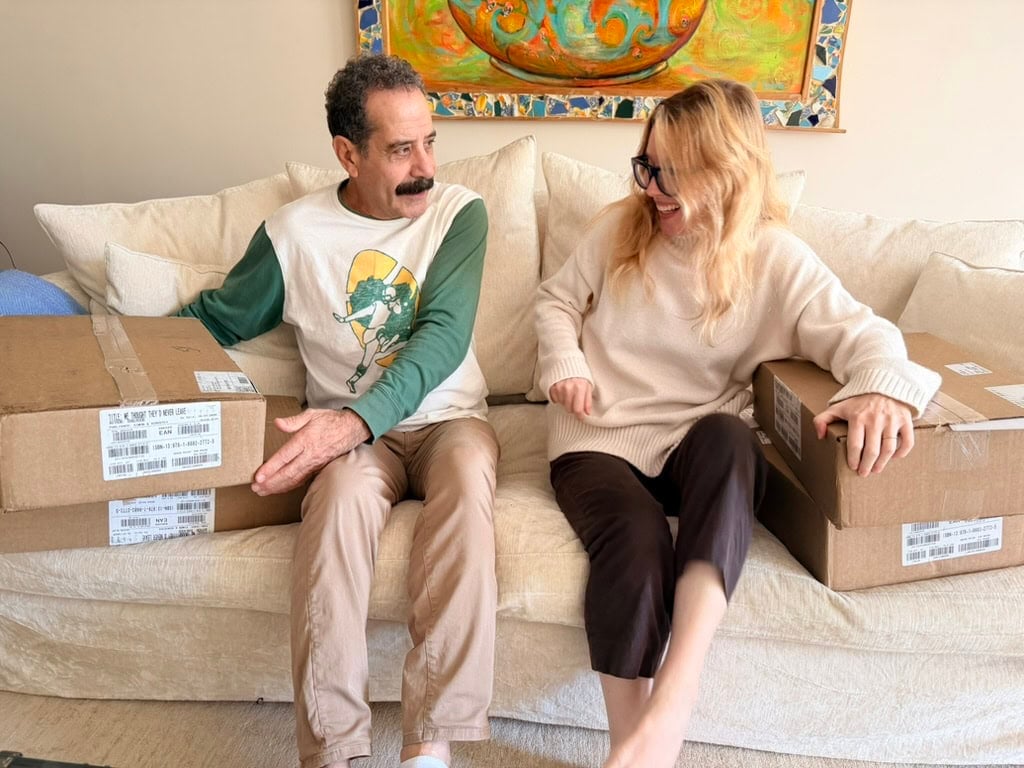
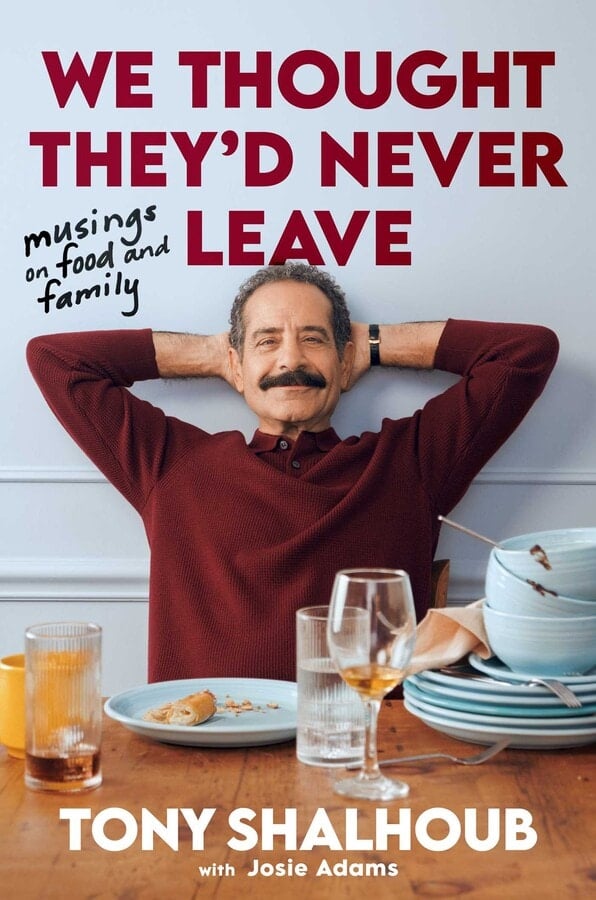
This week’s guests on Food with Mark Bittman are the actor Tony Shalhoub and his daughter, writer Josie Adams; Tony just released a book, We Thought They’d Never Leave, an essay collection-style memoir based around food, with a special spotlight on their family’s 50-plus person Wisconsin-based family reunion, a yearly affair that has been going on for more than five decades. Josie collaborated on the book with him.
Everyone has a favorite Tony Shalhoub project. Maybe it’s Big Night, which would be expected from the people listening to our podcast. Maybe it’s The Marvelous Mrs. Maisel. Maybe, of course, it’s Monk. Or maybe it’s any one of his theater projects, including his Tony Award-winning role in The Band’s Visit. (Mine? Barton Fink, hands down.) Regardless of your pick, we think you’ll enjoy We Thought They’d Never Leave; it’s cozy and warm and funny. The below is an essay excerpted from the book. – Mark
When I was an undergraduate student in Portland, Maine, I worked a lot of jobs because I had a talent for being busy without being particularly well-funded. Depending on the semester, I worked during the school year, over the summers, or both. I had a string of strange and memorable jobs, but like many students, I landed in food service more than once. Waiting tables paid better than most things I was qualified to do, and it came with the added benefit of feeding me occasionally.
One year, I got a job as a waiter at the Eastland Hotel in downtown Portland.
An old hotel that had been around for what felt like forever, the Eastland was slightly worn, faintly grand, the kind of place that had once been important and still carried itself as if that might happen again. By the time I worked there, it was what they called a “residence hotel.” That meant it functioned partly as a regular hotel for overnight guests and weekend visitors, and partly as long-term housing for permanent residents—mostly older people who lived alone. Affordable, dignified housing with a roof, a lobby, a dining room, and, if one so desired, a meal plan.
Every evening between four thirty and six, they had the “early bird special,” which featured a discounted, limited menu. Soup. Salad. A few simple entrées. The same choices each day. After the early dinner crowd cleared out, the restaurant would reopen with a broader menu for hotel guests and people from around the city. I sometimes worked the early shift, which meant I waited almost exclusively on the residents.
They were mostly lovely. They sat at the same tables, in the same booths, every night. They ordered the same meals. I quickly got to know if they wanted crackers with their soup, who liked their sauce on the side, and whether they wanted to chat or preferred quiet efficiency. Their routines were precise, and they took comfort in that.
And then there was Mrs. Thornton.
I remember her name because it was the same last name as a friend I’d had in high school, which made it stick. Mrs. Thornton was a single woman, older, small, neatly dressed. She had a gentle manner and a face that seemed permanently hopeful. She was adorable. She came down for dinner every night, and I was often her waiter. And every single night, she asked me the same question.
“Do you have chicken salad?”
We did not.
The residents’ menu did not include chicken salad. There was no chicken salad in the kitchen. There had never been chicken salad. There would never be chicken salad. This was not a rotating menu. These were the same few options, year after year, and chicken salad had never been among them.
And every night, I would say the same thing.
“I’m so sorry. We don’t have chicken salad.”
I would say it kindly. I would say it gently. I would say it as if this were the first time she’d asked.
Because for her, it was.
She would pause, disappointed but polite, and then order something else. Tomato soup. A sandwich she didn’t really want. Something beige and uninspiring. And she would eat it without complaint.
This went on for weeks.
And it slowly broke my heart.
I don’t know exactly what was happening cognitively for Mrs. Thornton. Maybe she forgot she’d asked before. Maybe she remembered, but hoped today might be different. Maybe chicken salad had once been a favorite, or a habit, or a comfort she couldn’t quite let go of. Whatever it was, she asked every night as if it were an entirely new request—optimistic, sincere, and quietly doomed.
One day, after a couple of weeks of this, I decided I couldn’t take it anymore.
I lived exactly five and a half blocks from the hotel, near downtown and close to school. I walked to work every day, and on that walk, I passed a deli. I’d never eaten there, but I assumed like most delis in Portland, they made a decent chicken salad.
And I thought, That’s it!
I was making something like a dollar seventy-five an hour. Tips were modest. This was not a period of financial abundance. But I decided that one night—just one—I was going to buy a chicken salad sandwich and bring it to work for Mrs. Thornton.
I picked up the sandwich on my way in and carried it carefully in my backpack to the hotel. When dinner service started and Mrs. Thornton sat down, I sauntered over to her table.
“Good evening,” I said. “How are you tonight?”
She looked up at me and smiled.
“Is there chicken salad tonight?”
“You know what?” I said casually. “There is.”
Her face lit up.
Back in the kitchen, I waited for a moment when no one was paying attention, then slipped the sandwich out of my bag and onto a plate. I added a few tomato slices and some chips, and covered the whole thing with a napkin like it was a state secret. I wrote something else on my order pad to keep the paperwork vaguely plausible and carried the plate out to her table.
She ate that sandwich as if it was the best thing she’d ever been served.
Whatever that deli had done—whatever ratio of mayonnaise to celery to chicken they’d struck—it was apparently perfect. She devoured it. She was delighted. She thanked me. And she left me a nice tip. I went home that night feeling extremely pleased with myself. I had done a good thing. A small thing. A slightly illicit thing. But a good thing.
The next day, I came into work.
Mrs. Thornton sat down.
I approached her table.
She looked up at me and smiled.
“I think I’ll have the chicken salad again today,” she said.
That stopped me cold. I didn’t think she’d remember!
I had to tell her we were out.
She was heartbroken.
And it was even worse than before, because now she remembered it. She remembered how good it was. How happy it had made her. And now it was gone. All because of me.
I couldn’t afford to buy her a chicken salad sandwich every night. I was a college student, not a benefactor! I suppose if I were a better person, I would have done it anyway. But . . . I only did it once. That was the end of the chicken salad. I never bought it for her again.
She ordered something else. I felt terrible.
Not much else from that job stayed with me. Except this: I learned to tie a proper bow tie at the Eastland Hotel, because clip-ons were not allowed. And I still remember how. That skill has outlasted many others.
I’ve never forgotten Mrs. Thornton.
Or the chicken salad.
Or how quickly one small decision can become the thing everyone remembers—whether you meant it to or not.
– Excerpted from WE THOUGHT THEY’D NEVER LEAVE by Tony Shalhoub. Copyright © 2026 by Tony Shalhoub. Reprinted by permission of Gallery Books, an imprint of Simon & Schuster, LLC.
Comment