


I was in Atlanta the other night eating and reading alone at a bar (one of my favorite things to do), absorbed in this compelling NY Magazine piece about the assassination of JFK, another in a now life-long procession of articles and books that has led many people to conclude that, yes, Lee Oswald was a “patsy” (his word), in some still-fuzzy scheme that involved, at the very least, a coverup by the CIA and others.
If you’re my age – 73 – Thanksgiving is “JFK season,” a phrase originated by the subject of Scott Sayere’s piece. Kennedy was shot on November 22, a Friday; Thanksgiving was the following Thursday. In my family, that was a busy time, anyway, because my parents’ wedding anniversary was November 23 and, for good measure, my mother’s birthday a week later. Throw in the occasional early Hanukkah and in some years, it was a full week of ritual, remembrances, and celebrations.
Needless to say, the assassination and its accompanying memories changed that a bit. If, in 1963, you were old enough to understand the words “the President was shot,” you have the same kinds of memories that 9/11 gifted many (not all; I understand) of us: Disbelief, horror, fear.
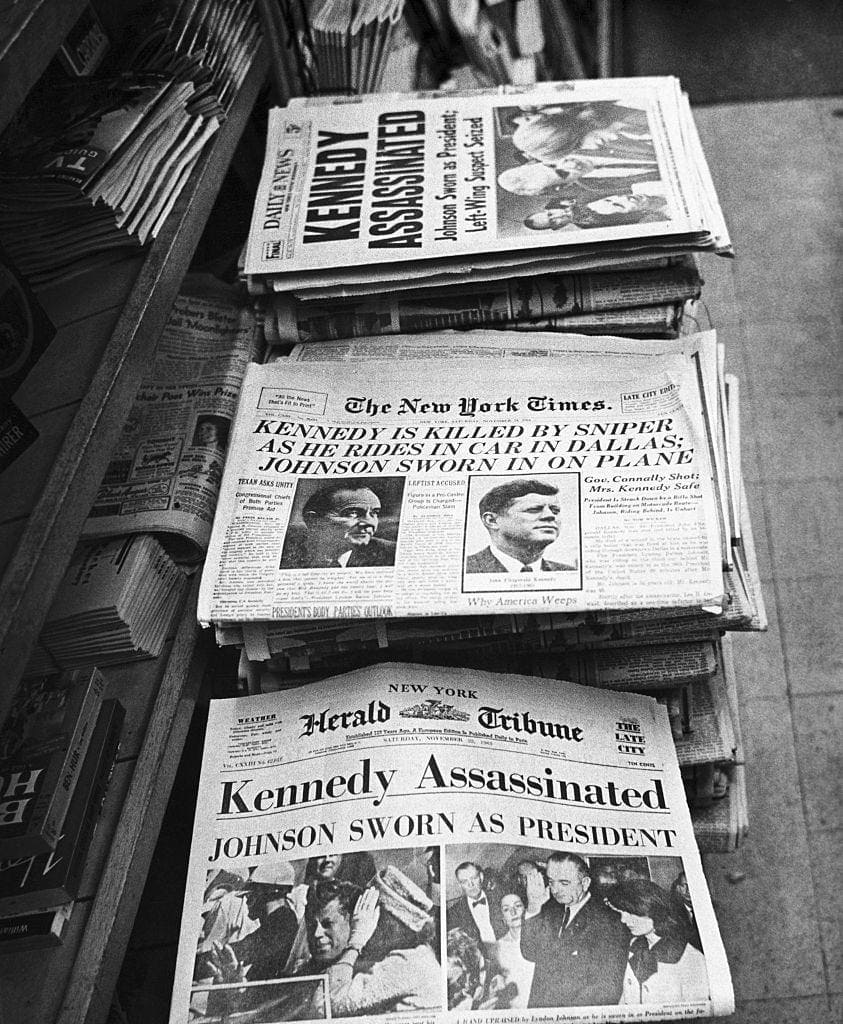
Sometimes the corny phrase is the right one: The world was a different place then. When, in the middle of the afternoon, we were yanked from our 8th-grade classes, hurried down the stairs, and herded into the cafeteria – an unprecedented event – we had no idea what could possibly be happening. In the staircase on the way, Miss (the word “Ms” had not yet been invented) Greenbaum appeared, sobbing and crying, “the President has been shot,” but we could not, would not, conclude that “shot” meant “killed.” Then, around 1:40, Walter Cronkite interrupted the soap opera As the World Turns and said that the president had been shot three times.
It was Dan Rather, I think, who affirmed that the president was actually dead. The radio was playing live, over the school’s PA system, and we listened and squirmed as we sat at those foodless cafeteria tables looking at each other and our equally befuddled and begrieved teachers, wondering what we were supposed to do. Some teachers, as they always did, told us to stop talking; others just cried.
We were sent home; it was almost time, anyway, and it’s not like the principal, or anyone anywhere, had any clue what to do. It was the Friday before Thanksgiving; I walked home from school with Mitchell, who died earlier this year. I don’t say this with pride, but we were already making jokes about the assassination. I’m not sure what a psychologist would call this, but “deflection” seems a likely word, because it’s not like we were feeling good; we simply didn’t know how to express our upset-ness, our grief.
Lee Oswald would be shot by Jack Ruby that Sunday; JFK’s funeral, with poor little John John standing there in his wool suit, would be Monday. It’s all pretty much a blur. But then there was Thanksgiving, and we took the subway to Astoria as usual, to go to my mother’s parents’ apartment, where my grandmother made potato nik and kishke and gefilte fish – she made the same food at every holiday – and an overcooked turkey, and opened a can of that amazingly perfect and awful and even terrifying cylinder of cranberry “sauce,” rightly called jelly or aspic.
There was never a November that passed without Mitchell and I sending each other links like the one above, or calling and saying, “Remember how that Saturday was so warm, and we were out early playing football, and everything was still and somehow normal, but completely wrong at the same time … ?”
I’m sad I can’t do that now; I’m sad I can’t have Thanksgiving with my parents and grandparents, even though I complained about it every year I did do it; I’m sad that the justice that I naively thought Jack Kennedy was going to bring to America has still not arrived. I think we all know now that there are no simple solutions to big problems, that the world is incomprehensibly complex, and yet that we must keep struggling to make it a better and more just place.
There are many things I’m not sad about, too.
In 1960, JFK had campaigned in New York, in Stuyvesant Town itself, where we lived. He rode in an open-top limo, waving and shaking hands, slowly taking that little curve on the service road by the women’s clothing shop called Plymouth (where my dad would take me to buy my mom a birthday present every year, just after Thanksgiving), on the corner of 20th Street and First Avenue. As children of Adlai Stevenson Democrats, of Roosevelt Democrats, we’d all been out there, naturally rooting hard for the young hero.
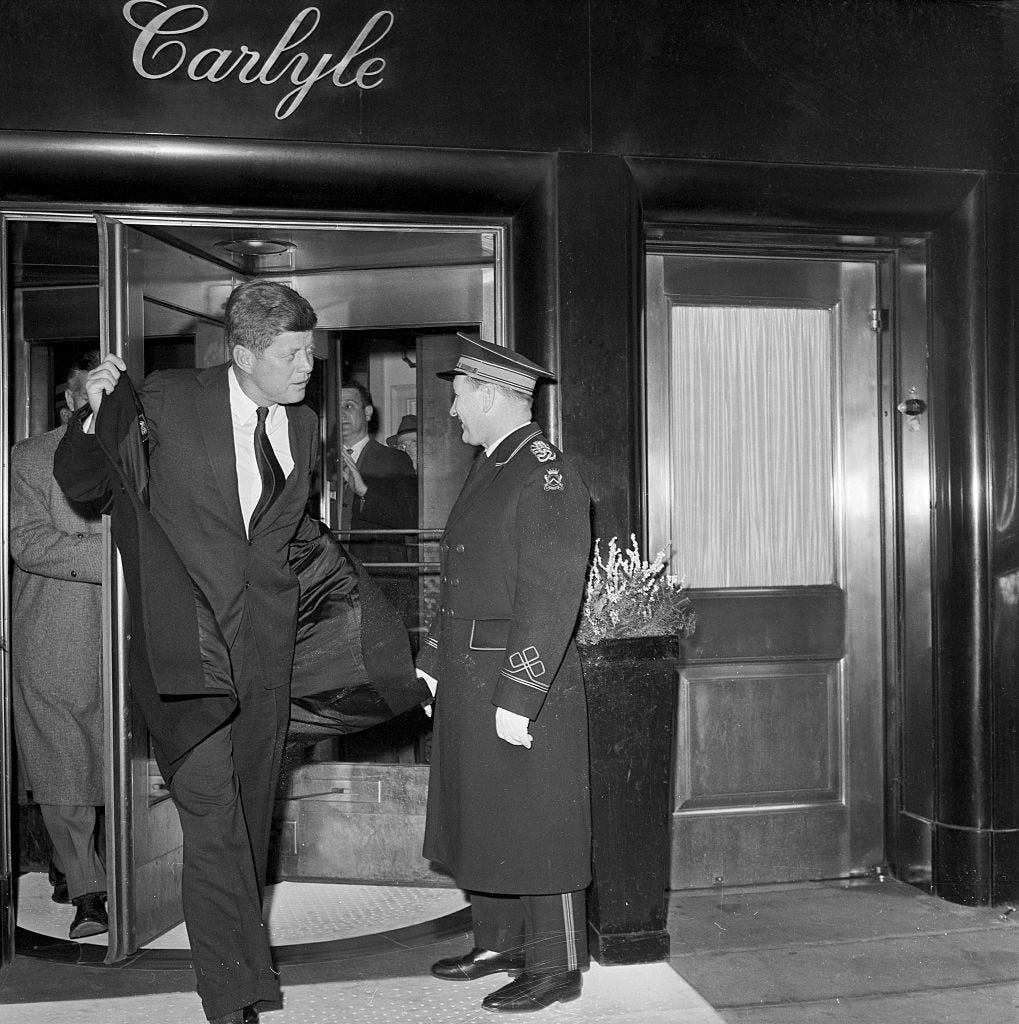
We did adore him; no one talked about his father’s rum-running and gangsterism, or his own flaws: He was A Prince to us. Silly, of course, but we didn’t know that then, and of course there was to be nothing close to that affection in my lifetime, though I cried when Obama was elected, falling again for the belief that “he shall lead us,” and forgetting briefly the lessons I’d learned between 1960 and 2008, and re-learn continually, the lessons that teach us that if you want change you have to fight for it, organize for it, and that although presidents can affect and alter history, there’s no substitute for exercising the will of the people.
It’s impossible to imagine what would have happened had JFK not been shot; Stephen King’s 11/22/63 does a fun job of tackling it, but if there’s one parallel universe there are an infinite number, so you can make up any story you like. Maybe things would have been better, but you can say that about a hundred different turning points in the last sixty years, and in the sixty years before that, and probably in the coming sixty years, too, and so on. You can understand the anger and injustices that led to Trump’s election, and remain bewildered that so many people would believe that a crazy, dare-I-say evil person was some kind of escape route.
November 22, 1963, was a gloomy day, weather-wise, as I recall it; but it brightened. The Friday was my parents’ anniversary, and I imagine somewhere in there we “celebrated”, though I have no memory of that.
It was a particularly fine weekend – especially for late November in New York. We peeled off layers as we played football on Saturday the 24th; the temperature was over 60 by noon.
I went upstairs to eat a sandwich – I think it was just me and my mom – and we turned on the TV, and we saw Jack Ruby shoot Lee Oswald right there on Channel 4, live, and that was more the end of innocence than anything, because if a known mobster could go into a police station and shoot the man who ostensibly shot the president – what were you supposed to believe? (Oswald, who was semi-conscious for a while at least, said nothing about the assassination, at least as far as has ever been reported.)
The next day, Sunday, we watched the funeral. I played more football with Mitch and the other guys.
And soon thereafter there was some vague return to normalcy, and it was Thanksgiving. Given my general adolescent grumpiness, and my absolute devotion to my friends — Mitch, and Pete, and Ken, and Bill, Jim, Mike, Roy, Rikki, Peggy, Ellen, Ann — over anything that had to do with family, I would have much preferred to hang out in the playground, or in one of our houses in a group, as we’d begun to do, eating potato chips and dancing to slow records. But everyone was going to their grandparents’ houses, and so, dutifully, did I.
By then it was six days after the shooting. My dad and I watched the Packers and Lions on black-and-white TV; no one else was interested. My mom and aunt helped my grandmother, my little sister scurried about, I popped into the kitchen once or twice, fascinated by my grandmother’s potato nik procedure. The fish and the kishke — a kind of sausage made of beef fat and flour and garlic and paprika, stuffed into a casing made of intestine — had been prepared long in advance, the turkey and sweet potatoes and whatever doomed vegetable she was making were cooking away, my grandfather had his annual shot of schnapps … and we sat down and ate, peacefully enough I’m sure.
Another weekend followed, of playing and watching football, of hanging out with the gang, of trying to avoid my parents. It felt like a permanent holiday, though not a celebration so much, and as I said there was no public hysteria or even grief that I remember. Of course there were no retaliations, there were no public demonstrations, everyone was unified or pretended to be, and no one cheered the death of the president, at least publicly.
Then a whole bunch of my life happened. We did publicly demonstrate against Lyndon Johnson’s actions, we did cheer when he announced he would not run for re-election, we did riot and protest and do brave and foolish things for the next number of years, and we did realize how privileged and naïve we’d been back in the late fifties and early sixties, in that period between childhood and seeing something of the real world.
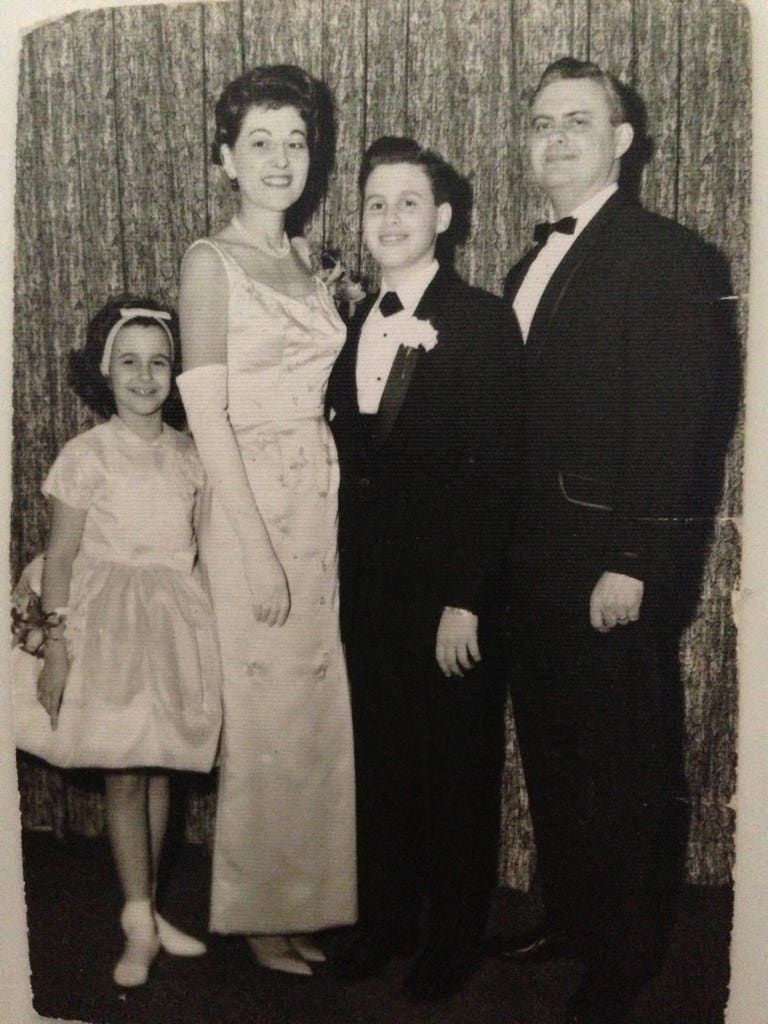
Much as I disliked it, year in, year out, the obligation, the mostly bad food, the time without my friends … I miss Thanksgiving the way it was, that time with me and my mom and dad and sister a little bit dressed up — my mom in her seal coat! — heading over to the subway, my dad hurrying us along, me distracted, walking by myself, my sister holding my mother’s hand … my grandparents yelling at one another, my grandmother scraping her knuckles on the grater while readying the potatoes, the jokes about it tasting so good because of the blood. I wish I had cooked with her more, though she always disapproved of my modern ways and shortcuts. Still, she once told me my potato nik was “pretty good.”
To be innocent again would be nice, for a moment. To make potato nik is always a celebration.
Potato “Nik”
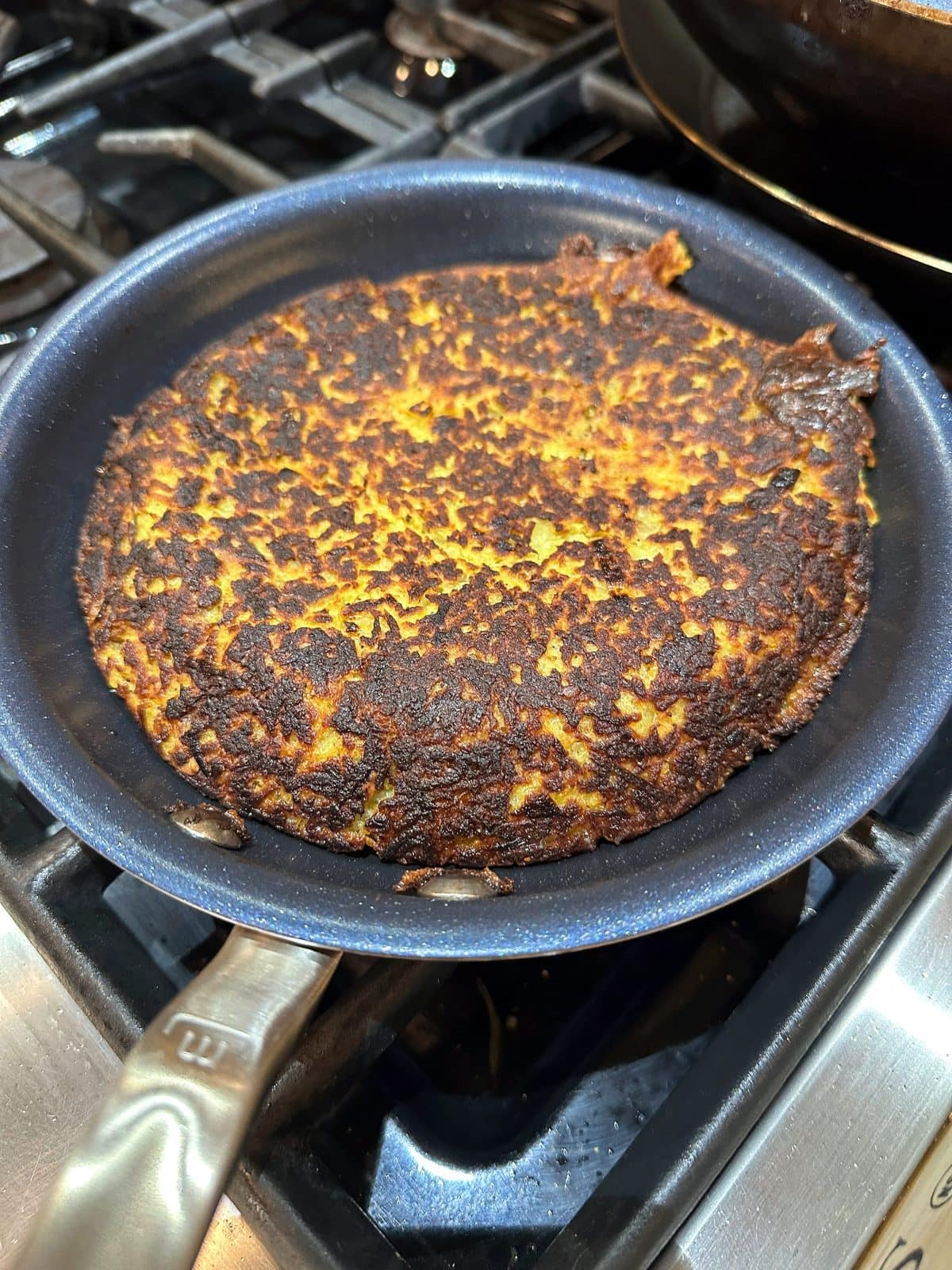
I love crisp, crunchy potato pancakes (also known as latkes) but they’re a pain to cook one by one. Fortunately, there’s potato nik, my grandmother’s clever solution with the mysterious, unexplained name. I figure one nik equals twenty latkes, and you can actually walk away from it for a few minutes while it cooks. Plus, it stays hot for a long time and is delicious warm or at room temperature. This is delicious served with your choice of sour cream, applesauce, chutney, or hot sauce.
Comment