


I am in Rome, and this is a somewhat disjointed assessment of the new year and how I am feeling about my place in it. I’ll give you a break and start with food so that if you’re already depressed, you can just stop reading when it takes a turn for the worse.
My new theory about Roman cuisine – and this may be true across much of Italy – is that the floor is high and the ceiling is usually not much higher. Translated: Any decent osteria or trattoria will have a specialty, whether it’s the “normal” Roman dishes – the four horsemen of the apastalypse: Cacio e Pepe (pecorino and pepper); Gricia (add guanciale); Carbonara (add egg); Amatracine (remove egg; add tomato); then, usually, lamb in some form; tripe in some form; salt cod in some form – or some other dishes, like fish, or Calabrian or Sardinian or Tuscan food, or hand-made pasta, or wood-grilled meat. Most of this will be good and not at all expensive. It’s unlikely anything will make you flip out, but you will leave happy, and the wine is cheap, which keeps prices down. (My friend Stewart had a bottle of wine in a restaurant down the block, paid $25 for it, flew to New York, and ordered the same bottle of wine for $125; and I’m sure that’s not uncommon, if someone wanted to document it.)
Many fancy places are the same food in a fancier atmosphere. You don’t eat better but you pay more; maybe the service is a little neater.
The ceiling is trickier: Many fancy places are the same food in a fancier atmosphere. You don’t eat better but you pay more; maybe the service is a little neater. Sometimes you get lucky: We stumbled on a seafood restaurant where the chef talked with every customer about what they wanted to eat, then crafted simple and beautiful dishes from the visually perfect fish and vegetables he had strewn about. That was expensive, and worth it.
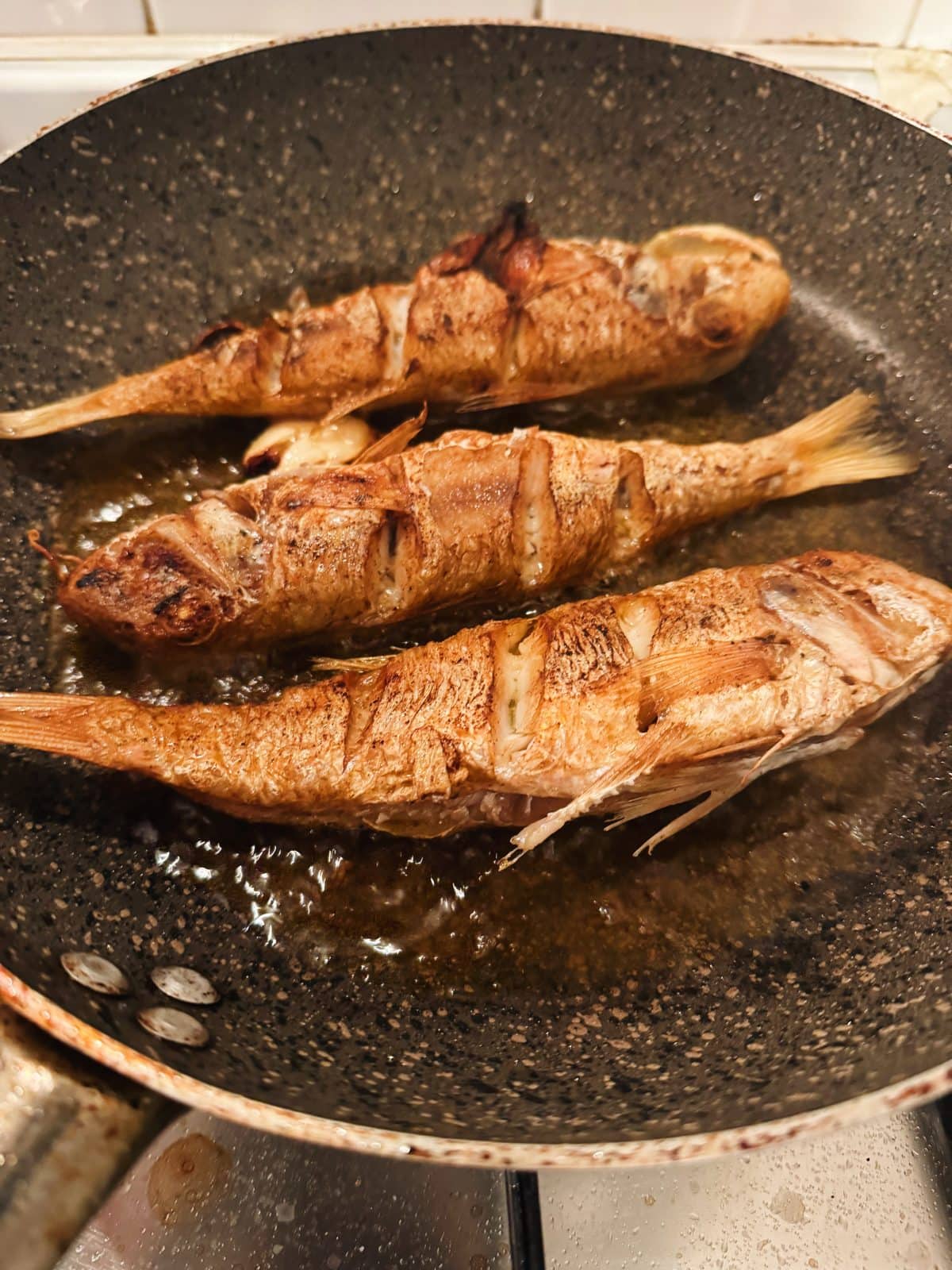
But once you have had your fix of rigatoni amatriciana and artichokes alla giudia, you start to look for and find differences: “burned” pasta, which is related to the lasagna you overheat in the oven until the edges blacken, and is fantastic (see above); fried moscardini, little tiny octopi-type creatures, no bigger than periwinkles out of the shell; puntarelle, of course, with great anchovies when you’re lucky; sepia (cuttlefish), in garlic and oil and chiles, and anchovies, with parsley (I made that); fried triglie, red mullet, quite possibly the best-eating finfish there is; grilled lamb; chicory; and Romanesco broccoli until it’s coming out of your ears. You’re in a permanent state of satisfaction, food-wise, but you get used to it quickly and don’t write home about it much, at least after your umpteenth visit!
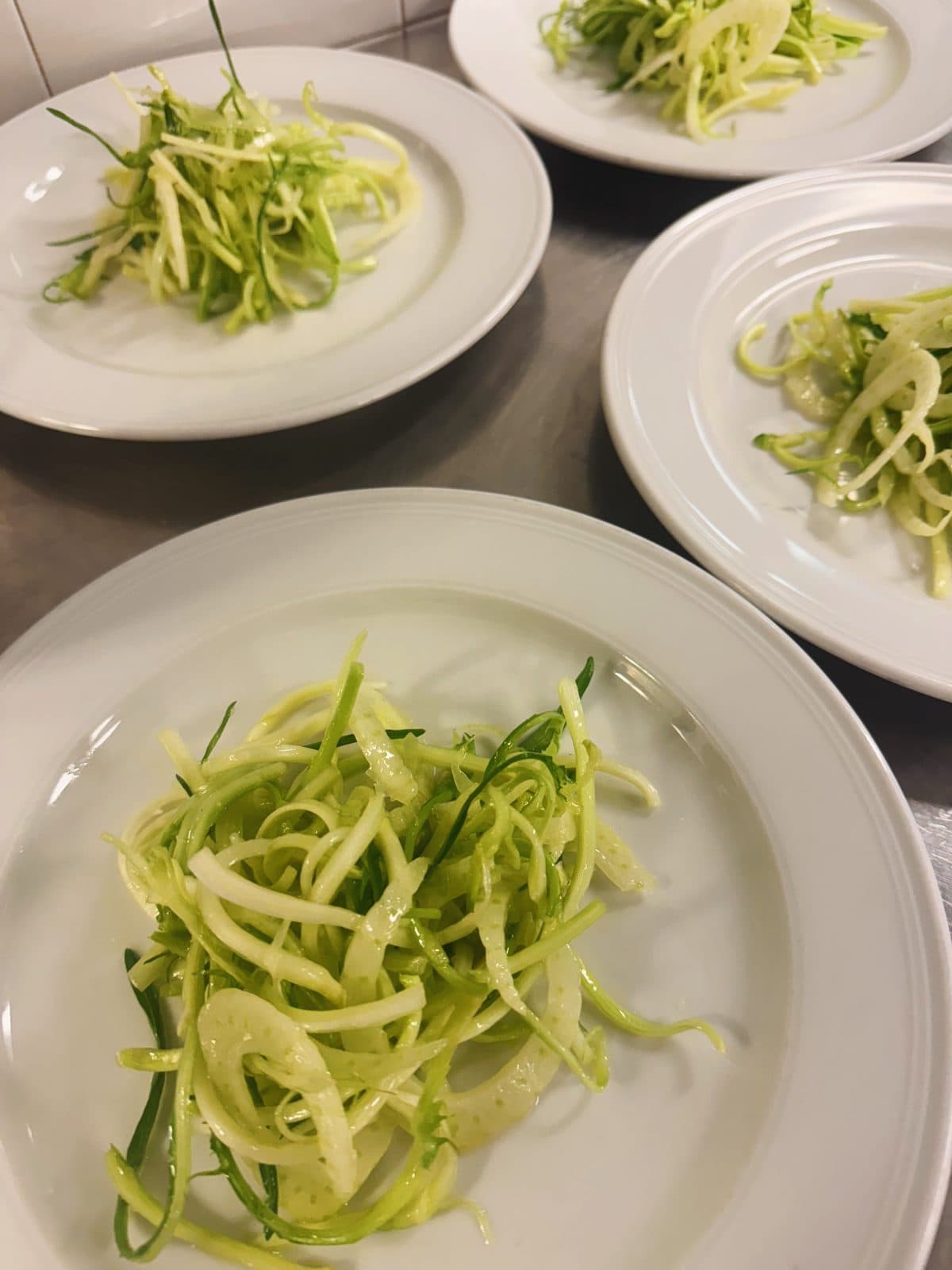
Kat and I helped the wonderful kitchen staff at the American Academy in Rome (where we are now the co-directors of the Rome Sustainable Food Project, about which more in a sec) cook for sixty people the other night (advice: once you pass 65 or 70, do not do this without getting special senior citizen treatment), and we made a menu of our interpretation of Roman food: A salad of puntarelle and fennel (from the garden here) with anchovies and oil and lemons from across the street; handmade pasta (Kat and a crew spent three hours rolling strazzapreti, a lovely shape whose name means “priest-strangler”) with sausage (made mostly by me, with lots of fennel) and a boatload of sprouting broccoli from the garden, which we cleaned and poached and shocked, then cooked with oil and garlic, pureed half as a sauce and re-heated the other half with the sausage; and a simple-brownie-like chocolate torte with not-so-simple, insanely good orange ice cream, made with bitter oranges, also from across the street. I had intended to give a little talk about great meals with not much meat, and this was one of them, but I forgot—mostly we each talked about the wonder of a regional food system, about cooking from scratch, about how institutional food could in fact be superb.

The Academy, home to an assortment of carefully selected artists and scholars, reportedly served terrible food – inedible, it’s said – to its residents, as recently as twenty years ago, when a former director asked Alice Waters, who was visiting, if she would come and help fix the situation. The story goes that Alice said, “Do you want an upgrade or a revolution?” and she was answered, “A revolution,” to which Alice replied, “Good, I don’t do upgrades.”
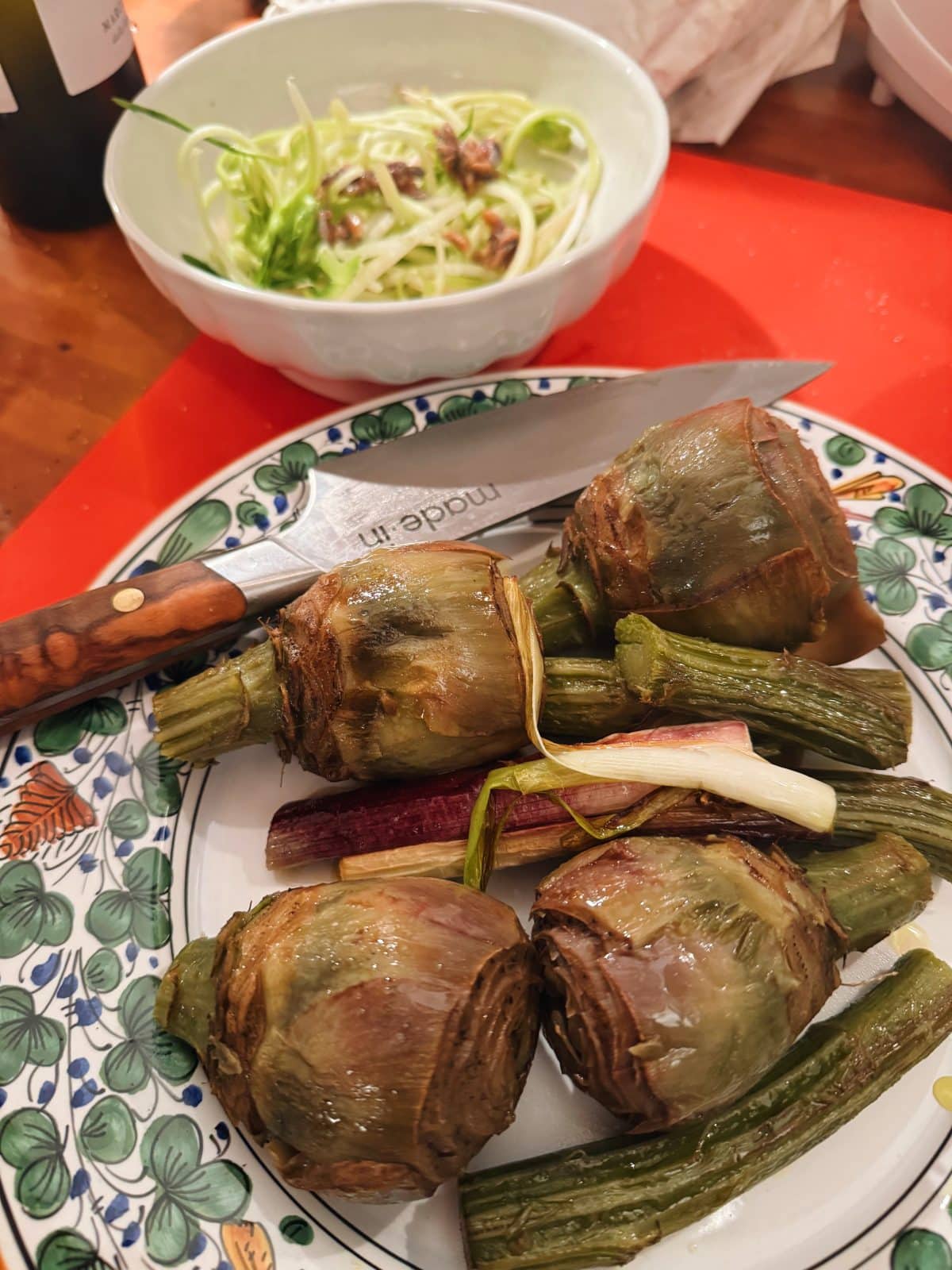
Alice proceeded to collaborate with the great chef Mona Talbot (Mona was boots on the ground, Alice no doubt provided support and genius) to turn the American Academy into a place where the cooking is better than any residential institution I’ve ever been in, and is certainly among the most impressive in the world. The tradition has been carried on by a succession of devoted and talented chefs, cooks, and interns. (Part of the work Kat and I are doing is seeing what we can do to make other institutions see the possibilities modeled here.)
In general, then, Rome is as expected. The weather is as hoped – East Bay-like – the beauty is omnipresent and profound and varied. (I visited the Villa Giulia yesterday, home of the Etruscan Art Museum and, as staggering and impressive that Etruscan work was, to me it was rivaled by the 16th century structure itself, which boasts stunningly bright frescoes on walls, arches, and ceilings, and a host of recovered Roman mosaics laid on the ground.) The food is, as we say, not bad. I would never say “Rome is my happy place” and it’s hard for me to hear people utter that kind of expression, but I like it here and hope to keep coming regularly.
To quote Solomon Burke, twice from the same song: “None of us are free if one of us is chained,” and, perhaps even more relevant, “If you don’t say it’s wrong, then that says it’s right.”
But (and here is your chance to leave) neither Rome nor any other happy place is truly a reprieve from daily or any other kind of life, nor is it a reprieve from what’s happening at home. “Wherever you go you sit in the same place,” the saying goes, or something like that, and my baggage is all over me. I never leave work, I am in contact with my laptop more often than I am with my shoes, but that’s not really the problem, even though sometimes, for the first time in my life, I wish I had a job I could “leave at the office.” But even if I could, unless you are prepared to ignore the world, there is no escape. To quote the great singer-songwriter Jason Molina, “If I see you struggling, I will not turn my back.” And to quote Solomon Burke, twice from the same song: “None of us are free if one of us is chained,” and, perhaps even more relevant, “If you don’t say it’s wrong, then that says it’s right.”
We’re just amping up the volume here, and it feels like our heads are going to explode.
Doom-scrolling was invented for times like these, but there is something extraordinarily frustrating about going to the Times website – and a million others – and not seeing the word “crisis” in the headlines daily. I and thousands of others have argued for years that there are several ongoing and simultaneous crises: those in public health, the environment, climate change, economic and racial justice. All of these meet the dictionary definition of crisis (“a time of intense difficulty or danger”) but politics is different because it’s through politics that these other kinds of crises may be created or ameliorated. Donald Trump creates a new real crisis daily, exacerbated by do-nothing Democrats. It makes last week’s crisis feel like this week’s normalcy, and that’s not normal. Crises should be alarming, and should be resolved ASAP. We’re just amping up the volume here, and it feels like our heads are going to explode. At least that seems to be the experience that I and those close to me are having.
And, no, I don’t see the potential nomination of RFK Jr. as a beacon of hope: a vague critique of ultraprocessed food does not constitute a plan for re-making our food system, which is about as likely to happen under a Trump administration as a dismantling of our nuclear strike force.
Maybe the air traffic controller involved in the DCA crash was a descendant of someone on the Mayflower; maybe the helicopter pilot was the grandson of a World War 2 hero, born in Boise; maybe not. It is among the cruelest and dumbest and (though it’s an old-fashioned thing to say), old-fashioned things to blame a plane crash on “diversity” as if some lower form of human had been allowed to be involved in what became a triangle of events and had caused it out of his or her idiotic tendencies, as if there were such a thing as a lower form of human, a form that can only be identified by the “common sense” of a raving lunatic. Who is left in this country who is crazy enough to say shit like that, out loud? President D. Trump, the man who is giving the Treasury Department to Elon Musk, the man who is dismantling AID. By the time you read this it’ll all be old news, but still a series of crises.
(And, no, I don’t see the potential nomination of RFK Jr. as a beacon of hope: a vague critique of ultraprocessed food does not constitute a plan for re-making our food system, which is about as likely to happen under a Trump administration as a dismantling of our nuclear strike force. Kennedy’s anti-vaccination stance in particular and his public health views in general are dangerous and deranged. We don’t need to get into this further, except to say that his cousin Caroline has called him a “predator.”)
The contemporary notion of disassembling government was popularized by Ronald Reagan, and we are seeing the true consequences of that attitude, vocalized by every Republican president since then and barely if at all countered by the “better” Democrats. Although many people my age have lived lucky lives – the America of the second half of the twentieth century was far from perfect, but rarely do countries experience such long periods of relative peace, prosperity, and even in many areas progress – it feels, suddenly, as if that period is ending. Maybe has ended. Trump’s executive orders have already affected billions of people worldwide: millions are likely to die as a result, tens of millions or more will suffer, and almost all of us will see the potential of our lives decreased, unless we see this as a crisis and act accordingly. That could mean demonstrating, writing to and calling your representatives, joining an organization that is fighting to support those most affected or to struggle against the outrage, getting ready to work to create an active, representative congress in 2026.
There is no escape from any of this – unless, again, you turn your back and leave the world; that’s the only way you can ignore social conditions. If you stay in society, personal conditions are affected by social ones, but even the lucky suffer: such is life.
My friend, the chef Charles Phan, died late last month, too young of course. We met when he first opened Slanted Door and I, like many food journalists, flocked out to San Francisco to talk to him about his form of Vietnamese-American food; he was an immigrant, a refugee from the aftermath of the American invasion of his country. Like most immigrants, he made the United States a better place.

Charles was a patient man, a terrific cook – he understood the power of the wok as well as anyone I’ve ever met – and a joyful, funny person. We saw one another last fall for the first time in a while and of course pledged to see each other more. A missed opportunity there.
With the death of every person you care about your life is somewhat diminished, and this we can’t escape unless we’re the person who’s dying. February is always a hard month for me as I mark the death of three close friends, separated by decades but all still difficult to commemorate. My birthday, a big one, is this month too, and if you want to get me a present you can either feed someone you love or, even better, someone you don’t know, or join the struggle against authoritarianism and for universal peace and justice.
9 Comments