

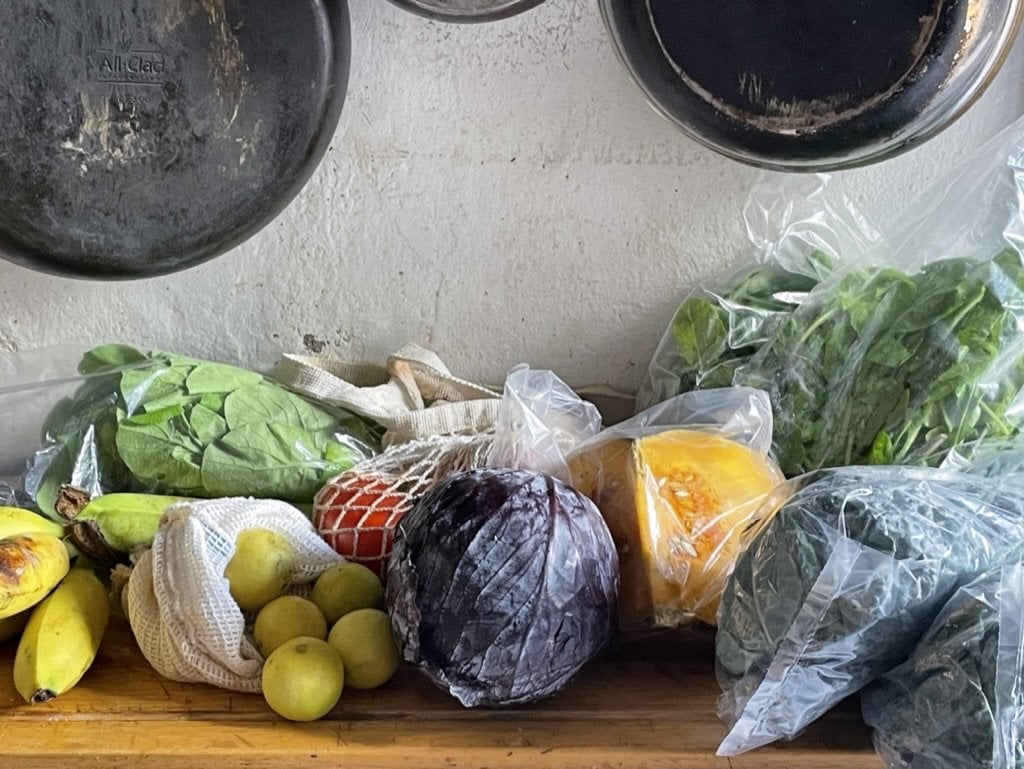
Every Wednesday and Thursday, I’ve come to expect messages from two farmers here in Puerto Rico whose vegetables, eggs, and goat cheese we buy at our weekly Saturday market. The messages, which come via WhatsApp, alert us to what’s available, what’s in short supply, and why the price of eggs has crept up yet again, and allow us to pre-order to ensure we have enough broccoli and arugula to get through the next week.
Price increases have come with transparency on the reasons why, while the supermarket gives no such explanations.
The patterns of availability have given me a sense of seasons, and they help me imagine what we’ll eat for the next week: When tomatoes and eggplant are in big supply, it’s a lot of pasta alla norma; when bok choy is the only green growing, I have to get creative and find new ways to dress it up after a steam. I also like not being surprised when a dozen eggs creeps up in cost—from $5 in 2020 to $8.50 now. These price increases have come with transparency on the reasons why, while the supermarket gives no such explanations.
Without these messages, I’d still go to the farmers’ market, but I wouldn’t have quite the same feeling of being in-the-know that allows these growers’ produce to be a continuous staple in my kitchen.
Will pushes for people to leave Meta for political and privacy reasons force folks to find a new free way to communicate about agriculture?
The more I’ve talked to people around the world about their grocery-buying habits and how they get in touch with local farmers, the more I’ve found out how common this is: In many places, like San Juan, it became a habit during the pandemic as a way to ensure that growers could sell their goods with the markets closed; in other countries, like Turkey and India, the app has long been an essential means of creating an alternative food economy. How did this come to be, and will pushes for people to leave Meta for political and privacy reasons force folks to find a new free way to communicate about agriculture?
WhatsApp has been gaining ground in the United States—its number of daily users increased 9% in 2023—but its main market has always been international. In countries where the cost per text message can add up, before the Meta takeover, WhatsApp was free for the first year and then $1 per year after that; ever since, it’s been free to use. This, coupled with its capacity for voice notes, have made it indispensable for many working in global agriculture, from Asia to Africa to Latin America and India.
When Meta spent a shocking $19 billion on the app in 2014, it was the most popular mobile messaging tool in India, Brazil, and Mexico, because of the proliferation of affordable Android phones. In many countries, as Belkis Boyacigiller, co-owner of Bi Nevi Deli in Istanbul, Turkey, tells me, these phones (and by extension, their apps) have acted as an introduction to the internet and thus social media use is prevalent as a means of communication. “The Internet came to people with their phones,” she says, “and everybody immediately learned how to use all of the platforms available. The Meta-owned platforms are very pervasive here in Turkey.”
Boyacigiller, for example, started using WhatsApp to communicate with her nearby purveyors in 2014 and has never stopped. It’s allowed her to forge direct connections to farmers. “I had a friend in 2015 who messaged me saying, ‘There’s a guy in the south of Turkey who’s growing pink dragon fruit. Are you interested in using it?’” she says. She was. Blueberries, avocados, and asparagus from a women’s co-op are all items she orders and coordinates through the messaging service. Kale was grown especially for her by a young farmer who wanted to get out of his family’s commercial tomato business and move into biodynamic farming; she was able to provide guidance to him directly on what the market was missing.
To use WhatsApp here in Puerto Rico makes sense because of how widely popular it is throughout Latin America. Gabriela Noriega Martínez, a psychologist from Panama who is based in Costa Rica, notes that even her patients prefer using it, and she keeps in touch with her own farmers in much the way I do. “It’s a commercial relationship based on trusting they are going to save it for you and they are trusting you are going to come and pay,” she tells me. “This dynamic also works for both conventional and organic—including produce, poultry, eggs, dairy, bread—but If you want to buy trusty organic or fair trade, it’s better to contact the growers directly.”
This popularity within Latin America extends to those who move to the States, too. Long Island–based recipe developer Kristina Felix, whose parents immigrated to the U.S. from Mexico, uses it to talk with her butcher. “If I meet someone that I want to stay connected with who speaks Spanish,” Felix says, “I just assume we’ll use WhatsApp, and we do.”
In India, which has the largest number of monthly WhatsApp users in the world, it’s absolutely crucial to regular food acquisition as well as running a culinary business.
“I extensively use WhatsApp to communicate with farms near Mumbai,” says Rini Singh, a researcher and writer exploring food systems and sustainability, as well as the founder of dhoop magazine. “Usually, all the farmers send a WhatsApp broadcast message and provide details on the availability of specific produce for the season or information on their produce subscription boxes.” This is also how Singh’s vegetable vendor keeps track of her balance: She gives him 500 rupees in the beginning of the week, and they run the tab; when she owes, he reminds her through the app.
The app isn’t just important for marketplace endeavors, either. Dr. Luis Alexis Rodríguez-Cruz, a professor at the University of Puerto Rico–Utuado, has seen it be useful in making organizations aware of climate conditions that can get needed funds to those dealing with disaster or weather changes as well as for peer-to-peer help. After the disastrous impact of Hurricane Maria in 2017, it was used for seed and information exchange. “Farmers that had a strong network of support, that were more tied into institutions, were the ones that faced fewer hurdles to recover their farms or their food,” he says.
This is a common scenario. In Senegal, voice notes have become indispensable for information and resource-sharing among farmers, researchers, and NGOs, according to a 2023 report at Rest of World. “In a country where nearly half the population cannot read or write, WhatsApp voice notes have become a vital tool for farmers to collaborate and access information in local languages to improve their produce,” wrote Jack Thompson. A 2019 report in the journal Spore also showed that in Caribbean countries like Trinidad and Tobago, it was used among farmers and agencies to share market prices for common crops as well as other knowledge.
Despite the importance of the app to global agriculture, its dominance may be in danger. In 2020, the FTC (Federal Trade Commission) filed an antitrust suit against Meta, which owns Facebook, Instagram, and WhatsApp; it is set to go to trial in April of 2025. The suit accuses the company of “maintaining an illegal monopoly over personal social networking with its acquisitions of Instagram and WhatsApp.” There are very legitimate privacy concerns around how Meta monitors’ user data and so, in addition to a distaste for Zuckerburg’s political affiliations and the company’s ditching of fact-checking, many would like to move their messaging to platforms like Signal, which offers more privacy and full data encryption.
Sarah May Grunwald, a writer and wine educator based outside Rome who uses WhatsApp for most of her contacts with farmers, a forager, and wine group, has wanted to push her network to move to Signal, “but it’s hard to get people to switch,” she says. People are set in their ways. Alice Driver, an investigative journalist who does a lot of reporting in Spanish, has also tried and failed to nudge people toward Signal. In contrast, Natalie McGill, who runs Perennial Roots Farm in Virginia, has found her customer base eager to switch.
Understanding how WhatsApp has transformed relationships between farmers and customers, as well as among farmers themselves, is one heartening outcome of technology’s grip on human lives.
Whether Meta will be broken up remains to be seen, and a voluntary move off of its platforms—especially WhatsApp—seems unlikely for those who’ve come to use it as a means of creating their own alternative local foodways. It’s unique in its reach and ubiquity internationally, and that makes it quite clear why Meta made that $19 billion bet over a decade ago. At the very least, understanding how this app has transformed relationships between farmers and customers, as well as among farmers themselves, is one heartening outcome of technology’s grip on human lives: Simple, reliable, and free tools that make connection easy have the power to help small farmers thrive.
Comment