

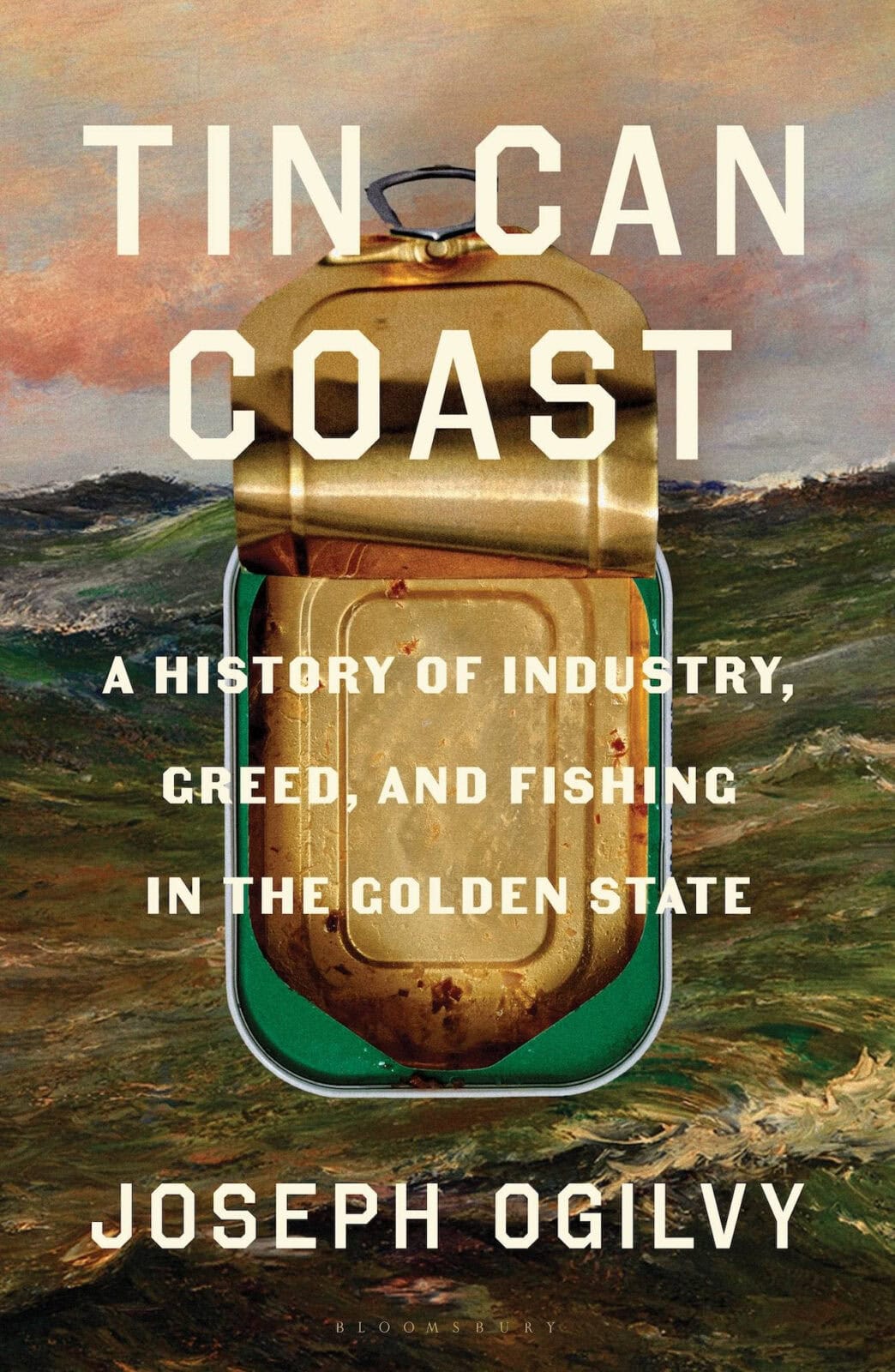
This week’s guest on Food with Mark Bittman is the writer and chef Joseph Ogilvy, and the first thing my dad said to him — which I don’t think I’ve ever heard my dad say until now — is that he’s been waiting all his life for someone to write the book Joe wrote, and that the instant my dad saw the book, he said to himself, “Ah. Finally.”
The book is called Tin Can Coast: A History of Industry, Greed, and Fishing in the Golden State, and we are very happy to be publishing this excerpt from it alongside the podcast episode. – Kate
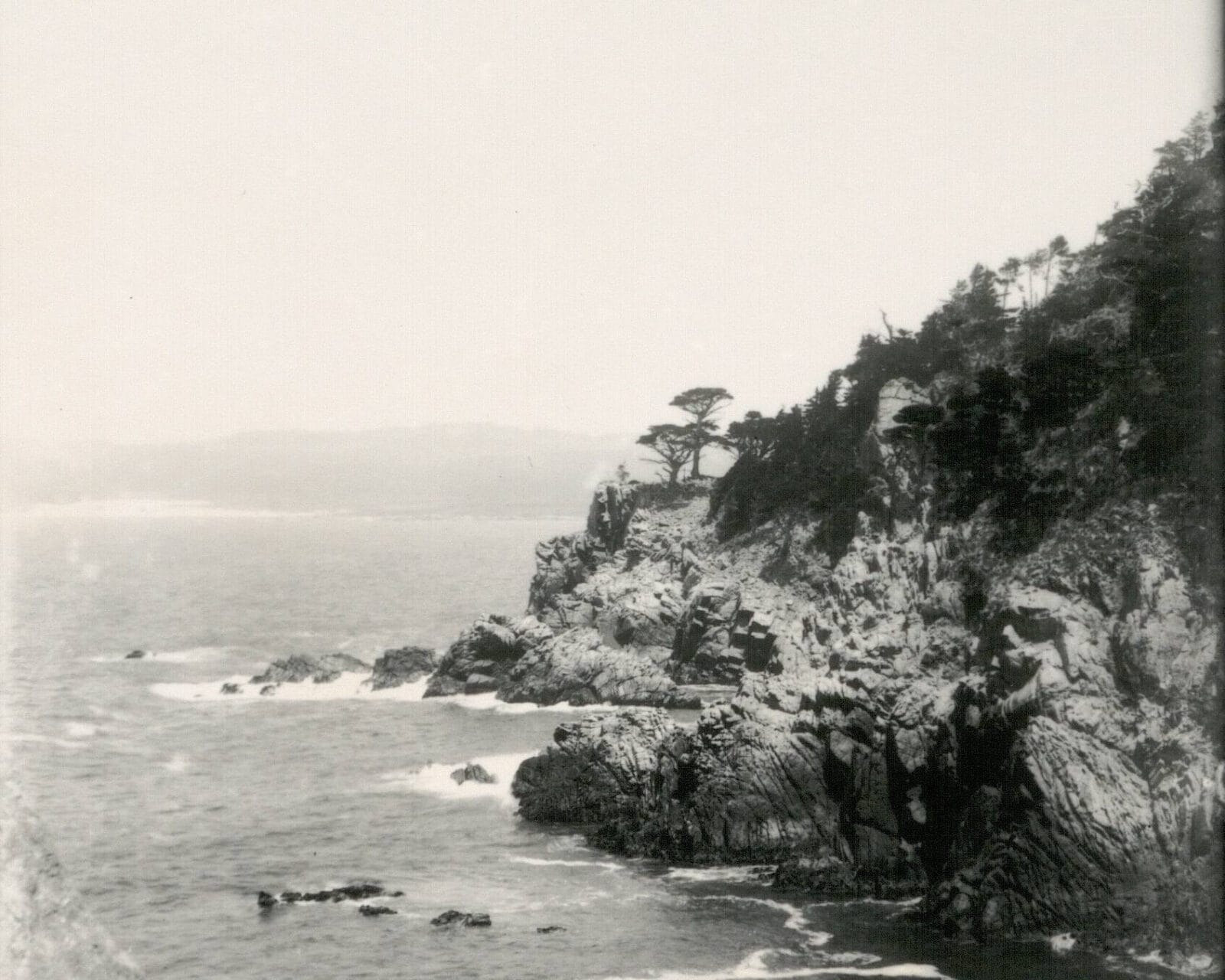
Look west from San Francisco, or Monterey, or Long Beach, past the pleasure boats and the surfers and the cargo ships. This is the California Current, the ocean system that made the Golden State: nineteen hundred miles of the most productive waters on earth, drifting slowly down the West Coast of the United States, slate gray and spumed with surf under the fog, or Prussian blue and dappled with windblown troughs, glinting under the sunlight.
Now look at it from far above. The Current begins around Vancouver Island, where the westerlies take hold of cold North Pacific waters and slide them past the straight up-and-down coasts of Washington, Oregon, and Central California in a broad, slack meander. At Point Conception, near Santa Barbara, it hangs a loose left and eddies softly in the wind-sheltered nook where the west coast turns toward Los Angeles. By the time it passes the Mexican border, it’s heading due south again, skirting the long tongue of Baja California. Only at Punta Eugenia, the tip of a fishhook bay halfway down the peninsula, does it leave the coast behind, driven west toward the deep subtropical Pacific by the equatorial trade winds.
The California Current isn’t a place so much as a tendency, the tropical migration of trillions of gallons of seawater and its consequences. The Current barely holds a shape. Its eastern edge is the wet sand and rock pools left by the high spring tides, just before the oceanfront condominiums, a little below Highway 1. Its already leisurely southward drift is tangled up and snarled by the local topology, swirling and jetting against the flow. There’s no real boundary to the west, just a point at which the water stills and the fish start to disappear a couple hundred miles out. Its movements are not much more consistent. It slows frequently. Sometimes, between October and March, it even stops and changes direction, moving in reverse and wandering poleward until spring, when the weather warms up again.
It’s around April that the Current really becomes itself. That’s when the northwesterly winds begin again: cool high-pressure air from the mid-Pacific, rushing in to take the place of sun-warmed air rising above the Mojave and Sonoran Deserts. When these winds begin to blow in earnest, they push the ocean’s surface water down. But the planet is rotating rightward, eastward, dragging the water away from the coast. As the surface water slides away, chill water from the deep rushes up to take its place. The harder the winds blow, the more the deep-ocean water wells up at the surface, spreading in blossoming plumes, cold and rich.
Now take a microscope to an alga diatom in a droplet of this cold California Current seawater. This single cell, the width of a strand of spider silk and clad in transparent opal, is one of the fundamental food sources for the entire current. What it needs is light and nutrients, primarily nitrates. In the surface waters off the Golden State, sunlight comes easily. Nitrates come with the uprushing deep-ocean water: the ocean’s dead, devoured, and digested, broken down by bottom-dwelling bacteria and carried back up to the surface.
The diatoms are simple, free-floating cells, short-lived and stuffed with chloroplasts, sometimes chained together in ribbons, sometimes loose. When the sun shines, the water carries them to the light; when the wind blows, the water brings them the nitrates they need; when they lack carbon dioxide, the water brings that too. They don’t need to fight gravity to reach the sun’s rays or burrow their way through the earth to suck out its nutrients. They have no roots, no leaves, no flowers or bark, none of the extraneous paraphernalia terrestrial plants need to support themselves. Instead, the energy they create can be turned with remarkable efficiency into more and more diatoms. The same goes for their marine photosynthesizing companions. All the ocean’s phytoplankton amount to roughly one thousandth of the weight of the earth’s terrestrial plants, and yet they create about the same amount of energy. When conditions are right, these diatoms can reproduce every twelve hours, doubling and doubling and doubling until they cover the sea in blooms so dense they tint the ocean jade green. It’s like the coming of spring as we know it on land—if spring came on all at once, in barely a few days. The massively concentrated volume of plant energy that follows the upwelling begins an exuberant rampage of consumption.
The grazing begins at night, under cover of darkness. The first to feed are copepods, tiny teardrop-shaped crustaceans, with art nouveau antennae and an elaborate curving symmetry like curlicues or musical notation. The shrimplike creatures are larger than their prey, but they are still tiny, barely speckling the water in our eyes. These innumerable flecks come together in schools that rise from the depths at night to avoid predators, or at least to try.
One size up are the krill, larger and more recognizably animal than the copepods, resembling especially tiny shrimp. One of the crucial distinctions in the ocean is between nekton and plankton, organisms that swim under their own power versus those that go with the flow. Krill sort of straddle the two categories, sometimes a kind of micronekton, sometimes a kind of macroplankton. At a lengthy inch or thereabouts, they can simply filter the diatoms through a basket formed by their legs as they move. During upwelling events they surface, staining the water pink as they pass through the algae blooms, thinning their numbers.
The next step is the really crucial one. Schools of sardines swim around the Current with their mouths wide open, straining water through their gill rakers, every so often gulping down diatoms, krill, and copepods indiscriminately. Sardines, anchovies, and a few other species are so-called forage fish, large enough to go looking for their food, and to be hunted and eaten by more sizable creatures, but small enough to eat copepods and diatoms. Tiny plankton are an extremely abundant but also extremely unwieldy source of food; a seal, seagull, or barracuda can far more easily get a hold of a fat plankton-fed sardine or anchovy. There are a lot of plankton in the Current, so there can be a lot of sardines. There are a lot of sardines, so there can be a lot of everything else.
Once the sun’s rays are transformed into sardine or anchovy flesh, the food chain becomes a snarled, confused web of constant ambush and attack and pursuit and escape, jaws open, gullets flaring. Humpback whales rush, mouths agape, at sardine schools, engulfing the fish along with the water they swim in, then driving the water out through frayed baleen plates in their vast mouths and leaving the sardines to be digested. Market squid encircle anchovies with their tentacles; pelicans come shearing down, hitting the water in a hard splash and scooping them up; spike-billed cormorants pierce the surface and swim after them underwater; dolphins herd them into a glittering baitball of terrified fish, as do seals and sea lions; tuna charge through the schools, tails pounding side to side, straining for a bite of sardine, anchovy, or even smaller tuna. Great whites chase the seals, who chase the sardines. Turtles tear chunks off squid bodies and sever their tentacles. Sardines eat tuna eggs and salmon eggs and sardine eggs. Young salmon eat sardine larvae and anchovy larvae and hake larvae.
Nearer to shore, giant kelp takes up the same nutrients as the diatoms. Its huge wafting tendrils can grow a foot or more each day, forming a shady submarine forest 175 feet tall. Down below, sea urchins gnaw at their holdfasts. Abalone wait for storms and waves to hammer the kelp to pieces, then clamp down on loose chunks of seaweed, grinding them into edible flecks. The shellfish shelter behind their hard shells, under assault by the chisel-like teeth of the California sheepshead, the wheedling tentacles of octopuses, and the pounding stone tools of hungry sea otters.
And all these hundreds and hundreds of animals spawn silently into the water column, or haul out onto the shore and mate in bellowing rookeries amid the briny, fermented stink of fish and shrimp, or nest on shit-stained sea cliffs amid deafening screeches, or birth calves and suckle them, year after year, generation after generation. All the while, a soft hail of feces and dead creatures and dormant diatoms and sloughed scales falls slowly through the Current’s warm surface water and into the depths, cold and dark and low in oxygen, to be eventually digested and excreted and one day brought back up to the riotous surface.
All this carried on and on, repeating and shifting and changing, for generation after generation, millennium after millennium, never once seen or touched by a human being.
From Tin Can Coast: A History of Industry, Greed, and Fishing in the Golden State by Joseph Ogilvy, on sale from Bloomsbury Publishing. Copyright © 2026 by Joseph Ogilvy. All rights reserved.
Joseph Oglivy is a writer and chef. After graduating from Oxford University, he spent several years working in restaurants in both London and Texas, while writing on his days off. His experience in kitchens led him to research involving the tangled human and ecological history of food. Tin Can Coast is his first book.
Comment