

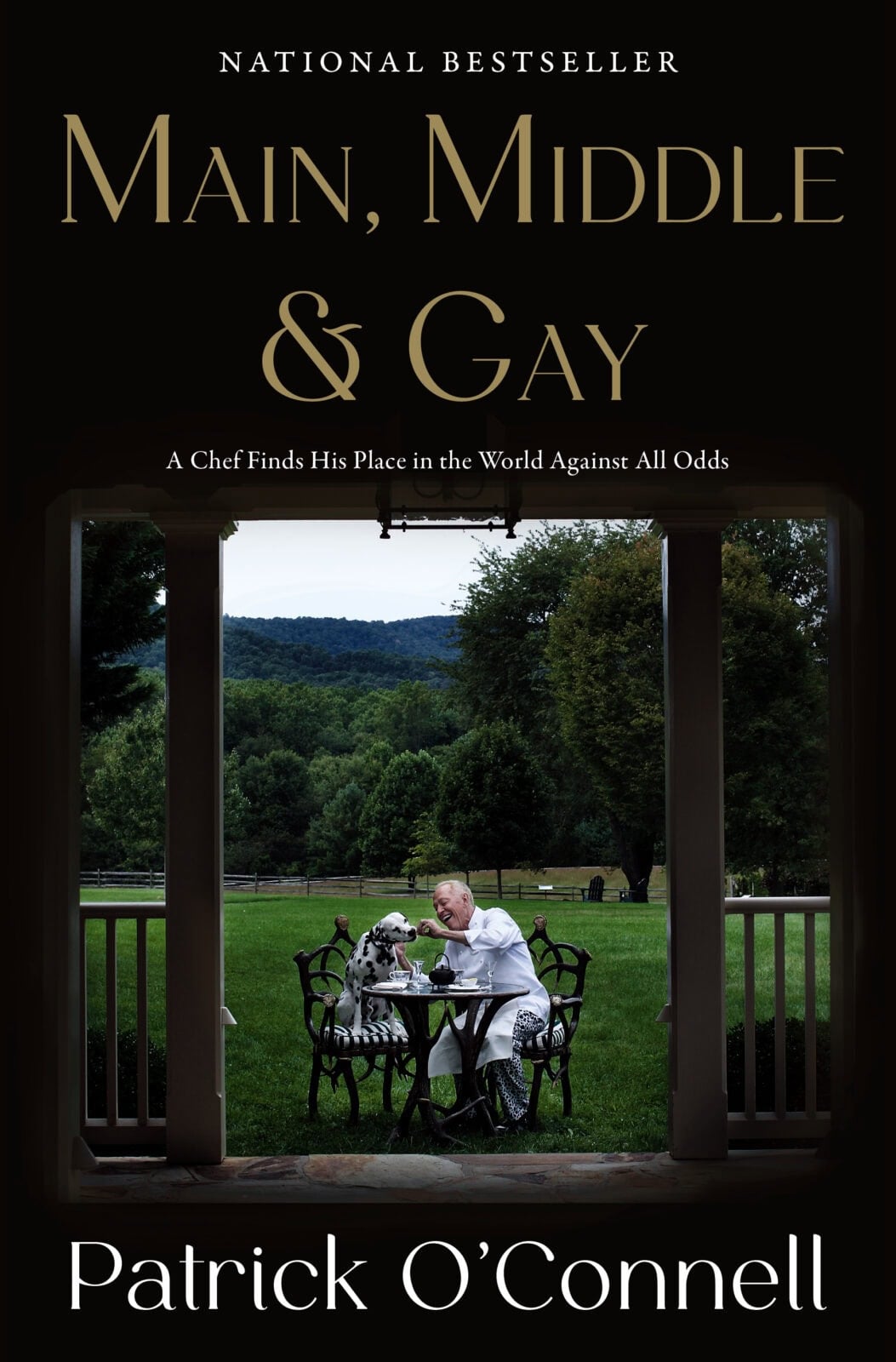
The following is an excerpt from Main, Middle & Gay by Patrick O’Connell.
My older brother, Mike, had a paper route. But when he got to high school, sports began to dominate his life. It must have seemed logical to my parents that I should inherit his paper route the same way that I inherited his hand-me-down clothes.
In those days a paperboy in a rural neighborhood was kind of a hero to the people who waited all day to get news from the outside world. The only part I hated was the dogs—especially the German shepherds. I knew all their names and tried to placate them by talking nice to them, but they were crazy and unpredictable and sometimes they bit. I’d keep rocks in the basket as a last resort. I put up with it for two years and then one summer I got bit by Rex, a vicious black-and-tan shepherd. I wanted him dead, but I knew that was not going to happen unless I started carrying a gun. One day I decided I’d had enough and after I delivered all my papers, I rode my bike up to the back door of the only restaurant in the area, Mr. H Hamburgers.
The place was warm and cozy and smelled delicious. A couple of cooks were wiping everything down and polishing up the counter. Mr. Hardesty asked me a few questions and then told me I could start the following week. I felt incredibly grown-up.
I should have known my parents wouldn’t be too happy with this decision. They started protesting about the late hours and the sorts of people who worked there. They implied that restaurant people were disreputable because they supported themselves with tips. But from the moment I put the five-cent white paper overseas hat on my head, I loved restaurant people. They seem to understand that life can be a cruel joke and that you might as well make the best of it.
I especially loved the dual realities of “out front” and “in the back.” The customers, not knowing what was going on behind the scenes, seemed as if they were one-dimensional by comparison to those of us who could move between the two worlds.
The first person I met at Mr. H was Cecil. He was a grill cook, a hardcore lifer who told amazing stories. Every winter he and his wife migrated to Florida and lived happily off her tips as a waitress wherever she wanted to work. There was a sign in the kitchen that said CLEAN AS YOU GO, and Cecil took it to heart. He was never without a polishing rag, wiping everything down. He trained me as if I were his son. The whole crew seemed thrilled to have someone they thought was a normal middle-class boy in their midst.
Every evening around dusk we got to take a dinner break sitting on milk crates out back. We could order anything we wanted. One night I decided to have a steak sandwich with onions on a grilled bun. One of the grill cooks told me to slap two steaks on the grill because they were almost as thin as construction paper. I did and got caught doing it by Mr. H. He gave me a good lecture about the cost of each of those sheets of frozen steak. I think they were forty-six cents each. Hardesty said I was killing his profits. I felt really bad and never did it again.
While I was enjoying my dinner break, I’d watch the lights from the stream of traffic sailing down the highway on Route 301 going south and wonder where all those people were traveling and why they were in such a hurry. I was always glad I was home and not rushing off somewhere on a trip down a lonely highway in the dark.
One night, a rugged, good-looking country guy came in for a double burger and some onion rings. He had a short brown beard and the powerful hands of a mountain man. He was building a house for his family and camping out nearby until it was ready for his wife and kids to move into. I sensed that he was lonely and that this hot meal was probably something he’d looked forward to all day. I took his order and began fixing his food.
I brushed the bun with garlic butter and carefully grilled it, then browned some onions in the burger drippings and slathered them over the beef patties, finishing the sandwich with a generous smear of mayonnaise, catsup, sharp mustard, and piccalilli.
He swooned as he devoured the meal with an animal-like fervor. I could tell from his eyes that it was the best burger he’d ever eaten. He looked over at me, raised his eyebrows, and winked. As he left, he nodded in my direction and with a disarming, playful grin said, “See ya tomorrow.” A fifty-cent tip was on the counter.
Considering that his entire dinner only cost seventy-five cents, the tip was extravagant, but his wink was what I thought about when I tried to sleep that night. I had never been winked at before and needed to spend some time savoring the moment and fantasizing about its meaning. A man like that had never even acknowledged my existence, let alone nodded and winked. If cooking could have this effect, perhaps I was receiving a “calling” from the restaurant business instead of the priesthood.
The next evening, he was back, wanting me to cook his burger again. Now, in the desolate wasteland of southern Maryland’s tobacco fields, both of us had something delicious to look forward to. I was beginning to understand the seductive powers of food and the unexpected connections it can bring.
The countergirl was named Frances. She must have started in the business as a kid and at some point, suffered a terrible burn on her face. She was pretty in a country sort of way, and with a good amount of makeup she was almost able to hide her disfigurement. All the men who came in flirted with her and she reciprocated. But it never seemed to progress. For as long as I worked there, Frances never had a date.
One day Frances was excited because she’d received an invitation to a wedding. She showed it to us and made us touch the embossed lettering. We were impressed and knew this was going to be a pretty big deal. Frances started shopping for her outfit. This went on for several weeks with special trips to suburban malls. Finally, she had assembled everything and was pleased about it.
The day of the wedding, Mr. Hardesty gave her the night off, even though it was a Saturday. Before she left, she came in to show us how she looked. Her thin body was dressed in a smartly tailored purple suit with a fine-looking purple velvet hat that swooped down on the left, shadowing the burned side of her face. Of course, the ensemble would not have been complete without the matching purple heels. Frances looked gorgeous. We sensed that her secret dream might be to find herself a Prince Charming at this posh affair.
Frances was quiet and a bit distant when she showed up for work on Sunday. Finally, Cecil asked, “Well, how did the wedding go? You must have been the prettiest girl there.” Then, in a matter-of-fact tone, Frances answered, “I just could never find the place where the wedding was supposed to be. It was so confusing. I had never been to that area before and I kept driving around getting lost, so I just finally turned around and came home.”
We seemed more crushed than she was by this revelation. It was as if she had endured so much misfortune in her life that this disappointment was relatively minor by comparison and not really surprising to her.
Maybe just being able to show us how glamorous she could look was reward enough. While the incident quickly faded from my mind in the hurly-burly of the busy summer season, I could never erase the image of Frances, so tragically glamorous in purple, lost, on her way to nowhere.
The restaurant world was a safe haven for her. Little by little it became one for me too. Much later in life I’d sometimes begin a speech by saying, “Probably the best and the worst thing that ever happened to me was that I got a job in a restaurant at the tender age of fifteen. I would never be the same.”
The restaurant world was an alluring addiction, and a good hiding place for misfits. Sometimes it felt as if everyone in it were paying a debt they didn’t owe.
The following summer I went back to the kitchen door and asked Mr. H for my job back. He floored me when he said, “You can’t work here, boy. You’ve got to go to a better place. I have a friend who’s the manager of a place with tablecloths. Let me give her a call.” He set up an interview for me. I felt like I’d hit the big time. There was only one problem. The place was almost forty-five minutes away in a whole other state. My mother was not happy. How did I intend to get there? I had no driver’s license. But I discovered that a guy in our neighborhood was also working there, and he offered to let me ride with him for a small fee. Robert was working the same shifts I would be. I paid him a dollar a day and he drove me all the way to Virginia and back.
I became a waiter in a busy restaurant on a major artery leading out of the city where it wasn’t uncommon for a busload of guests to arrive at once.
A young person grows up fast working in restaurants. You meet people your parents would prefer that you didn’t. But you learn a lot about life. Reading people is a big part of the work. Figuring out who needs interaction and who wants to be left alone, who’s cranky and needs to be turned around, who wants to eat and run and who wants to linger.
I discovered I was good at it. I was nimble and quick and had adapted my natural routine of being like a long-tailed cat in a room full of rocking chairs. I was making more money in tips than I knew what to do with and bringing fat wedges of glazed strawberry pie home to my mother.
Sometimes after work I went with my restaurant friends to a racy nightclub called the Crow’s Toe and watched a Black female impersonator named Princess El Ra Nu dance. The Supremes had just come on the scene and the Princess would lip-synch to their smash hit “Where Did Our Love Go.” I had no idea such things existed. The scene was intoxicating for a boy who had only recently had a paper route in Clinton, Maryland.
Two summers slipped by and I started sleeping later each morning, which seemed unhealthy to my parents. They could sense that I was slipping into an underworld and becoming a restaurant person.
Comment