

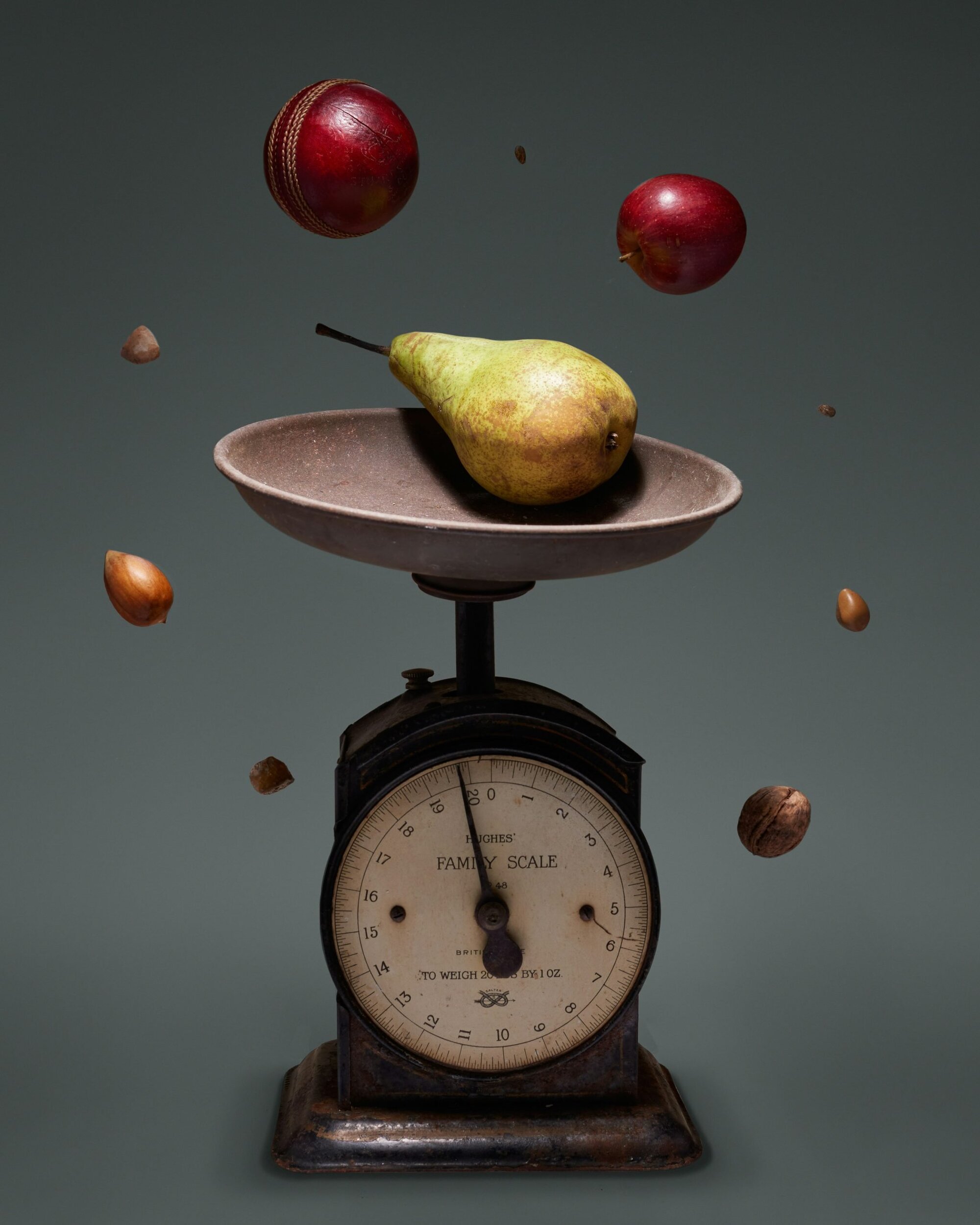
Calories are a fantastic way of measuring the output of an industrial food system and, if we are to buy into all that an industrial food system implies, a great way of balancing our fuel intake. But food isn’t fuel, it’s food; and we aren’t machines, we’re people. So our complex physical and social interactions with food run far deeper than a simplistic “energy in, energy out” formula.
The underlying assumption that we can assign a number of calories to an array of foods and non-foods with little regard to how things are grown, manufactured, at what stage in their life we harvest and process them, or how we prepare them, is wholeheartedly wrong.
While the concept of calories provides a convenient way of packaging all our food and health concerns into one unit of measurement, there is no way it can contextualize in any meaningful way the value of food for individual human beings. Instead, calories have played a role in stripping away our connection with food by maintaining a false equivalence between food and non-food, cultural food practices and industry, dynamic biological processes and fueling an engine. We haven’t really been able to break away from eating enough to eating well enough at scale and that’s likely due to how much meaning we try to pack into our very loose definition of what calories are.
What are calories, really?
“A calorie is a calorie” has been a longstanding myth that nutritionists first embraced and are now trying to combat. The basic understanding of this myth was/is that the source of calories was less important than the amount because calories are supposed to be the bottom-line measurement of food and energy. However, the underlying assumption that we can assign a number of calories to an array of foods and non-foods with little regard to how things are grown, manufactured, at what stage in their life we harvest and process them, or how we prepare them, is wholeheartedly wrong.

For example, older leafy vegetables tend to have tougher cell walls than younger plants of the same species. Cell wall structure in plants is a key factor in our ability to extract the actual substance of the food that is measured in calories; the tougher the wall, the fewer calories we get from the plant. In another example, the calorie count for vegetables with weaker cell wall structure like spinach and squash will fall significantly when cooked, compared to most root vegetables. In this way we can see how the stagnant measurement of a calorie doesn’t fit with food that has an active biological life, so to speak.
It’s easy to assign calories to digestible non-foods that don’t follow the same life cycles as real, whole foods. Luckily, we now have a bizarre hindsight for this comparison: Health-conscious Americans who bought fast food burgers in the 90’s and kept them for over 20 years, only to find that the bread, burgers, and fries never rotted or decayed. In a way, calories are a great measurement for supply chain output; that McDonald’s burger is just as stagnant as the calories that define it.
Thinking beyond manufactured foods, there’s nuance and varying levels of impact to basically everything we consume, despite caloric equivalence. For example, most beers in the United States range from 90-150 calories, while the average bowl of seasonal fruit contains 100-150 calories. Nutritionally speaking, your body has a completely different experience processing fruit compared to alcohol. Beyond macronutrients, the fiber from the fruit aids digestion while alcohol disrupts it, and that has both short- and long-term impacts on our dietary preferences, health and the energy we receive from food.
Energy
Our bodies are dynamic and our nutritional needs change over time. As far as metabolism, energy, and aging and our relationships with food go, calories don’t even begin to scratch the surface. Yet the working assumption is that calories directly dictate energy and therefore if you eat your recommended number of calories each day, you will have the right amount of “fuel” for your body. Whether or not that is explicitly stated, most literature, both in the journalism and academic spaces, conflates calorie intake with energy intake.
The hard truth is, though, that even the simple sugars that our bodies use for energy are not created equally even though some are calorically identical. Glucose and fructose are assigned the same number of calories and both stimulate insulin production. However, fructose has been found to increase hunger levels compared to glucose, and while this isn’t directly correlated to energy intake, it does calls into question the idea of a caloric limit and its relationship to energy intake. When we fill our gas tanks with fuel there is a storage capacity, and that capacity can be indicated by the number of gallons in fuel; this gives us a firm understanding of how far our cars will go given the fuel level. But sugars, which our bodies use for energy, can cause us to overconsume and feel more lethargic with less energy to move after “fueling up,” so their function is not true to what a calorie is supposed to be.
In the long run, the make-up of our diets can also influence the pacing of our metabolism, which in part dictates how much energy our bodies have to use. When we eat, we’re not actually “fueling up”; we’re reinforcing behavior and attempting to meet our bodies’ needs.
Beyond just sugars, different foods have different metabolic pathways which impact the amount of energy provided by the food source. Proteins have a more complex pathway than do fats and carbs, so more energy is lost in the heat generated through the protein pathway. This is why fats and carbs are more easily converted into stored fat. This means that you receive fewer actual calories than the amount assigned to protein sources and that those calories function very differently across food sources. In the long run, the make-up of our diets can also influence the pacing of our metabolism, which in part dictates how much energy our bodies have to use. When we eat, we’re not actually “fueling up”; we’re reinforcing behavior and attempting to meet our bodies’ needs. Unfortunately, our emerging understanding of energy, food, and biology still conflicts with some of our original, static explanations of these dynamic processes.
Science and War
The calorie has had an interesting journey from its origin in Parisian mechanical engineering classrooms to the back of every packaged food item in our local grocery stores. When it was introduced to the English language in 1863, it was used to measure the energy needed to heat one kilogram of water up from zero to one degree Celsius.
To be fair, metabolic pathways weren’t a real consideration until around 1945, so we can understand how experts may have seen calories as a useful correlation between biological and mechanical phenomena. While the mechanical measurement provided by calories doesn’t do much to contextualize the process of growing, preparing, eating, and digesting food, it does provide a convenient tool to measure the output of an industrial food system—it gives analysts some kind of measurement of the food value of crops. At the time, that was a very important consideration.
Following the Great Depression, several global hunger crises and the end of WW2, America faced a nutrition crisis. Major public health initiatives like the establishment of the Food and Nutrition Board, fortifying bread, and introducing Recommended Daily Allowances (RDA) were all tied to widespread malnutrition caused by America’s economic woes. Altogether, these and many other initiatives were aimed at beefing up American men—who were perceived as “emasculated” due to their nutritional deficiencies—for the draft. The calorie was an easy and maybe even an appropriate way to set a baseline of food intake for daily function.
Along with it, though, came the backing of military-funded research and an entire industrialized supply chain ready to weaponize food through high-yield crops that provide the world with a lot of calories. After the end of WW2 America, as it sought to continue fighting differing ideologies globally by addressing malnutrition abroad, established the Interdepartmental Committee on Nutrition for National Defense (ICNND). The ICNND’s work heavily prioritized using calorie intake as a metric, and that had much to do with America’s ability to produce food on an industrial level during a time of global instability. Unfortunately, the relationship between industrial food production and tracking global food systems based on the calorie has persisted and has had a lasting impact on how we perceive food.
Global calories
Globally, the calorie still functions as a way to data-fy food. Our World Data, USDA, FAO, and NatGeo all continue to produce reports on the global food status using the calorie as the main metric. That could be partly due to the real abject hunger that exists across the world. However, if people are calorie deficient, they almost certainly face malnourishment, and focusing on the calorie plays into the more dysfunctional aspects of global food systems rather than addressing root issues. In other words, we already have a system that overproduces, wastes, and introduces a number of non-communicable health conditions to entire populations. Doubling down on this way of measuring well-being as it relates to food has had a role in perpetuating the co-morbidities of malnutrition and obesity across the globe. Some researchers have described obesity as a result of overconsuming energy while lacking necessary micronutrients, and consider it to be an active state of malnutrition.
The issue with the calorie is how it reduces food to fuel and our bodies to machines; the solution is to reconnect our whole selves with real food.
There have been attempts to shift the metrics of agriculture from yield and calorie to a more holistic index and to include metrics for land use and nutrition. As many people around the world might be adding their calorie count to food tracker apps on their phones, there is an ever-increasing number of people who recognize that food is much more than fuel. Systematizing food into one unit of measurement is inherently the issue. Food has to matter to people in order for people to take care of food and to reap the benefits of food. This balance can be achieved through a number of ideologies. The issue with the calorie is how it reduces food to fuel and our bodies to machines; the solution is to reconnect our whole selves with real food.

Ultimately, the calories as a staple in our food system undermines the dynamic story of our land, food, and bodies. Caring for ourselves requires us to properly define and understand how our food works and what our calories are really worth.
Comment