

Plus: Visiting with Abi Balingit and Holly Haines, one defense of carnivorism, and the actual value of being “P.C.”

This Week’s Marksisms
Food with Mark Bittman: Kin Lui and Casson Trenor, AND Frank Bruni
It’s been a wild couple of weeks which included some amazing cooking (you’ll hear about it soon, but Abi Balingit and Holly came to visit), a little more work than planned, a lot of reading and lying around, a bit of swimming and running, and almost no writing. I did come across a few interesting things, however (read on).
And two podcasts have come out since we last published here. The first is with Casson Trenor — who I met probably fifteen years when he was at Greenpeace, trying to prevent fishing piracy at sea — and Kin Lui, a sushi chef and Casson’s partner, who recognized years ago that the upswing in the global popularity of sushi was directly threatening the existence of many fish, including one of the kings of the ocean, the bluefin tuna.
Eventually, Casson and Kin would join forces to create what amount to vegan – that is, fishless, sushi restaurants. And that’s not as incongruous as it sounds: Sushi has always been primarily about rice, not fish – the word itself means soured rice, a reference to the vinegar that’s used to prepare it. What it does not mean is “pieces of fish wrapped with rice.” Vegan sushi is not an aberration but the norm. There’s a lot to unnpack here, and it’s all interesting.
And then the podcast that went up yesterday is with my old colleague, Frank Bruni, who I have tremendous respect and admiration for, and who used to be my next-door neighbor at the Times — we had offices next to each other. We first ran this episode in May of 2022, when Frank’s book, The Beauty of Dusk: On Vision of Lost and Found, came out, and people loved it, so we figured we’d bump it up to give more people a chance to love it. The Beauty of Dusk reflects on Frank’s imperiled eyesight and the challenges of aging. That’s what I wanted to talk to him about; I read the book and found it incredibly poignant, a very compelling read, and I wasn’t disappointed in this conversation — in fact, I was thrilled by it. (You can find the recipe for The BruniBerry here.)
Follow Food with Mark Bittman on: Apple Podcasts | Spotify | Overcast | Pocket Casts | Amazon Music
A Win-Win Sweepstakes

You couldn’t support a better cause, and you can’t ask for a better prize. Your support goes to Veggies to Table, a non-profit farm that grows and donates organic produce and flowers to help local people experiencing hunger; and the grand prize is a week-long stay in a gorgeous Paris apartment with panoramic rooftop views and a balcony. Get your entries here.
A Strange (But Amusing) Defense of Carnivorism
Here’s an amusing if illogical quote from the Booker Prize finalist The Trees, which is worth reading:
“Since when do you eat meat?” Gertrude asked.
“I figured, what’s the difference? I was probably only going to prolong my life for a few minutes at best. And also, how many cows would I be saving? In fact, when you think about it, since no one’s going to raise domestic cows for fun, and since they’re too stupid to exist in the wild, then I’m really helping to save the species from extinction.”
Italian Food Sucks, Says Famous Author
The content below was originally paywalled.
As long as I’m quoting, this is from The Count of Monte Cristo. The content isn’t surprising, since Dumas was a famous gourmand, but the opinion … what were things like in the 19th century? “… he was paying the meal the compliment one would expect from a man who has been condemned for four or five months to suffer Italian cooking (which is among the worst in the world) ….”
The Actual Value of Being “P.C.”

A fun piece from the Washington Post about Animal House (the movie) and political correctness. Obviously, no one in their right mind is going to claim that this was a politically correct movie, nor was it intended to be. Ty Burr, here, argues (with reservations) that in fact it represented a moment that freed people from feeling obligated to be politically correct. And that might be right.
But could I please just note that, while “political correctness” sounds like an obnoxious thing, it is in fact a term that refers, in condensed fashion, to being polite, respectful, and truthful to people who are not like “us,” whoever “us” may be? And, as such, sure it’s fine and fun to tease people about it, humor is a thing, but in fact a lack of political correctness – that is, a tendency toward racist, gender-phobic, sexist, anti-immigrant, etc. behaviors – is exactly what brands the anti-democratic movement (or, you could call it the MAGA movement, or the pro-Trump movement) in this country. And that, despite its geekiness, and its association with weird academic trends, political correctness is a good thing.
Thank you for listening. I had to get that out.
A Sign of Approval?
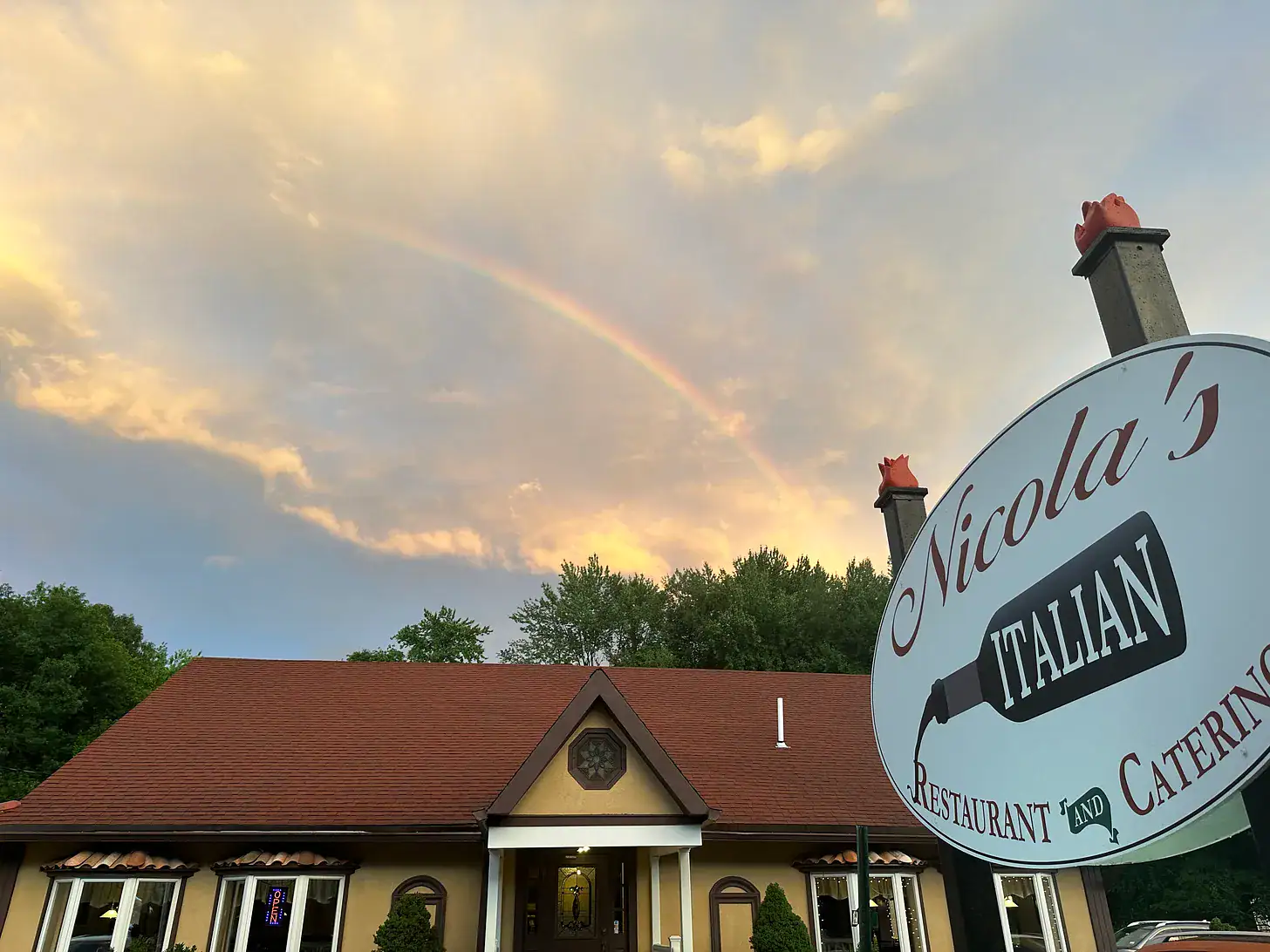
A rainbow over one of our local favorites.
Just Filling Bellies is Not Enough
Why food pantries need to do better, a near-perfect statement by Greg Silverman, who runs New York’s Upper West Side Campaign against Hunger, one of the country’s most progressive food pantries. As he so rightly points out, “Community problems need community solutions, and hunger is no different.”
See ya next week!
Comment