

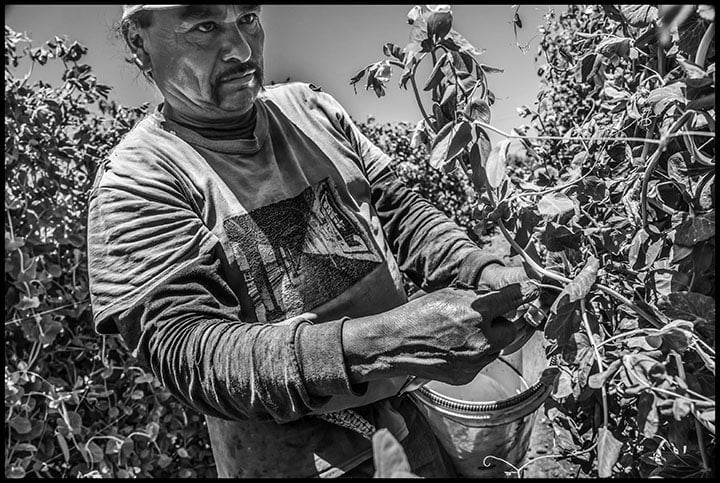
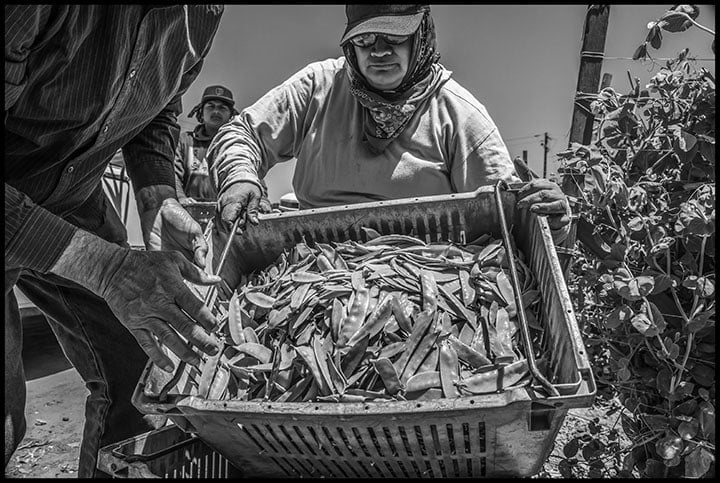
Not long ago I pulled my car to the side of the highway when I saw a crew almost hidden in tall rows of vines, harvesting snow peas. It was a small group, working for a small grower, Bautista Farms, in a field along that part of State Route 166 that begins as East Main Street in Santa Maria, and ends as West Main Street eight miles later in Guadalupe.
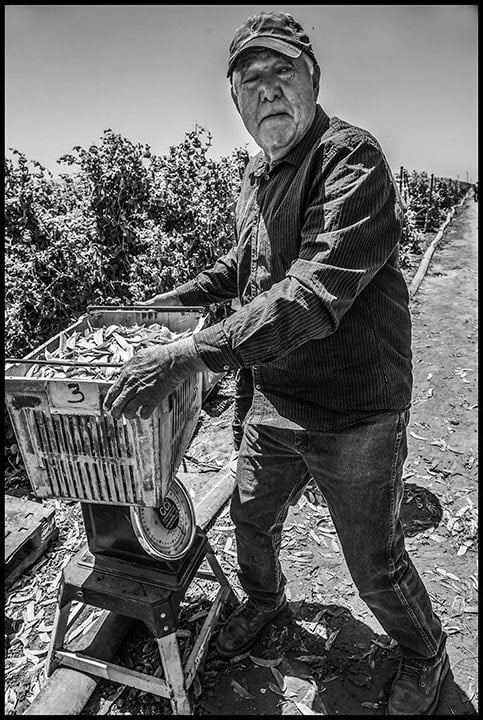
Marco Bautista and his father Berto Bautista, the owners of Bautista Farms, planted the field. Unlike many growers, though, they don’t actually own the land under the vines. Marco explained that the family rents three fields next to each other, each planted at slightly different times. As one ripens, the workers go in to pick. By the time they finish that field, the next one is ready. And when workers have come to the last row in the last field, more snow peas are ready in the first field and the cycle starts again.
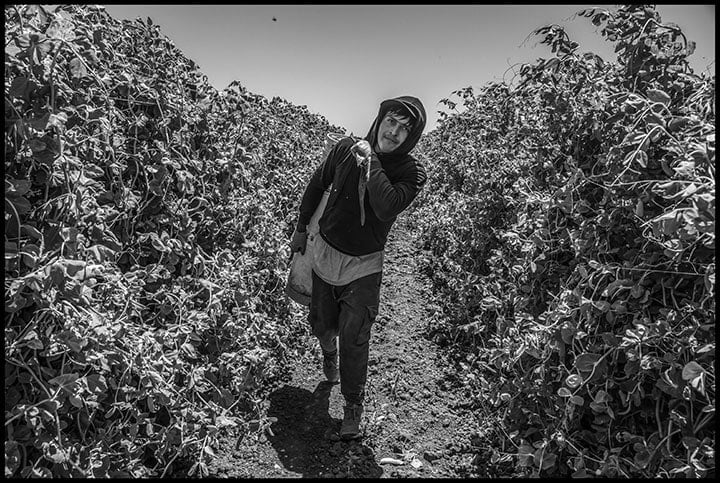
A good snow pea field can yield as much as 10,000 pounds per acre.
In the season between April and October, Marco said, the crew will pick each field as many at least eight times. Mark Gaskell, farm advisor for the University of California Extension, explains, “The best fields may be picked 15 to 20 times, with 3 to 5 days between pickings.” A good snow pea field can yield as much as 10,000 pounds per acre. In 2008 snow peas earned California growers $35 million.
According to Ann Lopez, author of The Farmworkers’ Journey, “The protracted growing season requires an ever-greater labor force to grow and harvest specialty crops effectively. California agriculture has thus become more dependent on migrant labor over the past few decades.” The crew of Mexican migrant workers in the Bautista field bore her observation out.
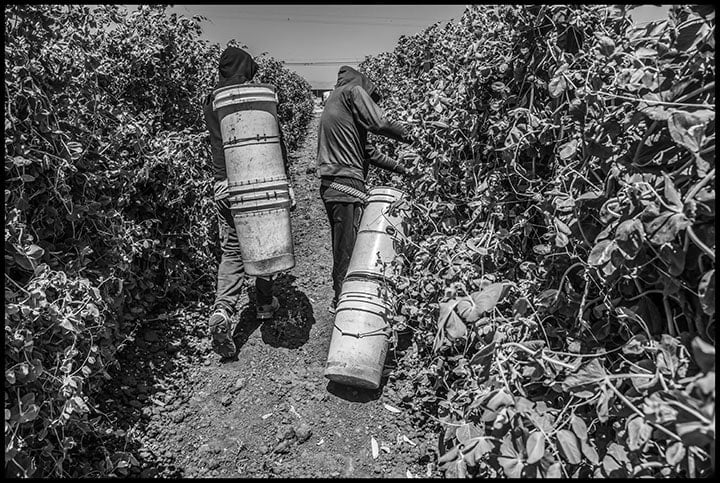
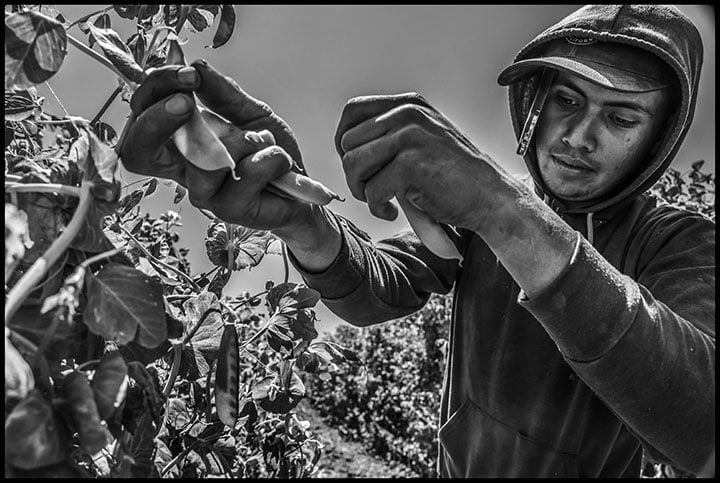
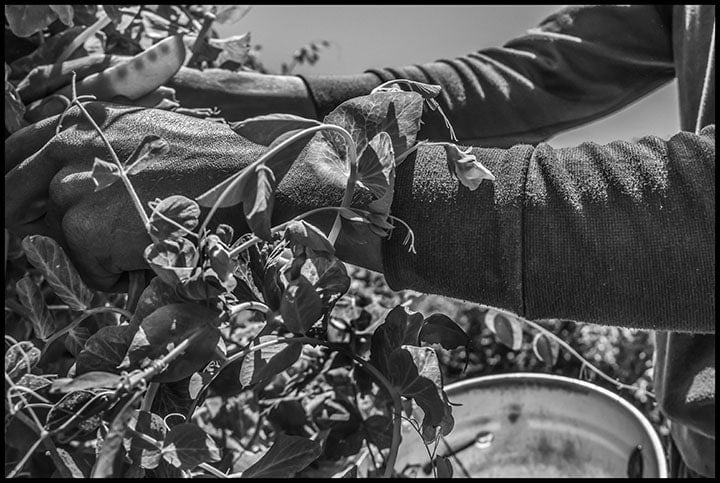
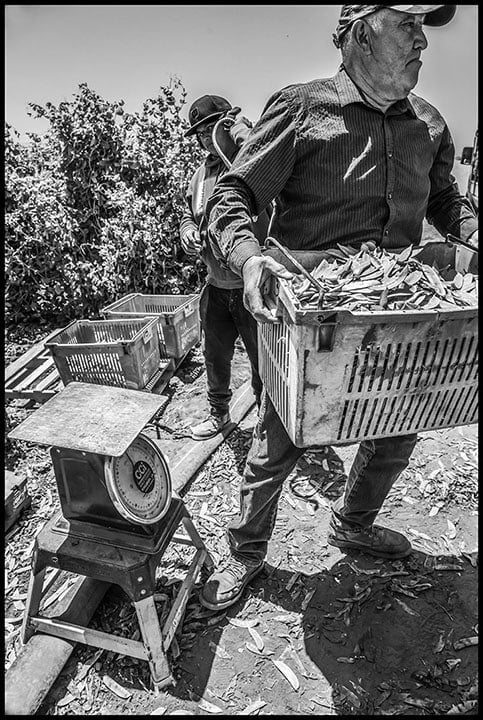
Snow peas are a rare crop in Santa Maria, among the miles of fields devoted to broccoli and lettuce on California’s Central Coast. Each crop demands from growers its own cycle and system for planting and cultivation, but for workers the labor makes a constant demand — speed. They are paid at a piece rate, and to make any money a person must work so fast that the movement of hands becomes a blur.
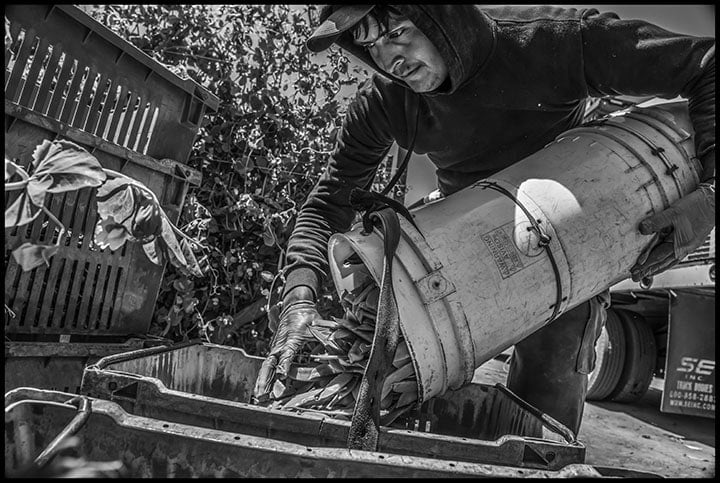
Lopez argues that labor costs are not only up to half the cost of crops like snow peas, but that “they are critical as components of the process over which the grower has some control.” Their answer is often to implement a piece rate system, in which workers are paid according to the amount they pick. “Approximately 30 percent of California farmworkers,” she writes, “are paid on a piece-rate basis, which may be the source of increased injury because attention is focused on maximizing production.”
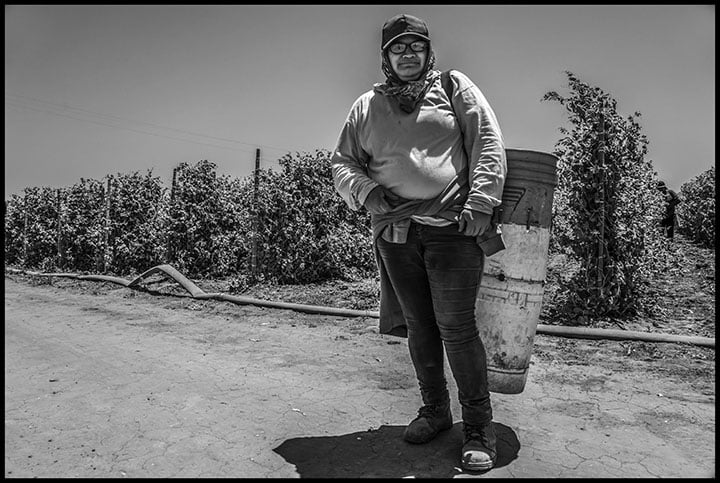
Photographing these farmworkers, therefore, required creating images that get close enough to see the blur of hands or the determined expression on a face — images that that allow the viewer to imagine the weight of the filled bucket. As a way of educating me, farmworkers are helping me take the photographs.
My education about farm labor began along this same Route 166 decades ago. My teachers were workers like Luis Ayala and Paulino Pacheco. Both were older men born in Mexico, who’d spent their lifetimes as farmworkers on this side of the border. In Santa Maria they’d organized the big lettuce and row crop strikes of 1969 and 1970, and I met them just after I joined the United Farm Workers a few years later.
Luis and Paulino knew that workers often carry a big load of anger into the fields. Paulino remembered going to Delano, in the Central Valley, at the beginning of the great grape strike, and then coming home to Santa Maria determined to start the farmworker movement there. He collected a few dead cockroaches (not hard in farmworker housing) and took them to work in his shirt pocket the next day. As the morning grew hot he went to the water cooler, put his mouth under the spigot (no paper cups in those days) and then pretended to spit them out. He yelled at the foreman that the water had bugs in it. People began shouting, and the strike in that crew was on.
Both men got blacklisted for their union activity, and worked in the union’s campaigns in the valley for many years afterwards. They and the small group of Santa Maria Chavistas (so called because they followed Cesar Chavez) were unreconstructed radicals. On my first visit to the house of one family I saw a huge picture of Che Guevara on the living room wall. I felt I was home.
When I met Luis and Paulino I was a legal worker in the UFW office, my Spanish still too primitive to be effective as an organizer. The education they offered began with correcting my bad Spanish. In the mornings they’d take me with them to visit crews working on the ten-mile stretch of fields between Santa Maria and Guadalupe.
As a city boy from Oakland, seeing the labor close up was a revelation.
I learned something about organizing, but even more, about work. As a city boy from Oakland, seeing the labor close up was a revelation. I’d been a printer, so the repetitive motions of work in a factory were familiar. But the pace demanded by work on the piece rate cutting lettuce or stripping snow peas from vines was something else again.
That road, where I found the snow pea harvesters, continues to be a school for me. Marco Bautista and the workers explained not just the cycle of work, but the impact of the plants on the soil, and on the people who will eat them. At the end of the season these snow pea vines will be plowed under. Snow peas concentrate nitrogen in their root nodules, so their fields can be rotated with other crops that will use what the peas put back into the earth. Growers like them also because they’re hardy, and can survive the fall’s first frosts, hence their name.
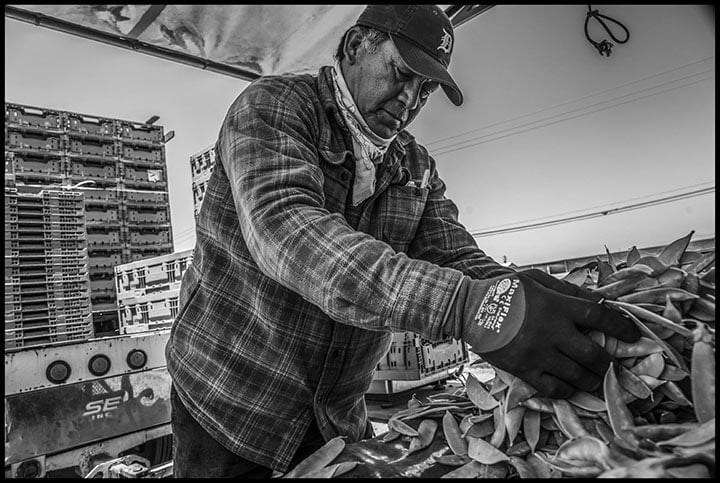
Picking snow peas benefits humans as well. One cup fulfills the daily requirement for Vitamin C, so they’re healthy both for consumers and the land. And snow peas are delicious. They can be eaten whole, and in fact are called “mange tout” in French, meaning eat-it-all. In Chinese they’re called “he lan do”, or Holland pea. We think of them as a common ingredient in Chinese dishes, but the fruit (because peas are fruits rather than vegetables) was first cultivated around the Mediterranean, and later adopted with enthusiasm by Chinese cooks in the 1800s. From China the peas made their way to Santa Maria, where Mexican hands pull them from vines and pack them into boxes for restaurants, food co-ops, and even Safeway.
David Bacon is a California-based writer and photographer, who was a factory worker and union organizer for two decades with the United Farm Workers and other unions. Today he documents the changing conditions in the workforce, the impact of the global economy, war and migration, and the struggle for human rights.
Comment