

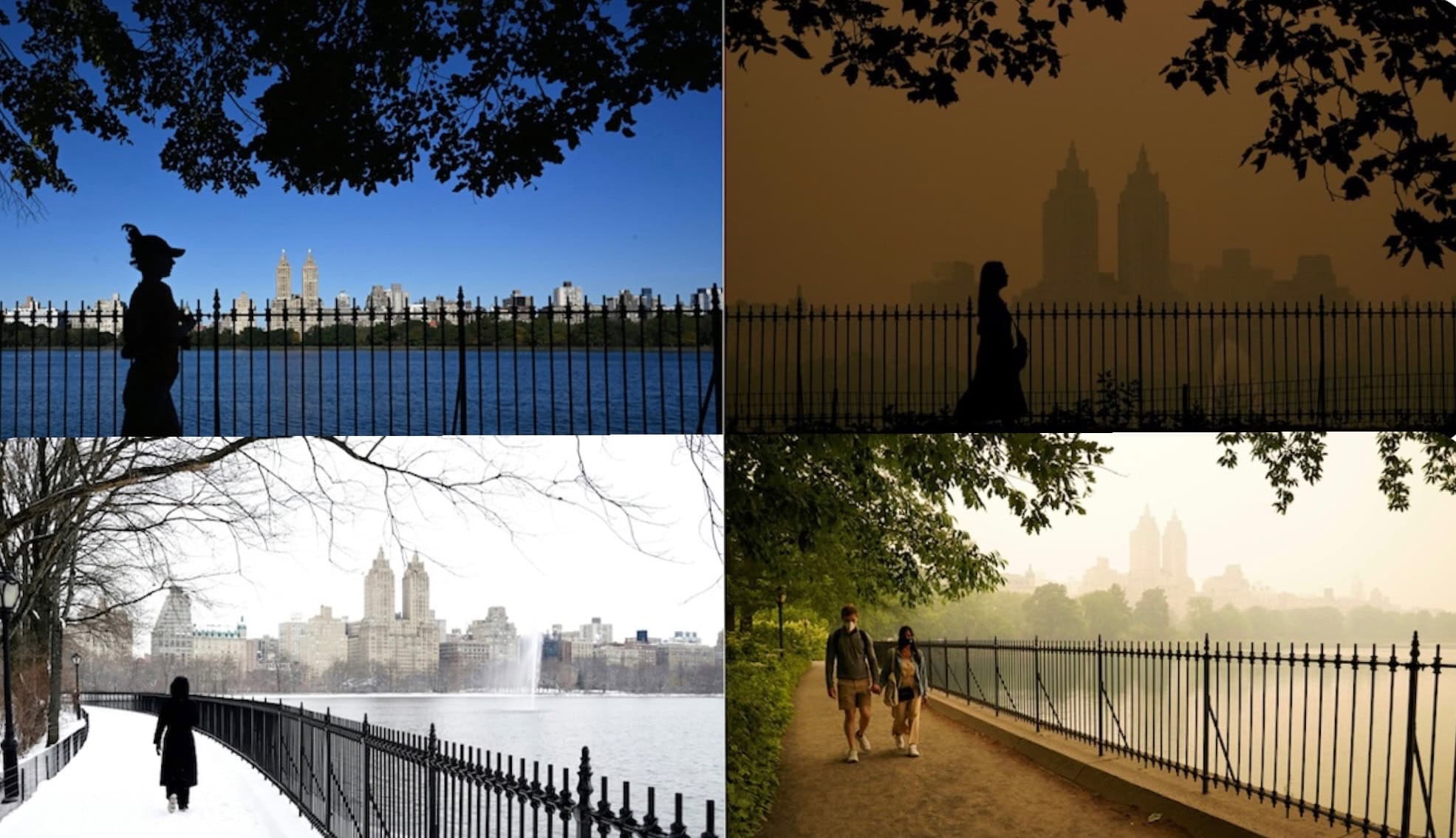
“We” – a number of people I call colleagues – have drawn attention to the definition of the word “crisis” a number of times in the last decade or two, and it’s time to do it again.
A month ago, when New York’s governor Kathy Hochul called the smoke situation an “emergency crisis” I was impressed. What’s worse than an emergency or a crisis? An emergency crisis! What did she do? Caution people to stay in the air conditioning. What did she do the next day? I don’t know, eat hot dogs in Troy.
The climate crisis is an actual crisis. No one treats it that way. Several years ago, Bill McKibben, one of the few imaginative people in this field that others sometimes listen to, suggested that we treat the climate crisis the way we treat a big war: gear up, rally the troops, attack. Defeat it. Some of my friends didn’t like that imagery, and I get it, but to me it makes more sense than the mindset that says, “Well, if we dither around, and small changes are made gradually, it won’t affect most of us.”
On the contrary, pals: You ignore ongoing and imminent peril at your own risk. I don’t know what you should be doing – making noise, at the very least, but this is the real shit.
As much as Hochul’s decidedly empty warning bothered me, it bothered me more when an intelligent, older, wonderful, thoughtful old friend said to me, “Well the only good thing is we won’t live to see it.” I’m stunned: “We’re seeing it now!” If you are going to wait until Miami is really a saltwater lake and it’s 110 in Phoenix every day and Canadian smoke makes everyone in the Northeast have chronic bronchitis – wait, you want worse? You want your children to “live to see it?”
I don’t know what it takes: A “dire, super-bad, real emergency crisis,” as Hochul might call it? Four hundred New Yorkers dead of smoke inhalation? Four thousand? People drowning in the streets in Miami? The disappearance of miles of coastline? Fires in the desert and mountains and forests at the same time? Tsunamis on the West Coast?
We sometimes seem capable of dealing with crises of huge proportions, imperfectly but responsibly: Covid, for example. When something almost unpredictable (because people did warn about rogue viruses that could make lots of people real sick all at once) comes along and starts killing people – that we can pay attention to. Our response to Hurricane Katrina, though woefully inadequate, at least happened.
But when the situation develops gradually and the numbers of deaths are … what do I say? Not that significant? Manageable? Acceptable? None of these is right – but when forty people get shot all at once, some of us weep for 24 hours and say, “If only there were gun control,” and others say, “Oh the school guard wasn’t well-trained,” and then, mostly, we move on and wait for the next shooting.
Or the Northeast all but shuts down, California-style, because no one can breathe and is looking for their Covid masks, and some people say “It’s time to put a moratorium on fossil fuel use, starting ASAP, and let’s figure out how to build a sustainable society,” and others say “Oh, we can build big exhaust fans to deal with that,” or “There’s only so much wood that can burn.“
Food is the same way. There’s a crisis: Most calories come from junk; chronic related disease is our biggest killer; monocropping is producing inedible “food,” and poisoning our land; etc, etc. You’ve heard all of this before. Big Food, chemical companies, John Deere, they’re all doing fine. WE are not doing fine.
There are many crises, big and small, confronting us: Inequity. Public health. Food access. The environment. To fight these, we need government that sees them as enemies, the way we’d see a saber-rattling foreign country that was starting to take the next steps. It’s not as if we need military solutions, but we need solutions on a military level, government that says, “Let’s assemble the experts and make a plan that will head-on address X crisis and treat it as a true emergency.”
We could tame the climate crisis before it’s too late. We could have our people eating well, farming well, being way healthier in ten or, at the most, twenty years. We can’t do it with a paralyzed, ineffectual government, one that at its best is fifty percent well-intentioned but rudderless and at its worst is fifty percent delighted to go down with the ship, a ship they mostly own.
“What’s that mean for me?” you ask. What it doesn’t mean is buying an e-vehicle or installing solar power or eating a salad and thinking your job is done – though all of those things are at least marginally better than their opposites. It does mean joining or supporting the struggles of people who are on-the-ground organizing to fight the causes of climate change, to get land into the hands of people who want to farm it well (many of whom were excluded from earlier land giveaways), to get good food to people who need it, to generally fight the poisoning of our land and our people. It also means finding politicians who are willing to join or at least support those struggles and get them into office; that may be the biggest challenge of all.
Here are some resources, if you feel like donating and/or getting involved:
Comment