

I’m woefully deficient in my knowledge of other cuisines, but I’ve learned a lot in the last few years just from our podcast. We’ve had people come on to talk about Filipino food (Abi Balingit; Jill Damatac), Mexican food (Rick Martinez), Hungarian food (Jeremy Salaman), African food (Alexander Smalls), Thai food (Max Wittawat and Jenn Saesue), Italian food (Francesco Turrisi, Victor Hazan) … I could go on.
Earlier this year we had Hawa Hassan on to talk about her book, Setting a Place for Us, for which she traveled to eight different countries. My dad, of course, asked her, of all the places she visited, which had the food she enjoyed most. She talked about how much she loved El Salvadorean food first, but then responded with “Lebanon. I think when a country has a few things going for it—the food, the people, and the place—it’s really special.”
Lebanese food, I thought. I could probably name one thing that I know definitively hails from Lebanon. Pathetic. So Maureen Abood’s new book, Lebanese Baking, called out to me.
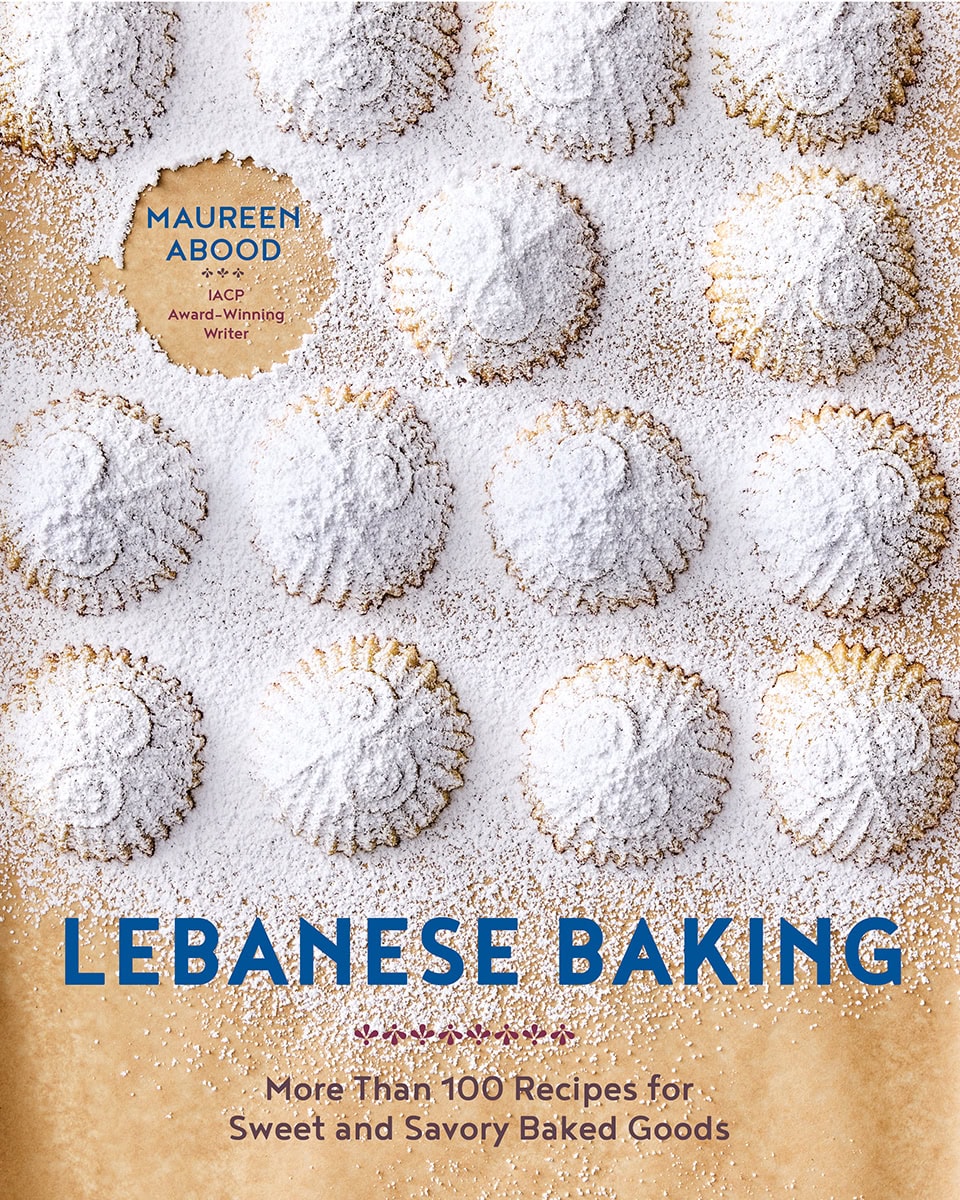
Maureen Abood won an IACP Award for a story she wrote in the Washington Post called “What Most People Get Wrong About Making Hummus” (how to make hummus that’s not grainy, essentially). I understand why this piece won an award. First of all, most hummus out there, whether store-bought or homemade, is not, as Maureen says, “luscious”—but, more importantly, Maureen’s voice is a delight. Lebanese Baking, which includes both sweet and savory treats, reads very much, and very much in a good way, like an old-school cookbook. It’s warm, and straightforward, and not trying so hard to be cool (which, to me, makes it cool). There are so many recipes in it that I want to make, and Maureen, in her wisdom, seems to tell me that even when a recipe seems demanding, I, too, have what it takes to make it work.
I talked with Maureen about Lebanese Baking, and you’ll find a couple recipes from the book below, too.
I’m going to ask the most difficult (probably) question first: What are your top three favorite recipes in your new book?
The scent [of baklawa] gives me an immediate channeling of my mother; bake it and there she is, thank heavens.
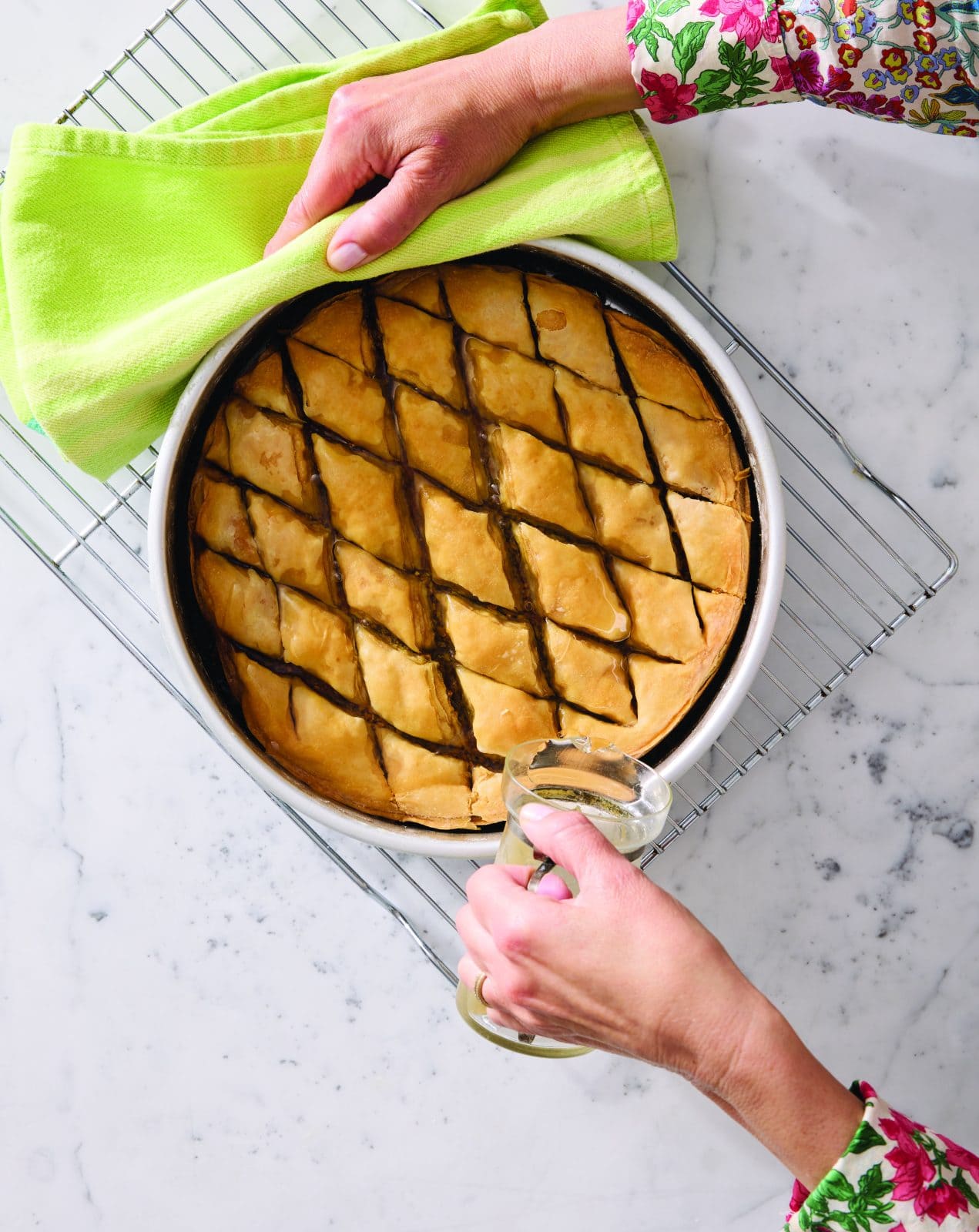
Sophie’s Choice! The Baklawa Diamonds steal the show in my heart as well as in the baking and eating. I love the recipe itself for the ingenious pour-over method I learned from my Great Aunt Rita: no buttering every sheet of phyllo as is traditional for this pastry. Instead, just assemble, cut into diamonds, and pour the clarified butter over the top to settle in before baking. The aroma of the baking baklawa and the sizzle of cold flower water syrup being poured over the top as soon as they emerge from the oven are a feast for the senses. Plus the scent gives me an immediate channeling of my mother; bake baklawa and there she is, thank heavens.
Manakeesh also ranks right up there. This savory yeasted flatbread is a Lebanese icon, enjoyed especially for breakfast. The man’oushe with za’atar topping or lahm ajeen (with seasoned lamb and tomato topping) are thin, foldable, and chewy, yet with a crisp golden crust.
I also have a thing for the recipes that are my innovations using traditional flavors. The Mocha Cardamom Snack Cake [editor’s note: see below!] will get you hooked with its warm, chocolatey flavors and swath of spiced coffee buttercream.
Phyllo is a staple of Middle Eastern cuisine, and an ingredient that plays a key role in your book. How often do you employ it in your cooking and baking, and do you usually make your own or use store bought?
I use a lot of phyllo in my baking, turning out pan after pan of Baklawa Diamonds, usually with toasted walnut filling. So I keep boxes of store-bought phyllo in my freezer, at least two boxes at all times! I am a huge fan of Athens Phyllo for its flavor and thinness; it just so happens to be the most widely available brand of phyllo, too. My recipes are suited to their standard 9 x 14-inch size.
Homemade phyllo is a baking project I dove into for Lebanese Baking with a deep desire to understand what the bakers before us had to do to make their baklawa, since they couldn’t run to the freezer aisle and grab a box. That experience was sooo illuminating, fun, and gave me such deep respect for their mastery.

What are the three (give or take) most important things to keep in mind when attempting to make phyllo at home?
First, be not afraid! Homemade phyllo is a manageable project if you: 1) read through the entire recipe first, gauging the time, equipment, and ingredients needed; and 2) decide which method works for you, the “dry method” or the “wet method.” One determination is counter or table space. You need a good 30-inch space to stretch the dough when making the wet method.
Soon after the end of WWI, Lebanon became part of the French empire; the French administration lasted around 20 years. As a result, Lebanese food became colored by a good deal of French influence. What are the most notable aspects, and which of the many important qualities of Lebanese cuisine do you consider to be distinctly Lebanese?
When I was in Lebanon, there were croissants filled and topped with za’atar (the Lebanese spice blend of thyme, sumac, and sesame seeds)—this struck me as a remarkable manifestation of French and Lebanese cuisines melding from that period in history. Many Lebanese speak Arabic, English, and French. There are so many distinctly Lebanese aspects of Lebanese cuisine: flavorings like that za’atar, 7 Spice, and aromatic pure flower waters. Our style of eating is a real hallmark: always gathering family and friends around the table, enjoying lots of fresh produce and fruit, cooking and eating traditional dishes such as kibbeh, stuffed grape leaves, hummus, labneh, and of course so much more. In baking, distinctions include fatayer (little hand pies with various shapes and fillings), knafeh, ma’amoul.
You baked so many different kinds of baklawa and knafeh for your book. Can you talk a little about each of those, and what makes each so special to you? And: I’m sure you love all your iterations, but which was the absolute standout for you personally?
Baklawa shapes are a ton of fun and the variations are countless. I could have written an entire book just of baklawa! The beautiful “pleated” baklawa include burma and nests, shaping by rolling sheets of phyllo on a dowel. It took lots of development to get those recipes to behave so that the delicate dough is made pliable for shaping. The diamonds and rolls are my favorite because these are what my mother and so many of the women in our family made most often, and the recipes are thoroughly streamlined without losing anything in the end results. I am a giant fan of the Baklawa Crinkle, which makes an impressive dessert by “crinkling” or bunching together phyllo sheets and baking them with butter and custard, finishing with flower water syrup. This one adapts easily to different flavorings and is simple to make, but makes it appear that you are a major pro.
The knafeh chapter was a real adventure!! I had no idea the extent of the knafeh styles, nor was it explained or collected in any one place. So I’m especially excited to have this chapter out there in the world to give a full overview of knafeh variations. The Nut Filled Knafeh is just delectable. Of course, the cheesey knafeh is the ultra-beloved, a salty-sweet goodness that the world is obsessed with. I’m happy about my method here that employs a dark, standard-sized pan to achieve a deeply golden crust that becomes the top of the knafeh when it is flipped after baking.
You write, “An entire lifetime couldn’t uncover all the distinctions among Lebanese breads, it turns out, because they vary from village to village, family to family, baker to baker.” What are some of the best ones you’ve had, ever, and made—sweet or savory? Are there others that you know about that you haven’t tried yet and would like to?
I am on a lifelong exploration of Lebanese breads and it’s just a ball. Once you start watching reels and videos of these on any social, you’ll get served up more of them every day. It’s mesmerizing. One of the finest breads I’ve ever baked, eaten, and shared is Talami bread. I’ve riffed on this traditional recipe to make it my own, always wanting it softer and softer, with more height, than what my grandmother and mom used to bake. Spread garlic butter over the hot loaf just out of the oven. I guarantee you will change lives with this one, especially because people who have eaten it will never stop mentioning it forever more.
The Cheese Fatayer XL is a flat pie with a little shaping around the perimeter, cut in wedges like pizza slices. This recipe very happily surprised me as a great recipe to try if you’ve never baked fatayer before, to start to get the hang of the shaping but in a less detailed manner.
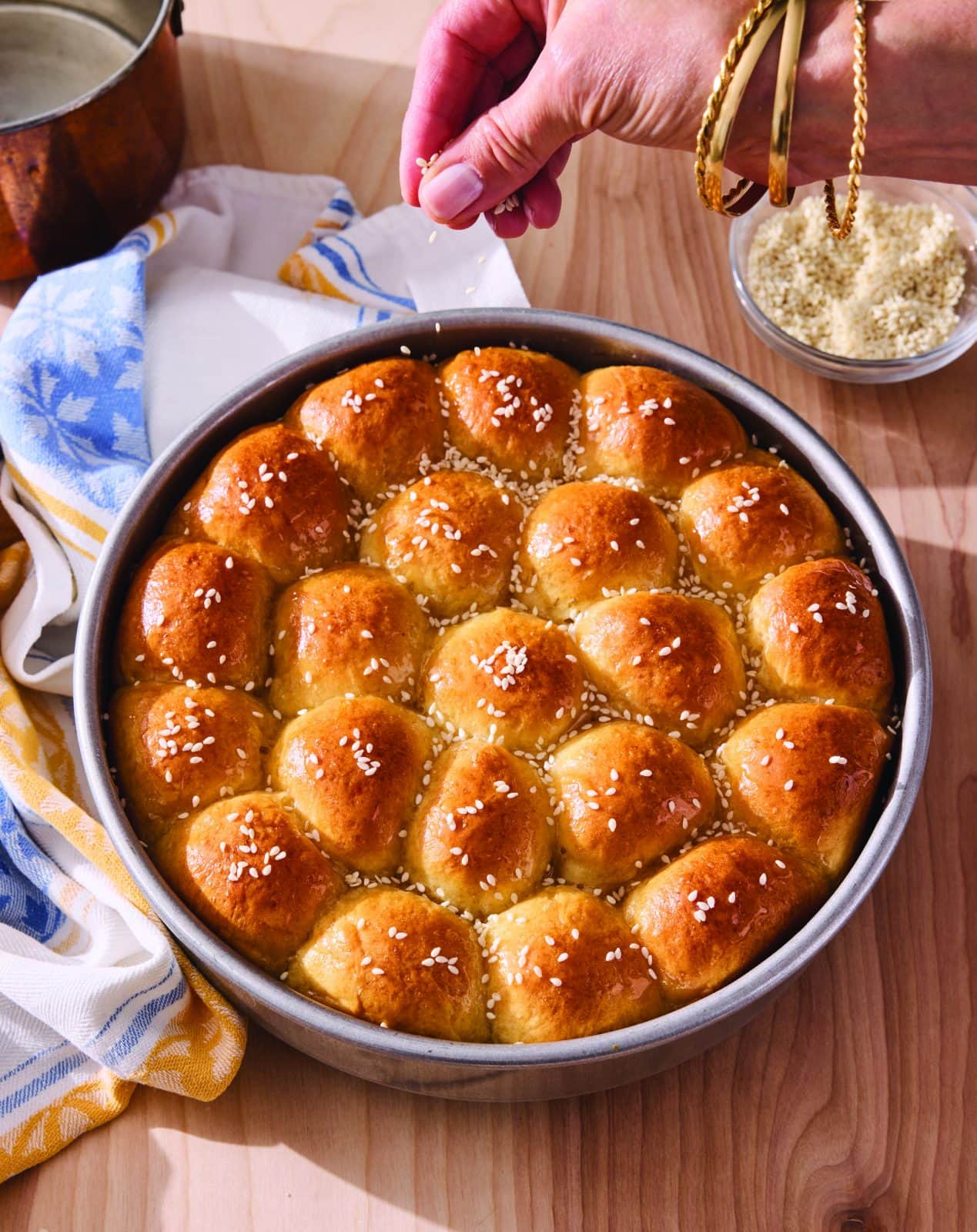
The Honey Buns are a traditional recipe that I discovered in research. They’re soft, lightly sweet, and so fun to make. They also make a lovely gift that is always received with that same surprise and delight.
It’s striking to me that the hand-written recipe is going away. There’s something so very personal about our handwriting.
Anything else you’d like to tell us about your gorgeous new book?
Thank you! Many of the recipes I studied were hand-written recipes that came from my family and their collections. It’s striking to me that the hand-written recipe is going away. There’s something so very personal about our handwriting. I can see my mother, my mother-in-law, my Sitto, and so many of my aunts in their written recipes that I have in my collection. So I hope that we can keep sharing recipes this way, or revive it, or at least write notes in our cookbooks so that the next generation will have something of ours, in that personal way, that speaks to them and helps them carry on the legacy of cooking and baking our recipes long after we are gone.
Pistachio Cupcakes with Strawberry Rose Water Buttercream
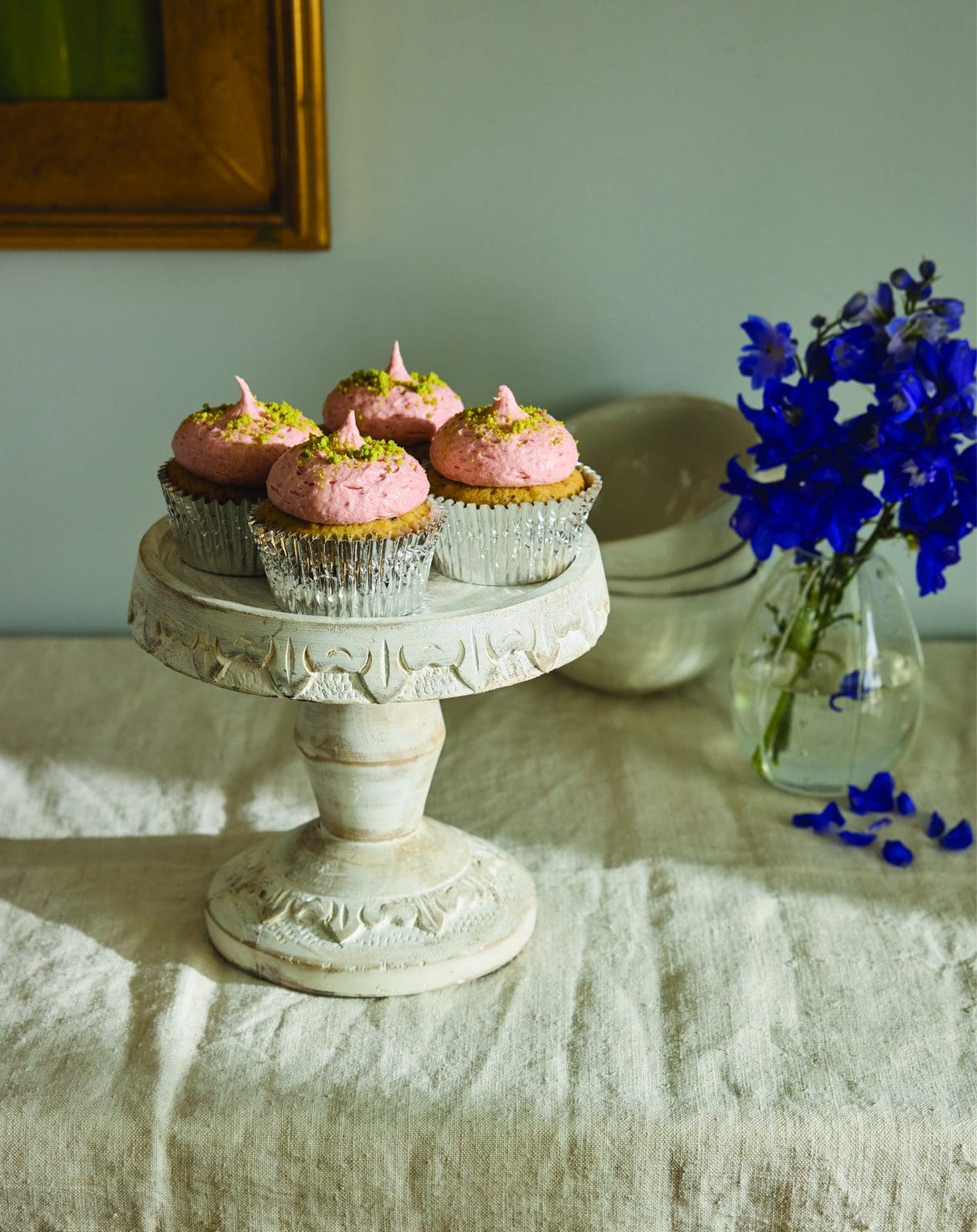
Miette Bakery in San Francisco launched my obsession with cupcakes that stand tall with thick layers of buttercream. Frosting-haters will say that too much buttercream is too much, but they haven’t tasted my buttercream! These cupcakes have a gorgeous combination of green and pink: pistachios and roses. In cakes and cookies, pistachios often get lost in the shuffle, but in this light cake, a whisper of almond extract enhances their flavor. Here I present my own cupcake of the highest order, Miette-inspired.
Mocha Cardamom Snack Cake
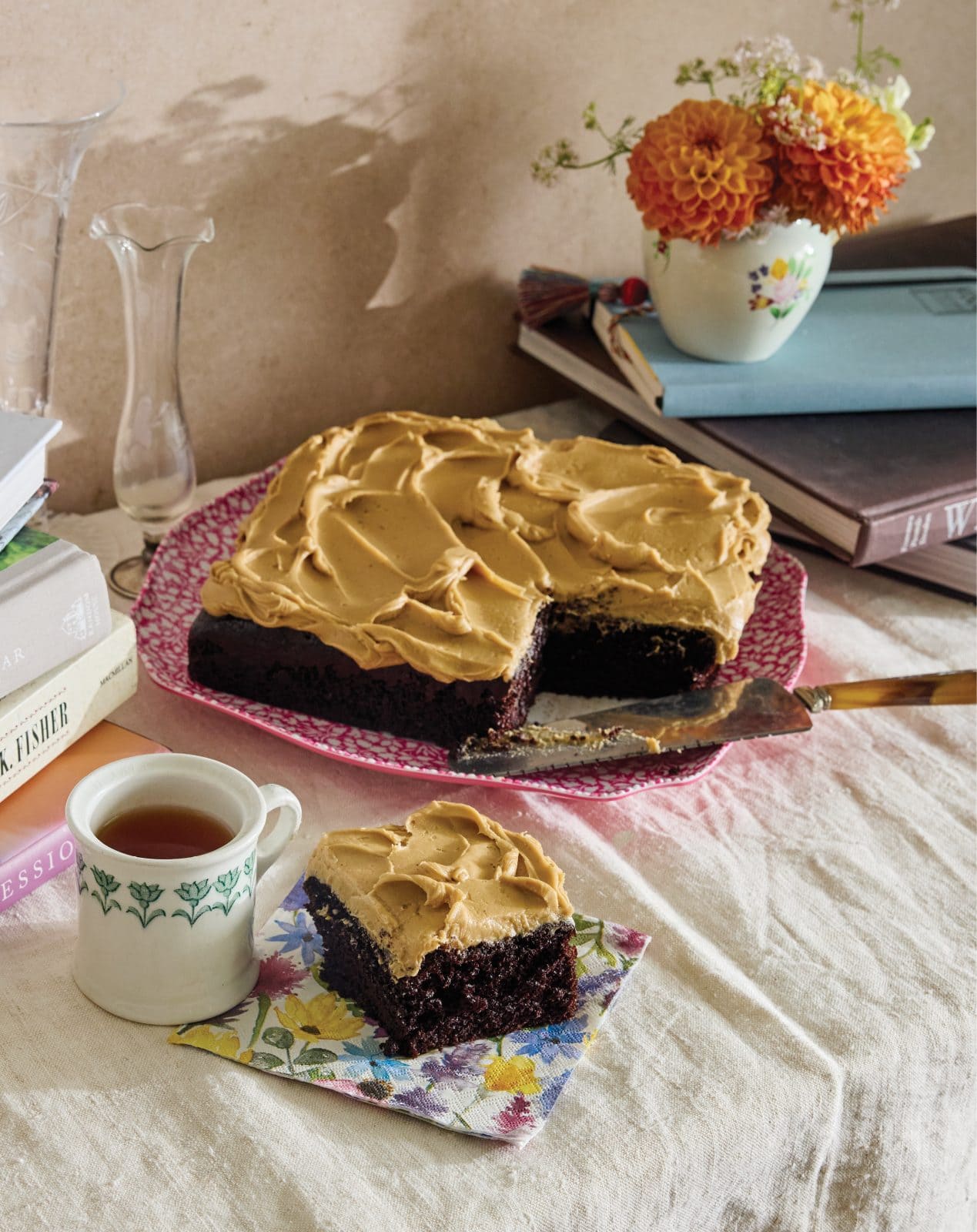
Arabic Cardamom Coffee is a form of hospitality, a special part of a warm welcome. Some people drink it with sugar and, rarely, cream. My love for qahwa (coffee), plus an inclination to soften it with sugar and cream, inspired this recipe, which harmoniously blends chocolate, coffee, and cardamom in a simple snack cake. The swath of cardamom coffee buttercream on top makes it irresistible, as does the ease of making it.
Comment