

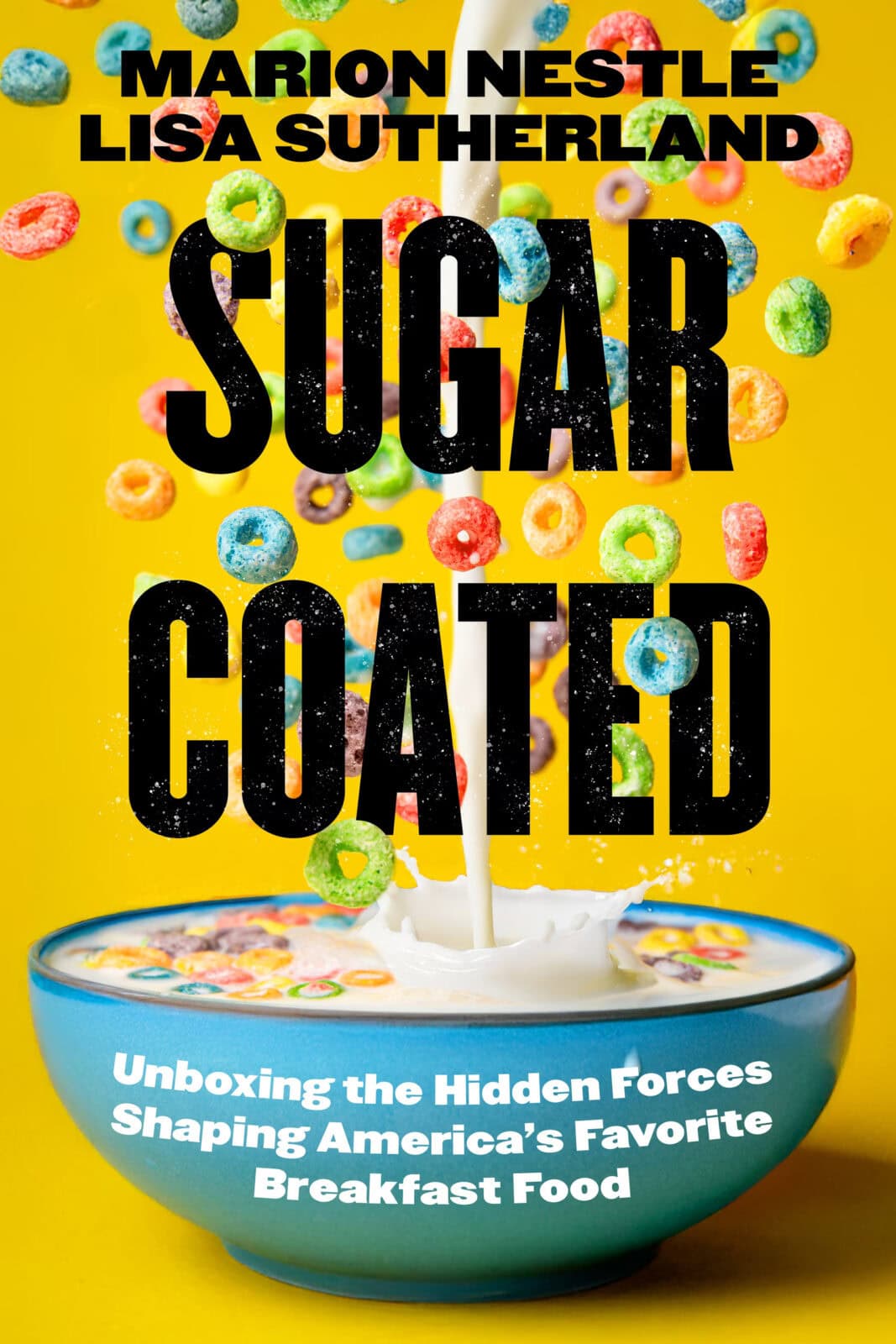
Today is Marion Nestle‘s 90th birthday, and boy is she is a woman worth celebrating. Marion is the doyenne of food politics, my friend, my mentor — and the author of more than 20 books, including the all-important Food Politics: How the Food Industry Influences Nutrition and Health. For today’s newsletter, Marion generously allowed us to excerpt her newest book, Sugar Coated: Unboxing the Hidden Forces Shaping America’s Favorite Breakfast Food, and we also have her on the podcast (listen here) to talk about this book, which she co-wrote with former Kellogg’s VP (and current Interim President of Jacksonville University) Lisa Sutherland. – Mark
With sugars and grains as the main ingredients in most breakfast cereals, companies struggle to differentiate their brands. Flavor innovations are an easy way to create line extensions, increase supermarket shelf space, and expand sales. Cheerios, with more than 20 varieties (e.g., honey, chocolate, peanut butter, cinnamon, and fruit flavors), is today’s most prominent example; its boxes occupy major portions of supermarket cereal aisles.
The cereal aisle is hardly a place where you would expect to find fruit, but here we find Froot Loops, Fruity Pebbles, Cap’n Crunch’s Crunch Berries, Blueberry Toast Crunch, and Strawberry Krispies, all grains and sugars, but fruit flavored and brightly colored. We concede that Kellogg’s Apple Jacks does have some fruit. Of its 22 ingredients (not counting the vitamins and minerals), dried apples constitute ingredient #10, appearing under the “Contains less than 2%” statement.
Natural flavors are not what anyone might consider natural. By the time they are added to cereals, they may contain as many as 250 different chemicals, some of which are artificial and synthetic.
“Natural” flavors
Ingredient #14 in Apple Jacks is “natural flavor.” And what, pray tell, is that? The Food and Drug Administration (FDA) has rules about such things; these refer to how companies can use, label, and market natural and artificial flavors. We love the FDA’s definitions. “Natural flavors” are
the essential oil, oleoresin, essence or extractive, protein hydrolysate, distillate, or any product of roasting, heating or enzymolysis, which contains the flavoring constituents derived from a spice, fruit or fruit juice, vegetable or vegetable juice, edible yeast, herb, bark, bud, root, leaf or similar plant material, meat, seafood, poultry, eggs, dairy products, or fermentation products thereof, whose significant function in food is flavoring rather than nutritional.1
Simply put, natural flavors are extracted from plant or animal sources. In contrast, artificial flavors are chemicals originating in a lab. But natural flavors are not what anyone might consider natural. By the time they are added to cereals, they may contain as many as 250 different chemicals, some of which are artificial and synthetic. This is why both natural and synthetic flavors are considered markers of ultra-processed foods.
The FDA also regulates how flavors appear in ingredient statements or on box fronts. Most kids’ cereals use a combination of natural and artificial flavors. Sometimes, boxes will say “With other natural flavors” (WONFs in regulation-speak). WONF means that some flavor comes from a natural ingredient, like the dried apples or apple juice concentrate (ingredient #11) in Apple Jacks, but the “other natural flavor” boosts it, creating a more intense apple flavor.
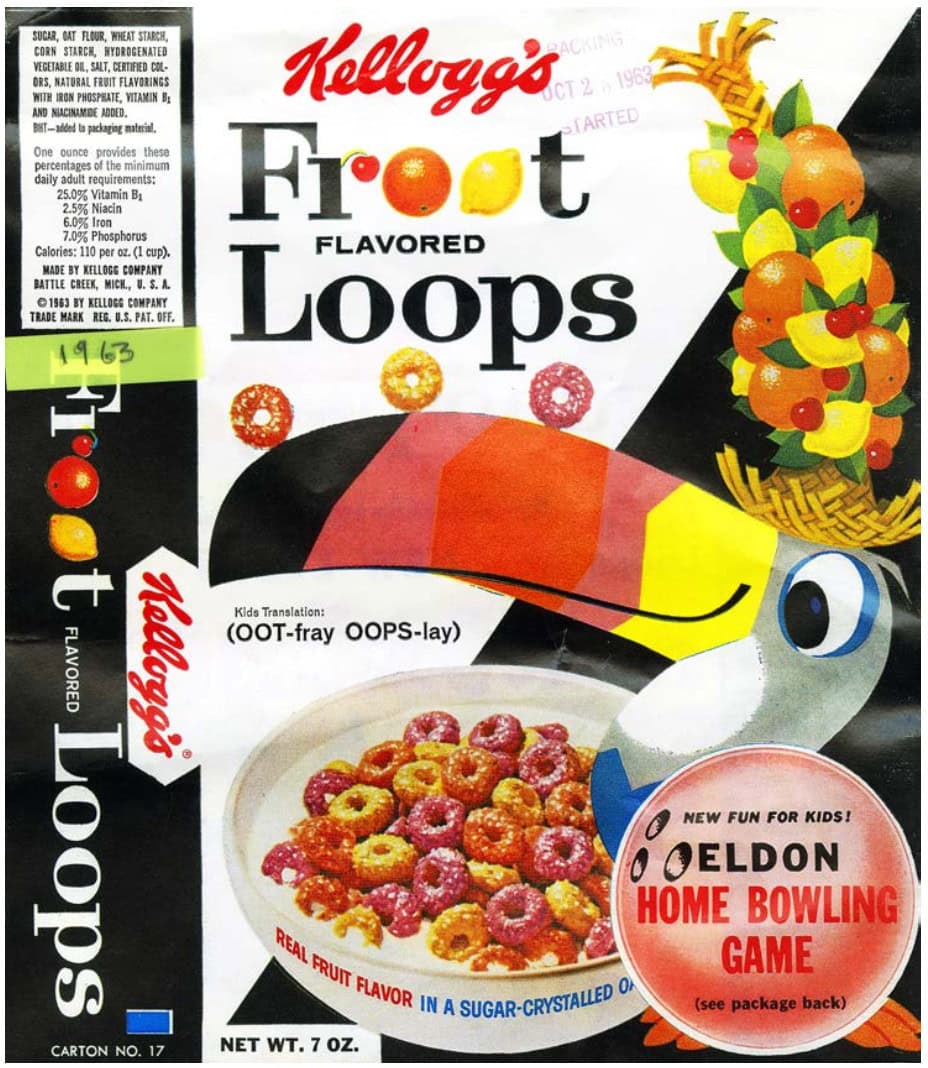
When first introduced, Froot Loops promised fruit flavors [as shown above]. By the 1980s, its boxes said “All natural flavors: orange, lemon, cherry” and, in tiny print, “and other flavors.” Its mascot Toucan Sam sings, “Follow my nose, wherever it goes, to the flavor of fruit.” The cereal still only contains natural flavors, but fun fact: the different artificially colored loops all taste the same.
The FDA says companies can use fruit names and images to describe a flavor, but the Federal Trade Commission requires the advertising on a cereal box to be “truthful and not misleading.” Thus, the use of fruit in cereal names and images occasionally landed the companies in trouble with regulatory agencies and consumer advocates.
Again, consider Froot Loops. Urban lore has it that Kellogg first wanted to name its brightly colored rings “Fruit Loops” but was quickly threatened with a lawsuit. We cannot confirm this legend, but we think it plausible. By the time Kellogg introduced Froot Loops as a “sugar-crystalled oat cereal in a puffed crisp form” with “real fruit flavor” in 1963, it knew enough not to use fruit in the name of a product that had none. “Froot Loops” also could be trademarked, preventing others from copying it—but not protecting it from litigation.
At least four lawsuits have been filed against Kellogg over Froot Loops, none of them successful. Each argued that Froot Loops misled consumers into thinking the cereal contained real fruit. Federal judges disagreed; they said no reasonable person would interpret “froot” as suggesting real fruit; a box of Froot Loops “truthfully depicts that cereal in the shape of multi-colored rings that do not resemble any known fruit” and “the fanciful use of a nonsensical word cannot reasonably be interpreted to imply that the Product contains or is made from actual fruit.” In 2009, a similar complaint was filed against Quaker’s Cap’n Crunch’s Crunch Berries. In that case, the judge said, “Any reasonable consumer would know that ‘Crunchberries’ were not berries.” Count these decisions as wins for cereal companies.
Still, the lawsuits over fruit names continue. In the mid-2000s, blueberries were marketed as a superfood, and they turned up in the names of cereals. The result: “Blueberry-Gate.” When General Mills introduced “naturally and artificially flavored” Total Blueberry Pomegranate cereal in 2009, plaintiffs filed the usual lawsuit: “Where’s the fruit?” In dismissing the case, the judge said, “If you look at the ingredients table, blueberry and pomegranate aren’t there. So I don’t understand how a reasonable consumer is somehow tricked into thinking it contains blueberry and pomegranate.”
“Froot” is not fruit. If you want fruit, add blueberries or whatever other kinds you like to your cereal.
Around that same time, Kellogg introduced Frosted Mini-Wheats Blueberry, also “naturally and artificially flavored.” The box shows “Mini,” its wheat biscuit mascot, juggling blueberries, but not one blueberry turns up in the cereal. To avoid further trouble, Kellogg changed the cereal’s name to Frosted Mini-Wheats Blueberry Muffin. Blueberries? Not a chance. The moral: “froot” is not fruit. If you want fruit, add blueberries or whatever other kinds you like to your cereal.
Excerpted from Sugar Coated: Unboxing the Hidden Forces Shaping America’s Favorite Breakfast Food by Marion Nestle and Lisa Sutherland, published by the University of California Press. © 2026.
- 21 CFR § 101.22. Foods; labeling of spices, flavorings, colorings and chemical preservatives. ↩︎
Comment